
A Two-Way Sport With a Three-Period Structure
Hockey is one of the few major North American sports with a genuinely two-way market. A game produces a winner and a loser, there is no draw, and the puck line at -1.5 removes the need for one.
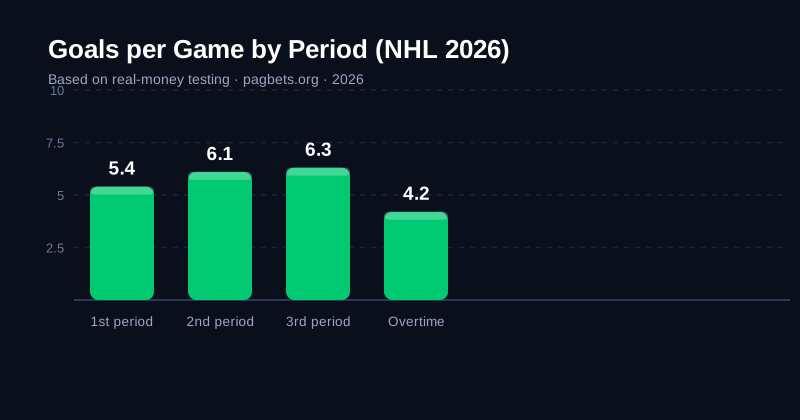
That makes the sport analytically cleaner than baseball, where scoring is low and a single event dominates. Hockey games produce around five or six goals, spread across three periods, and the structure is consistent enough that period-level patterns are genuinely predictive.
It is worth contrasting hockey with basketball immediately, because the two are frequently bet side by side and the settlement rules differ in a way that changes the bet. In hockey, overtime goals count toward the final total. In basketball, they do not. Our over and under guide covers how period structure changes a totals line, and the American sports guide covers the comparable North American markets.

The Settlement Rules That Catch People Out
Two rules cause more confusion in hockey than anything else, and both are worth stating plainly before any market is discussed.
First, overtime goals count toward the final score in moneyline, puck line and total markets. A game 2-2 after regulation is not a draw; it is a live game that continues. Second, the total includes overtime for the same reason, so a game heading to overtime has almost certainly already gone over a total of five.
These are the rules that distinguish hockey from basketball, and getting them wrong invalidates an otherwise reasonable analysis. A bettor who assumes a tied game will settle as a push has misunderstood the sport's central rule, and no amount of good research recovers from that.
- Overtime goals count toward moneyline, puck line and total
- No draw outcome, every game has a winner
- Half-goal puck lines are standard, so no pushes
- Shootouts count as one goal, not per attempt
- Totals include overtime, a tie game is usually over five
- Series bets are per-game, the price applies to each game
Special Teams Drive the Totals
Special teams are the single largest driver of hockey scoring, and they are fully public before a game.
Each team has a power play percentage and a penalty kill percentage, and roughly a quarter of all goals in the league come from special teams. A strong power play against a weak penalty kill shifts the expected total materially, and it is one of the most reliably available inputs in the sport.
The refinement is line matching — which unit is on the ice together. A top line on the power play produces more than a checking line, and the deployment patterns are widely available. This is why NHL totals move meaningfully when a top centre is ruled out, and why the market is fairly efficient on that news. Our the baseball guide covers the comparable bullpen and starter inputs in another sport.

Puck Lines and Why -1.5 Is Standard
Almost every NHL game is posted with a puck line of -1.5 and +1.5, and the reason is structural rather than a preference.
A whole-goal line such as -1 or -2 would create pushes, and a bettor would have a meaningful share of bets returned rather than won or lost. Half-goal lines eliminate that possibility entirely, which makes the market cleanly two-way and comparable to Asian handicap — the same structure, and our Asian handicap guide covers the settlement rules in full.
The practical consequence is that the market prices both teams almost evenly at around 1.90, and the real analytical work is in estimating the expected goal difference. A one-goal difference between two evenly matched teams is the single most useful number in hockey betting.
| Market | Settlement | Overtime counts | Main research input |
|---|---|---|---|
| Moneyline | Winner at final score | Yes | Expected goal difference |
| Puck line -1.5 | Win by 2+ goals | Yes | Goal difference distribution |
| Game total | Combined goals over/under | Yes | Special teams, pace |
| First period total | Period 1 combined goals | No overtime | Opening lineups |
| Player points | Points, shots, goals | Yes | Line deployment |
| Series winner | Best-of-seven winner | Per-game price | Goaltending, rest |
| Series games | Total games in series | Per-game price | Pace, closing ability |
Playoff Series Are a Different Product
An NHL playoff series is a best-of-seven contest, and betting it is structurally different from betting a single game.
Because the quoted price applies to each game in the series, a bettor who backs a team at 1.90 for the series is holding a position that can be right and still lose individual games. Over a seven-game series, the variance is materially higher than over a single game, and the appropriate stake is correspondingly smaller.
Two markets are specific to the playoffs. Total games is well priced and settled on the series, and it depends primarily on expected pace and the goaltending matchup. Series handicaps offer value when one side has a materially stronger goaltender, since a single elite goalie can carry a series on their own.
A Sensible Hockey Routine
Because the sport is analytically cleaner than baseball and the markets are tight, the value lies in the smaller lines rather than the headline ones.
Focus on first period and first period totals, which are priced with less analysis than the game markets and still depend on the same underlying information. Check special teams matchups before every total. Use player props where a line deployment change creates a genuine edge, and avoid popular scoring props where the public narrative is strong.
On the moneyline and puck line, expect to need a genuine edge and be willing to pass on most games. Our journal guide covers how to test whether your hockey reading is actually better than the market's across a full season, and the in-play guide applies to hockey's fast periods.
- First period markets, less analysed, same information
- Special teams matchups, check before every total
- Goaltender form, carries more weight in the playoffs
- Series handicaps, elite goalies are underpriced
- Pass on most moneylines, the market is efficient
- Stake smaller on series, variance is much higher
- Set limits with our tools guide
Goaltending Is the Most Underpriced Variable in the Sport
Across most sports, the market prices the best player on the field heavily. In hockey, the most important player is the goaltender, and the market prices him considerably less than that role deserves.
The reason is a data problem rather than an analytical one. Goaltending performance is genuinely difficult to measure, because a goalie facing weak shots on a strong team will post excellent numbers through no particular skill of his own. A goalie facing a high-volume team in a high-scoring game will post poor numbers while making an extraordinary number of saves. Raw save percentage therefore measures the team in front of him as much as the goaltender.
Three metrics do a much better job. Adjusted save percentage accounts for shot quality. Quality start is defined as a goalie stopping at least a set percentage of shots faced in a game they start. And five-on-five save percentage removes the special teams skew, which is substantial because a goalie rarely faces a full power play.
The practical consequence is that a goalie in form is a genuinely valuable signal, and the market is slow to price it because the raw numbers look bad. Our the baseball guide covers the comparable pitcher form problem in baseball, where the same confounding between player and team occurs.
Home Ice, Travel and the Eastern Conference Effect
Hockey has a modest but real home advantage, and understanding its source is more useful than simply assuming it exists.
Three factors drive it. Line matching favours the home team, because a team can deploy its best line against a weaker opposing unit more readily at home where the matchups are visible. Familiarity with the building matters more in hockey than in almost any other sport, because sightlines, board play and the bounce off glass are genuinely easier to judge in a rink you play in every week. And travel is genuinely burdensome, since NHL teams play a dense schedule with frequent late-night arrivals.
The Eastern Conference travels more and therefore benefits slightly more, which is a real but small effect that occasionally appears in aggregate data. For betting purposes the important conclusion is that a home underdog priced as a true equal is usually worth a look, and that the effect is strongest early in the season before teams settle into a rhythm.
Our lower-league football guide makes the related point about how much deeper information advantages exist when a market is thinly covered, and hockey is a thinner market than the headline numbers suggest.
Position, Possession and the Modern Betting Question
The most interesting development in hockey betting over the last several years is the growth of possession markets, and they are the closest the sport comes to a genuinely new analytical tool.
Traditional hockey betting uses shots, faceoffs and power play opportunities. Possession is a different measure, taken at the zone exit and re-entered in the offensive and defensive zones, and it does a better job of describing how a game was actually played. A team can outshoot its opponent for most of a match and still deserve to have lost, and possession is the statistic that catches that situation.
Where these markets exist, they are usually priced by fewer people than shots or faceoffs, and that thinner coverage is where the value tends to be. A team consistently winning the possession battle at five-on-five, facing a goaltender in average form, is a position the market prices as closer to even than the underlying data suggests.
Our exchange trading guide explains why a market with less liquidity often carries more information than a heavily covered one, and how to take advantage of that when the spread is wide.