
The Tools Exist. Almost Nobody Uses Them.
Every licensed bookmaker ships with a full responsible gambling toolkit — deposit limits, loss limits, session reminders, reality checks, time-outs and self-exclusion. And almost nobody opens the settings page. That's not an accident of design; frictionless betting is the product. This guide is the counterweight: a practical, five-minute tour of every tool, how each one works, and exactly when to use it.
Deposit Limits: The Foundation
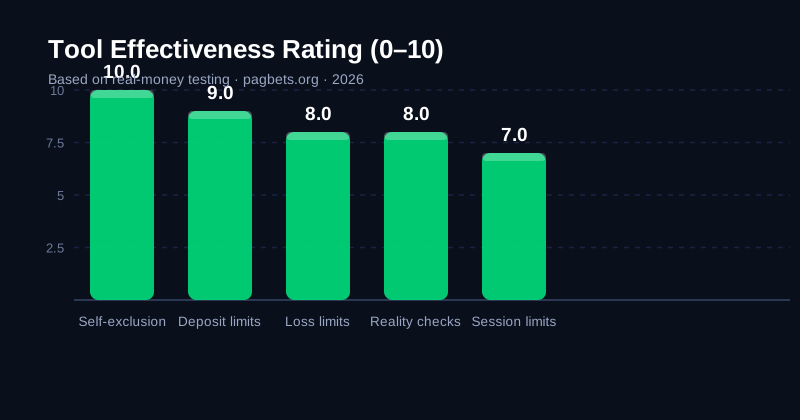
The deposit limit is the single most protective tool you have: a hard cap on how much you can add to your account per day, week or month. Set it on day one, at the number you decided in advance — not the number you're comfortable with after a win. The built-in friction matters: lowering a limit takes effect immediately, while raising it requires a cooling-off period (24 hours to a week depending on the operator). That asymmetry is deliberate and is the tool working as designed.

Loss Limits and Session Limits
Loss limits cap how much you can lose in a period — when you hit the ceiling, the account blocks further betting until the period resets. Session limits cap how long you can play, logging you out after the timer expires. Loss limits protect the bankroll; session limits protect the evening. Both are available at Bet365, Betway, Stake and most ranked operators, and both should be set alongside your deposit limit.
Reality Checks: The Autopilot Breaker
Reality checks are timed interruptions — a pop-up showing elapsed time, deposits made and net result, typically after 30 or 60 minutes of play. They are the most effective tool for live betting specifically, because live betting compresses decisions and dissolves time perception (our psychology guide explains the traps). Enable the 30-minute check on every account where you bet in-play; the interruption alone breaks most chasing loops.
Time-Outs and Self-Exclusion: The Emergency Brakes
Time-outs are short self-imposed breaks — 24 hours to six weeks — useful after a bad run or before a known trigger period. Self-exclusion is the serious tool: a block of six months to five years, applied across the operator (and in some jurisdictions across all operators via national schemes like GAMSTOP). Self-exclusion is not a failure; it's the correct decision whenever betting stops being entertainment. If you're considering it, you should probably use it.
The Five-Minute Setup
Open your bookmaker right now and set: a monthly deposit limit at your entertainment budget, a daily loss limit around 5% of that budget, a 30-minute reality check, and a session limit of two hours. Four settings, five minutes, on every account you hold. That's the entire responsible betting toolkit — and it works far better set in advance than remembered in the moment.
When Tools Aren't Enough
Tools manage behaviour; they don't treat problem gambling. If betting is causing harm — chasing losses, lying about stakes, borrowing to bet — the right move is professional help, and it's free: BeGambleAware and GamCare offer confidential counselling, and Gamblers Anonymous runs meetings worldwide. Our responsible gambling guide has the full directory, warning signs checklist, and helplines by country. Reaching out is the strongest responsible gambling tool of all.