What Asian Handicap Actually Does
Asian handicap is the market that most directly answers the question a punter actually has: which team is stronger, and by how much? A standard match result market forces you to pick a winner from three options. A handicap market removes the draw entirely and applies a virtual score adjustment so that both sides begin level.
Take a favourite priced at 1.60 against an outsider at 2.40 with a draw at 3.40. The imbalance is obvious. A handicap of -1.5 on the favourite and +1.5 on the outsider turns that into two near-even prices, because you are no longer predicting the result — you are predicting the margin.
That reframing is the single most useful thing about the market. Instead of asking whether a team will win at all, you ask how comfortably they will win. On paper it sounds simpler. In practice it is harder, because margins are harder to forecast than results, and because a one-goal defeat and a three-goal defeat carry identical weight on the match result market but very different weight on a handicap.
The market is most commonly offered on football, ice hockey and rugby, and increasingly on cricket through handicap runs and totals. Availability of quarter-ball lines varies considerably by operator and sport, which is worth checking before you build a plan around them. Our football betting sites comparison shows which operators carry the deepest handicap markets.

Reading the Line Correctly
The line is displayed with a sign attached to the favourite. A line of -0.5 means the team must win. A line of +0.5 on the underdog means the underdog only needs a draw, or a single lost goal is enough to lose. The whole language of the market is a single number and its sign, and it is worth pausing on that number every single time.
When a market is presented as 0, the line sits between the two teams and a draw results in a push. That is why many beginners reach for 0 first — it feels safer. In practice a 0 line is less safe than a half-ball line, because a push is neither a win nor a profit. A push on a zero line returns your stake, which means that bet genuinely accomplished nothing beyond occupying your time.
Working from the perspective of the underdog is useful, because it forces you to think in positive margins. A +1.5 underdog needs to win or lose by only one goal to win the bet. A +0.5 underdog needs to win outright. A +2.25 underdog needs to lose by only one goal, and a half win or half loss occurs if they lose by exactly two.
| Line | Favourite needs | Underdog needs | Draw outcome |
|---|---|---|---|
| 0 | To win outright | To win outright | Push |
| -0.25 | Win by 1+ | Win outright | Half win / half loss |
| -0.5 | Win by 1+ | Win by 2+ | Favourite wins bet |
| -0.75 | Win by 2+ | Win by 2+ | Half win / half loss |
| -1 | Win by 2+ | Win by 3+ | Push |
| -1.25 | Win by 3+ | Win by 3+ | Half win / half loss |
| -1.5 | Win by 3+ | Win by 4+ | Favourite wins bet |
Why Half-Ball and Quarter-Ball Markets Matter
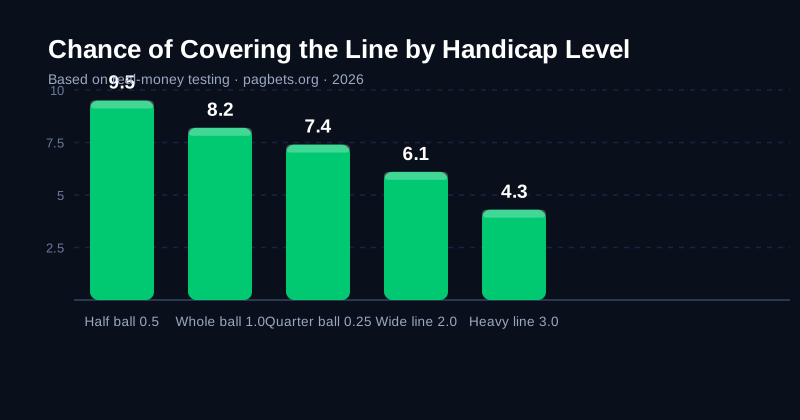
Half-ball lines (0.5, 1.5, 2.5) give a clean binary outcome. Either the margin beats the line or it does not. Quarter-ball lines (0.25, 0.75, 1.25) sit between two lines and split your stake across them, which converts what would otherwise be a push into a partial win or partial loss.
This is the detail that separates people who understand the market from people who memorise the prices. On a 0.25 line, half your stake is on 0 and half on 0.5. If the favourite wins by exactly one goal, the half on 0 loses and the half on 0.5 wins — you are left with a half-loss and half the return. Understanding this one mechanic removes almost all confusion about quarter lines.
The same logic produces a genuinely useful piece of information for planning. A quarter-ball bet is never a push, which means a small handicap is a real commitment rather than a free option. If you want a low-risk way to take a small handicap, quarter-ball is not it — half-ball is lower risk, because at least a portion of the stake can be returned. A whole-ball line is lowest risk of all, because pushes are most common there.
- Whole ball (0, -1, -2): exact margin returns your stake — a push
- Half ball (0.5, -1.5): no push possible, clean win or loss
- Quarter ball (0.25, -0.75): stake split across two lines, never a full push
- Half-quarter (0.75, 1.25): also split, sitting between a half and a whole line
Pricing and Value
Because the line is set to balance the two sides, you are rarely offered a genuinely long price. A well-run handicap market produces odds close to 1.90 on both sides. That means the edge, if you have one, has to come from your read of the margin rather than from a mispriced line.
The practical approach is to price the match yourself before you look at the market. Ask what margin you would need to feel the bet was safe, then see whether the offered line gives you more room than that. If you think a team should win comfortably, taking them a line lighter than your own number is the value. The discipline is to set your own number first.
It helps to be honest about how narrow this edge is. Even a strong handicapper might only find one line in five that is better than their own estimate, and even then the margin of advantage is small. The people who succeed with handicap betting are not the ones who find dramatic value. They are the ones who place a large number of small, well-reasoned bets and accept a modest edge on each. A more detailed treatment of this appears in our value betting guide.
Reading the Line as It Moves
The opening handicap line reflects the market's first estimate of the strength gap. Movement in the opening hours, particularly in the direction of a side you follow, is a signal that money or sharp information has arrived. The closing line is the one most respected, because it is the last price before kick-off and therefore the hardest to move.
A team drifting from -1 to -1.25 while shortening in price is being backed. A team easing from -1.5 to -1.25 while drifting is being sold. Learning to read these movements takes time and watching, but it is one of the more useful habits you can build in this market.
Line movement should be interpreted with care, particularly on small leagues where the market is thin. In a low-liquidity competition, a single sizeable bet can shift a line by a full goal without any new information existing, and the movement tells you about one bettor rather than about the match. The deeper the market, the more the line reflects a genuine consensus.

When the Margin Is Doing the Work
A detail that catches out beginners: on an even match with no line applied, the two handicap prices are not quite symmetrical, because the bookmaker builds a margin into both sides. Back a 0 line on both outcomes and you will lose money in expectation even if your assessment of the match is perfectly accurate.
It is a small effect, but it is worth being precise about what the market can and cannot do. The handicap does not remove the bookmaker's edge. It removes the draw as an outcome and makes the market two-way, which reduces variance. Both of those are genuine benefits — the point is simply that a reduced margin is not the same as a negative one, and a handicap bet is not automatically a fair bet.
- Two-way market reduces variance compared with match result
- Margin remains — the bookmaker still prices in an edge
- Push option on whole and half-quarter lines adds flexibility
Handicap Markets in Cricket and Other Sports
Football dominates handicap betting, but the same core logic appears in several other sports with slightly different conventions. In cricket, handicaps are usually applied as run handicaps in test matches and in over totals in limited-overs cricket, where a side batting second needs to reach an adjusted target. In ice hockey, handicaps are expressed as puck lines, usually at a half goal, and a 1.5 line produces the same push logic you would expect.
The mental adjustment is small once you internalise the principle. The question is always the same: does the outcome beat or fall short of the stated number? In American football and rugby, a one-point spread produces pushes constantly, which makes whole-number lines the safest entry point in those sports.
One genuinely useful cross-sport note: in sports with frequent small scoring increments, half-ball lines push far more often than in football, and whole-number lines are correspondingly more common. What does not change is the arithmetic. Compare the final margin with the line, and the settlement is mechanical.
A Simple Staking Plan
Start flat. The most common beginner error in handicap betting is escalating stakes to recover a losing run, and it is the fastest route to an empty account. A workable plan is to risk a fixed small percentage per bet, typically one to two percent of your bankroll, and to bet no more than a handful of selections a day.
Keep a written record of every bet: the line, the price, the reasoning and the result. After fifty bets you will have something more valuable than a profit or loss figure — you will know which lines you read well and which ones you are guessing at. That record is the foundation of any long-term approach, and our betting journal guide sets out a structure that works.
Handicap is also an excellent market for learning the settlement rules, because the outcomes are so clearly defined. Bets here settle in minutes and there is no ambiguity about what happened. Learning on this market is far less costly than learning on a complex in-play bet, where the rules are harder to check in the moment.
- Set your own line first, then compare it with the market's number
- Risk 1–2% of bankroll per bet, never more
- Prefer half-ball lines while you are learning the settlement rules
- Avoid chasing losses with increasing stakes
- Track every bet and review the log monthly
- Use the tools in our responsible betting tools guide to set limits before you start