Why Lower Leagues Are Priced Differently
Every football market is priced by the people betting on it, and the quality of that pricing depends on how much money and expertise is attracted. The Premier League attracts the most attention in sport betting. The National League attracts a fraction of it.
Two things follow. The margin widens, because a bookmaker covering a thin market still needs to protect themselves, and the prices carry more of their edge. The information gap widens too, because less analysis is done and local knowledge is less widely shared.
That combination is why lower-league football is genuinely interesting, and also why it is genuinely hard work. A wider margin is a cost as well as an opportunity — it means your edge has to be larger to overcome it. Our value betting guide covers the arithmetic.
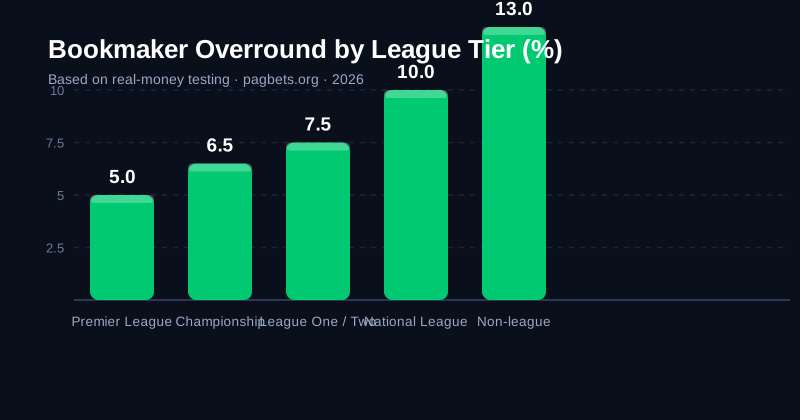
The Margin Ladder
Margin is not uniform, and the pattern across a country's pyramid is consistent. Premier League matches typically carry a 4 to 6% overround. Championship football runs slightly higher. League One and League Two widen further, and the National League and below widen more again.
Understanding the ladder matters because it calibrates your expectations. In a 10% overround market, you need a genuine edge of several percentage points before you have anything worth taking. A small misjudgement in a top-flight match might still leave you with a marginally positive bet; the same misjudgement in a non-league fixture will not.
This is also why the exchange matters so much in lower leagues. Where a bookmaker's price carries 8%, the same selection on an exchange might carry 3%, and the difference between them is frequently the whole question. Our bookmaker selection guide covers how to assess pricing properly.
| League tier | Typical overround | Liquidity | Research burden | Verdict |
|---|---|---|---|---|
| Premier League | 4–6% | Very high | Low | Efficient, hard to beat |
| Championship | 5–7% | High | Moderate | Reasonable for regulars |
| League One / Two | 6–9% | Moderate | High | Opportunity with effort |
| National League | 8–12% | Low | High | Wide margin, thin data |
| Non-league | 10–15%+ | Very low | Very high | Marginal for most bettors |
What Public Data Misses in Lower Leagues
At the top of the pyramid, teams are covered by analysts, data providers and journalists, and the public numbers are close to complete. Lower down, the information that matters most is frequently not in any dataset.
The most valuable items are local. A manager who has left without a replacement is a serious negative. A club that has signed a player from a higher level is a genuine positive that takes a week to appear in the numbers. A ground with a poor pitch, a fixture congested around a cup run, or a squad carrying several injuries from a reserve fixture are all known locally and invisible statistically.
Home and away splits are the most under-used public statistic in football generally, and they matter more in lower leagues because the effect is larger. A team with a 1.90 home record and 2.60 away record is a different betting proposition from one averaging 2.20, and averaging the two is the single most common analytical error.
- Home and away splits, the most under-used number in football
- Managerial changes, no replacement is a serious negative
- Squad rotation, check who played in the last cup match
- Travel distance, significant for midweek fixtures
- Ground quality, a poor pitch costs home teams more
- Fixture congestion, midweek games often mean rotation
- Local news sources, they carry the information that matters
Which Markets to Target
Not every market suits a league you do not know well. The guiding principle is to prefer markets determined by structural factors you can verify over those requiring a precise estimate of team strength.
Both teams to score and over/under both require scoring rates you probably do not know, which makes them hard to value. Handicap markets are more tractable, because the line is a function of expected goal difference and home advantage is a more stable number than absolute team strength.
The most reliable lower-league angle is often a structural one: a home team that wins by exactly one goal more often than the price implies, or a team that consistently fails to score away from home. These are patterns that hold across a season and that you can verify from a table. Our Asian handicap guide covers the mechanics.

Live Betting and Why It Works Less Well
Lower-league in-play markets are the weakest part of the opportunity, and the reason is liquidity rather than analysis.
A live price reflects what people have actually bet. In a Championship match with substantial money, that is a reasonable proxy for market belief. In a non-league fixture with almost no money, the live price is close to the bookmaker's own estimate, updated slowly and with a wide margin. You are not getting a sharper price in-play; you are getting a slower and wider one.
Where live lower-league betting can work is on red cards and penalties, because the effect on a match is so large and so quickly priced that even a thin market reacts quickly. Even then, the margin applies. Our in-play betting risk guide sets out the discipline this requires.

Reading a Lower-League Table Correctly
A league table for a lower division is far more informative than one in the top flight, and the reason is that there is less money distorting the results.
At the top of the pyramid, clubs are under enormous pressure to win at home because of broadcast money, and a strong home record may reflect commercial priorities as much as football ability. Lower down, that distortion is much weaker, and a genuine home and away split is more likely to reflect the underlying teams.
Read the table in four columns rather than one. Points per game shows overall strength. Points per game at home and away reveal whether a team performs differently by venue, which is the most valuable single split in football. Goal difference and goals scored then tell you whether the results are backed by performance or by finishing, and a team with an excellent record and a negative goal difference is a team due a correction.
Two further details are worth checking. Points dropped from a losing position is a genuinely strong indicator — teams that score first drop remarkably few points — and it is available in the head-to-head data. Results against the top and bottom of the table are the other, and a team with a flattering record built entirely against weaker opposition is usually a team the market has priced correctly anyway.
Making It Work
Approach lower-league football as a research project rather than a betting strategy. Pick two or three leagues, learn them properly over a season, and become genuinely knowledgeable about the teams. That knowledge is the only edge available, and it takes time.
Write down your own prices before checking the market, exactly as you would at the top level. If your estimate is 2.20 and the market is 2.60, that is value. If the market is 2.10, walk away — and accept that walking away will be the most common outcome.
Keep stakes small, because a wider margin means a longer expected losing run, and keep a written record so that your research is being tested rather than assumed. Set limits with our responsible betting tools guide, and if the research stops feeling interesting and starts feeling like work, that is a good moment to stop.
- Pick two or three leagues, learn them properly
- Write your price first, then check the market
- Use home/away splits, not overall form
- Check local news, team news is the real edge
- Prefer pre-match over in-play, liquidity is thin live
- Compare exchange prices, the gap is often wide
- Keep a record and stake small, this is a research project