A Marketplace, Not a Bookmaker
The most important difference between a betting exchange and a bookmaker is who takes the other side of your bet. A bookmaker takes it themselves, builds a margin into the price and takes the risk. An exchange matches you with another punter and takes a small commission on winnings instead.
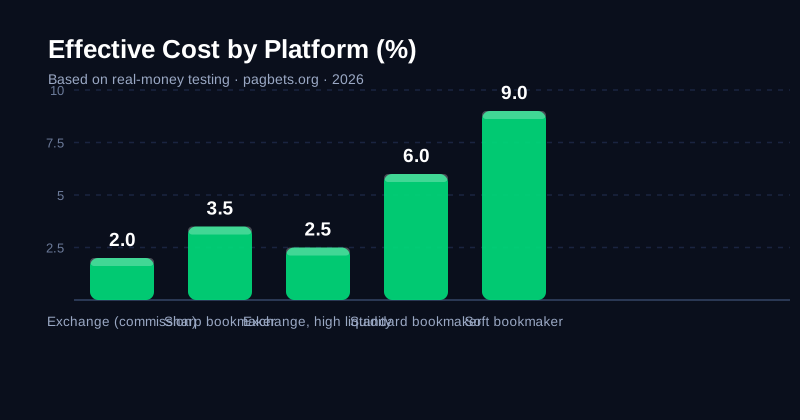
The practical consequence is that the exchange price is closer to the true probability of the event. A market with a 6% bookmaker overround typically costs about 2% in exchange commission, which sounds marginal until you realise it applies to every single bet you place over a long period.
There is a second consequence: an exchange price is not an opinion, it is a fact about what the market currently believes. When the exchange moves a price, that is other money arriving — which is what makes it such a useful reference point.
Back and Lay in Plain Terms
Backing a selection means betting that it will win. Your stake is at risk, and you are paid at the back odds if it does. This is functionally the same as a normal bet, and the reason to use an exchange is generally the better price.
Laying a selection means betting that it will not win. Someone else stakes money on it winning, and you are their counterpart. If they are right, you lose their stake. If they are wrong, you win it.
Laying is what most newcomers find counter-intuitive, because it is a position that wins when the popular selection loses — which feels unnatural when you are used to backing favourites.
- Back odds, what you receive if the selection wins
- Lay odds, what you receive if the selection loses
- Matched odds, the exchange equivalent of a bookmaker price
- Spreads, the gap between the best back and lay price
- Commission, the exchange's fee on net winnings
- Liability, what you must hold to cover a losing lay
Liability and the Risk People Miss
Laying a bet creates an obligation that is larger than the stake you receive if the selection wins. At longer odds the ratio becomes severe, and this is where inexperienced exchange users lose considerably more than they planned.
Lay £10 at 2.0 and a correct selection takes your £10, and you owe a further £10. Lay £100 at 10.0 and the same selection takes your £100 while you owe £900. The exposure is not a cost of doing business, it is a real risk that must be covered by funds actually held in the account.
The alternative — trading out rather than holding to the finish — avoids that exposure entirely. A back and lay pair locks in a position, and because the liability disappears the moment both legs match, the risk profile is much closer to a normal bet. This is the single most useful habit for a new exchange user, and our trading guide covers the mechanics.
| You lay | Stake received | If selection wins | Amount at risk |
|---|---|---|---|
| £10 @ 2.0 | £10 | £10 | £20 |
| £10 @ 3.0 | £10 | £20 | £30 |
| £10 @ 5.0 | £10 | £40 | £50 |
| £10 @ 10.0 | £10 | £90 | £100 |
| £10 @ 20.0 | £10 | £190 | £200 |
Trading Out Instead of Holding
The defining habit of a successful exchange user is not laying — it is trading. When you back a selection and the price rises, you can lay the same selection at the new price and take a profit immediately, regardless of whether the selection ultimately wins.
The mechanic is simple. Back at 2.0, the price moves to 2.4, and you lay at 2.4. You have locked in a profit equal to the difference, minus commission, and the selection's final result is irrelevant to you.
It is worth being clear about the trade-off. Trading locks in profit early and reduces the maximum possible return, because you no longer benefit from a large further price movement. The same principle applies to trading a loss out at a lower price, which caps a downside. Neither is dishonest; both are decisions about which risk you would rather carry.

How to Decide Whether a Bookmaker Price Is Good
The exchange gives you a reference point that no other tool provides. Check the exchange price for a selection, then check the best bookmaker price for the same selection, and the difference is your margin of advantage before commission.
On a liquid football market, the best bookmaker price might be 2.02 where the exchange is 2.00. That is a trivial difference and not worth chasing. On a lower-profile fixture, or in a market the exchange covers poorly, the gap can be several points — and that is where the value is.
Our value betting guide covers the arithmetic in full, and choosing an operator matters because the best exchange prices are not offered by every bookmaker.
Common Exchange Mistakes and How to Avoid Them
The exchange introduces three failure modes that do not exist on a bookmaker, and all three account for most of the losses new users experience.
Not covering liability is the first. Placing a lay without realising the exposure can exceed your entire balance means a single correct outcome empties the account rather than merely reducing it. The position size must be calculated from the worst case, which is why professional users lay on an exchange with a larger bankroll than they would back with.
Trading too early is the second. Trading a 2.02 back price out at 2.05 locks in a small gain and forgoes any further movement, which sounds sensible and is mathematically fine. The mistake is doing it reflexively on every small move, where the commission eats most of the edge and the bettor accumulates a series of tiny gains and occasional losses.
Ignoring the spread is the third. The best available back price and the best available lay price on a liquid market can differ, and that spread is a real cost. A bettor who checks the exchange price but places the bet on a bookmaker priced two points away has not used the information.
Which Markets Have the Tightest Exchange Prices
The exchange advantage is not uniform across markets, and knowing where it is largest is what makes the habit worthwhile.
The tightest exchange prices are on high-profile football — Premier League, Champions League, the major international tournaments — because that is where liquidity concentrates. On those markets the exchange price is a genuinely reliable reference, and a bookmaker offering a point or two better is a real opportunity.
The advantage narrows on lower-profile football, because fewer exchange traders cover it and the spread between the best back and best lay price widens. Where liquidity is thin, the exchange price becomes less informative rather than more, and the bookmaker price is the better reference.
For non-football sports the picture varies sharply. Horse racing and greyhound racing are among the most liquid markets on any exchange, because the trading tradition is strongest there. Tennis, cricket and lower-profile racing can be thinly covered, and a wide spread there means the reference price is less useful. Our horse racing guide makes the same point about exchange value in racing.
A Sensible Starting Approach
For a newcomer, the most useful habit is to check the exchange price before every bet, whatever the habit of taking the best available bookmaker price. The habit costs nothing and is the single most valuable piece of information available.
When you have a genuinely strong view on a selection, comparing prices across several bookmakers and the exchange regularly finds a few points, and a few points repeated across hundreds of bets is where a real edge comes from.
Start with back bets only, and use the exchange as a reference before moving on to matched betting or trading. Set limits with our responsible betting tools guide before you begin — bankroll discipline applies here as much as anywhere, and an exchange is unforgiving of a miscalculated liability.
- Check the exchange price before every bet, the cheapest habit with the most value
- Back before you lay, learn one side first
- Understand liability before placing a lay, it can exceed your stake many times over
- Trade out rather than holding, it removes the exposure
- Compare prices across bookmakers and the exchange, the gap is the point
- Use a spreadsheet, price logging is essential on an exchange
- Set limits with our responsible betting tools before you start