
The Only Bet With No Risk — In Theory
Arbitrage betting exploits one simple fact: bookmakers disagree. When two operators price the same market far enough apart, you can back every outcome across both and guarantee a profit regardless of the result. It's the only bet in sports with no sporting risk — and it's also the fastest way to get limited or banned by every bookmaker you use. This guide explains the maths, the practical reality, and the honest 2026 verdict.
The Maths: When an Arb Exists
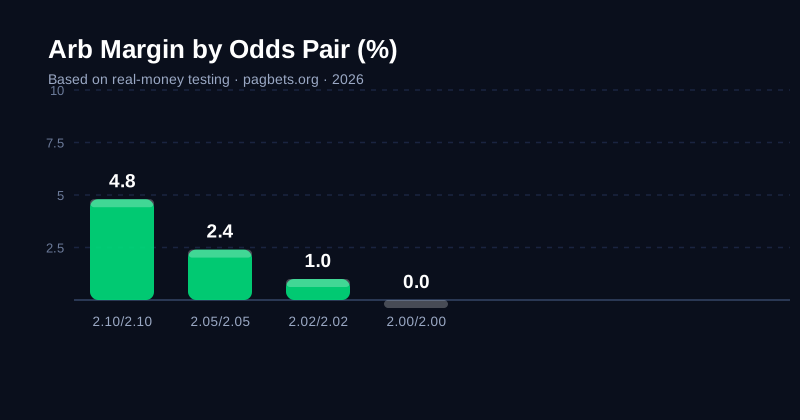
The test takes seconds. Convert each outcome's best price to implied probability (1 ÷ odds), add them, and if the total is below 100%, you have an arbitrage. Example: a tennis match priced 2.10 on player A at one bookmaker and 2.10 on player B at another. Implied probabilities are 47.6% each, totalling 95.2% — leaving a 4.8% margin you can capture by splitting your stake correctly.
Stake splitting is the mechanical part: your stake on each side must be proportional so both returns are equal. A $100 total on a 2.10/2.10 arb means roughly $50/$50, returning about $105 whichever player wins. Our odds calculator guide covers the arithmetic in full.
| Outcome | Best odds | Implied prob. | Stake | Return |
|---|---|---|---|---|
| Player A | 2.10 | 47.6% | $50 | $105 |
| Player B | 2.10 | 47.6% | $50 | $105 |
| Total | — | 95.2% | $100 | +$5 (4.8% ROI) |
Why It's Much Harder in 2026
Three forces have compressed arbitrage. Sharper markets: the gaps between major bookmakers have narrowed as models converged — typical arbs now yield 1–3%, not the 5–10% of a decade ago. Automation: professional arbers run software that spots and executes within seconds, so opportunities vanish before casual players see them. Account limiting: the decisive factor — bookmakers detect arbing patterns quickly (round-number stakes, unusual markets, quick withdrawals) and restrict the accounts generating them.

Exchange Arbing: The Legal Version
Betting exchanges remove the limiting problem. On an exchange, you can back one outcome and lay another, capturing the price gap between bookmakers and the exchange market without violating anyone's terms. The mechanics overlap heavily with sports trading — the difference is intent: arbers lock guaranteed profit from price gaps, traders speculate on movement. Our sports trading guide covers the exchange mechanics.
The Honest Verdict
Arbitrage betting is real, legal, and mathematically sound — and for most people it is no longer worth the effort. The margins are thin, the windows are short, the tooling is competitive, and the reward for consistency is being limited by the very bookmakers you depend on. If you're drawn to the mathematical side of betting, value betting and exchange trading both offer a better effort-to-return ratio in 2026 — with none of the account risk.