Why Live Betting Is a Different Game
The arithmetic of in-play betting differs from pre-match in one important way: the window for acting is seconds, not hours. That single fact explains almost everything about how live betting goes, including why experienced traders rest when they are not sharp and why casual punters lose more here than almost anywhere else.
It is easy to assume live bettors are simply faster rather than more informed. The evidence suggests otherwise. Studies of live betting consistently show higher loss rates than pre-match betting, with the difference largely explained by bets placed in emotional response to an event — a goal, a red card, a near miss — rather than from a considered view.
How Live Prices React
A live price is a continuously updated estimate of the final outcome, and it responds sharply to events. A goal does not simply shift the price in one direction; it transforms the remaining problem, because the scoring team now needs fewer goals and the trailing team must chase. The bookmaker's algorithm reprices in a fraction of a second, and sharp traders often move it before casual attention arrives.
This creates a window that works for and against you. The seconds immediately after a goal often contain pricing that is either excellent value or a trap, depending on how you read it. If you know the team involved, you may recognise a mispriced reaction. If you do not, the same moment is simply a sudden change you are being asked to act on.
Which Live Markets Are Worth Using
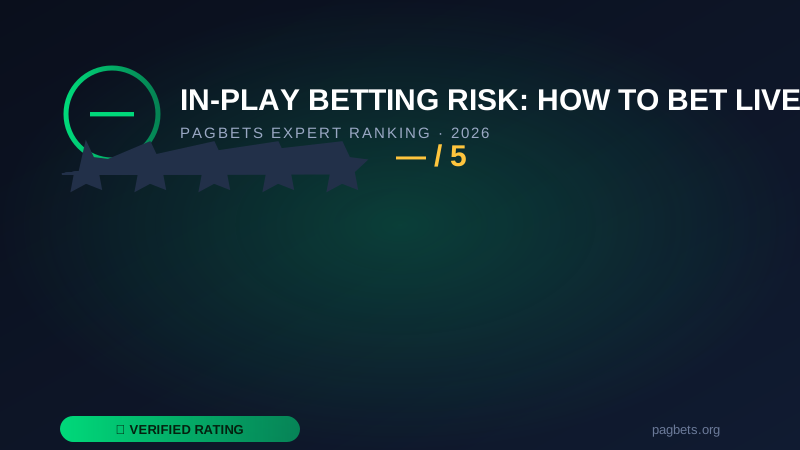
Not all live markets deserve attention. The result market becomes heavily priced once a goal goes in, and its remaining value is small. The interesting live markets are the ones that price the next event rather than the final result: next goal, next corner, cards in the next ten minutes, and updated totals that have not yet fully absorbed the match state.
Totals markets in particular tend to be the best live value, because the algorithm adjusts the line as goals are scored and the pace of a match is often under-reflected in the price. The discipline required is to have decided your angle before the event, rather than constructing a reason immediately after it happens.
| Live market | Typical value available | Main risk | Best for |
|---|---|---|---|
| Match result | Low after a goal | Overpaying for obvious outcomes | Not recommended live |
| Next goal | Moderate | Fast, reactive decisions | Experienced traders |
| Goals total | Often good | Line not fully adjusting | Punters who read a match |
| Corners | Variable by fixture | Low liquidity on minor games | Set-piece aware bettors |
| Cards | Usually thin | Referee-dependent | Selective use only |
The Chasing Trap
The most expensive live betting behaviour is reacting to a losing position by adding to it or by immediately placing another bet on the same match. This feels like determination and is closer to a compulsion — the belief that a team trailing is 'due' a goal is a misunderstanding of independence, because each event in a match has no memory of the last.
Live betting also removes the usual safeguard of time. In pre-match betting you can leave a bet, close the site and return later. In live betting, the price that tempts you is on screen right now, and the whole environment is built to make acting feel necessary. The single most effective protection is a hard rule on live stakes, set before you start.
- Set a live stake cap before the match and do not raise it
- Decide your angle before the event, not after it
- Avoid betting live when tired, angry or watching with others
- Skip the result market, it is rarely good value
- Use totals and next-goal markets, not the obvious ones
- Take a break after any live session that felt out of control — our responsible betting tools guide has session reminders
Pre-Match Research Makes Live Betting Safer
The strongest defence against impulsive live betting is not discipline in the moment, which is precisely when it is hardest to find. It is having done the work before the match started. A punter who has already read the team news, formed a view on the likely shape of the game and identified the totals line they would attack is far less exposed to a reactive bet after a goal than one who opened the site at half-time.
Pre-match preparation also changes what you notice. If you have established that a side tends to concede early, a goal in the twelfth minute is confirmation rather than a shock, and you are less likely to chase. If you had no view at all, the same goal is simply an event demanding a response, and the pressure to act is at its strongest.
There is a practical version of this that costs almost nothing. Before kick-off, write down the single live market you would consider and the price at which you would take it. If the market never reaches that price, you have not bet, and nothing has been lost. If it does, you are executing a decision made calmly rather than reacting to a moment.
For more on how to build a pre-match process that carries into live play, our football betting strategies guide is the natural next step.
The Role of Bet Size in Live Betting
Live staking deserves its own rule precisely because the decision window is short. A pre-match bettor can place a stake after thinking; a live bettor frequently places first and reflects afterwards. The practical protection is to decide your live stake as a fraction of your normal stake before you open the market, and treat that number as fixed.
The temptation to increase is strongest precisely when it is most dangerous — after a loss inside the same match, when the reasoning feels urgent. A live losing position is not a reason to add; it is simply information about the match, and adding to it is a doubling-down on a view that the market has already repriced in response to what happened.
There is a legitimate use of size variation in live betting, and it is timing-based rather than loss-based. If your threshold is reached before an event you expect, a larger stake is a considered decision. If the threshold is reached after an unexpected event, it is a reaction. The distinction is only reliable if the threshold was written down beforehand.
The Difference Between a Rule and an Intention
Most live bettors have rules. Fewer have rules that survive contact with a goal. The distinction is worth examining, because the failure mode is specific: the rule exists in a calm moment and is tested in a charged one, and the charged moment is exactly when the rule is worth having.
A rule that works has a number attached to it. 'I will not chase' is an intention. 'I will not place a second live bet on this match' is a rule, because it can be followed without making a judgement at the moment of temptation. Converting intentions into rules with specific numbers is the entire discipline.
It also helps to decide the rule before you open the market, because a rule formed during a match is a rule formed while arguing with yourself. If a predetermined limit is reached, the correct response is to close the market rather than to renegotiate it. Live betting markets stay open precisely because the design assumes you will want to keep looking.
A Sustainable Way to Bet Live
If you enjoy live betting, treat it as a skilled discipline rather than a faster version of the same thing. Watch a match end to end without betting for the first several, learning how prices respond. Restrict yourself to one or two live markets rather than clicking through all of them. Keep a record, because live results are the ones most distorted by hindsight — our betting journal guide explains how to avoid that.
The realistic goal is not profit. It is to participate in a market you find interesting while limiting the damage that impulse can do. A punter who stakes small, bets selectively and reviews their record afterwards will have a far better time — and lose far less — than one who treats every match as an opportunity to act.