The Most Efficient Market in Betting
The NFL attracts more money than any other sport in most markets, and that money makes it the most efficiently priced. When sharp bettors, models and the public all focus on the same games, prices are close to correct far more often than anywhere else.
This has a direct practical consequence: most published NFL handicapping systems do not work. A system that identifies genuinely strong teams will find that the market has already priced that strength in, and the bet returns nothing after the margin. The edge is not in picking winners better than the average. It is in finding small price differences between books and occasionally catching a genuine mispricing.
That is a less exciting proposition than most people signing up for, but it is the honest one. Our value betting guide sets out the arithmetic behind why accuracy alone is not profitable.
Point Spread: How It Works
A point spread creates a level playing field by giving one team a virtual head start. If the Chiefs are -6.5 against the Bills, you can back Kansas City to win by seven or more, or Buffalo to lose by six or fewer. Both sides carry roughly even risk, which is why spreads attract the most action.
Whole-number spreads such as -6 or -3 produce a push when the margin lands exactly on the number, returning your stake. Half-point spreads such as -6.5 remove that possibility entirely, which is why serious bettors generally prefer them — a push returns nothing.
Spreads move throughout the week. The opening line is a broad public estimate, the mid-week line reflects initial injury news, and the closing line on Sunday afternoon is the fully informed price. Most of the movement comes from one source: the availability of a star player. Our guide to reading odds movement explains how to read those shifts.
| Line | Kansas City needs | Buffalo needs | Margin of 6 |
|---|---|---|---|
| -7 | Win by 8+ | Lose by 6 or less | Push |
| -6.5 | Win by 7+ | Lose by 6 or less | KC wins bet |
| -6 | Win by 7+ | Lose by 6 or less | Push |
| -5.5 | Win by 6+ | Lose by 5 or less | KC wins bet |
| 0 | Win outright | Win outright | Push |
Totals and the Over/Under Market
The totals market asks how many points will be scored in total, and it is generally the second most popular market. It often offers better value than the spread because public betting concentrates on picking winners, leaving the total less thoroughly analysed.
Modern NFL totals are set around 45 to 48 points, and understanding why they have moved requires more than reacting to the line. A total rising from 45 to 47.5 usually reflects offensive expectations, weather, or pace on both sides of the ball. A total falling for a specific game often signals a weather effect or a defence that has improved from a previous matchup.
Live totals are the more interesting version. A game at 21 total points after three quarters frequently has a live total well below the closing figure, and understanding why — pace, game script, or simply a long tail of outcomes — is where a real edge exists. That variance is visible in our in-play betting risk guide.

Moneylines and When They Offer Value
The moneyline is the simplest market and usually the least attractive. It requires picking the outright winner at a price that is rarely generous, because the public concentrates on favourites. On heavily favoured teams the price collapses to around 1.10 to 1.20, which returns very little for a genuine risk of defeat.
There is one situation where the moneyline becomes interesting: when a strong favourite is available at 1.33 or higher, the market may be understating their quality. This happens when a team is expected to win but has a soft schedule, or when public sentiment has moved against them for reasons unrelated to their actual strength.
Against that, there is a real temptation to fade favourites in the NFL specifically, because public money is often on big teams. This can work over a season but is unpredictable week to week, and it requires discipline. Our betting terms glossary covers the terminology used throughout the sport.
Player Props and Their Limits
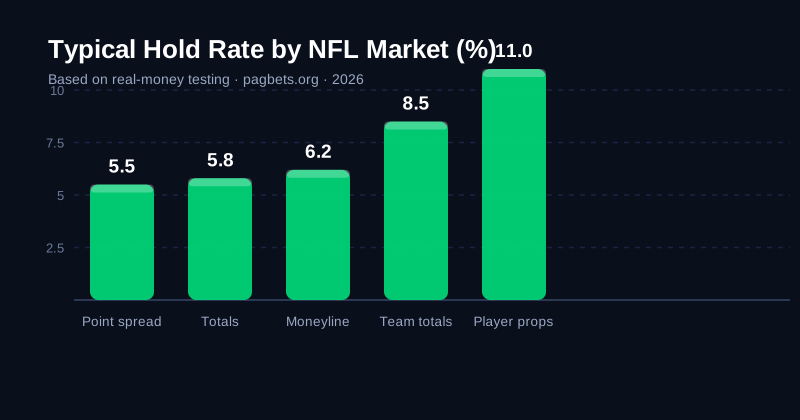
Player props are the fastest-growing part of NFL betting, and they are also the most heavily margined. Narrative markets attract concentrated money — a famous quarterback's passing yards, a star running back's rushing total — and a wide margin is the result.
Some props are structurally hard to evaluate. Receiving yards depend almost entirely on the quarterback's willingness to throw to that receiver. Completion percentage depends on game script in ways that are difficult to forecast in advance. Even rushing yards involve an offensive line whose performance is a separate bet in itself.
Where props can hold value is in obscure or situational markets: first touchdown, receiving first catch, or team totals. These are less heavily bet, and because they are resolved simply, a clear opinion can be worth acting on. Treat the marquee props as entertainment.
Why the Closing Line Matters More in the NFL
Because the NFL is so heavily bet, the closing line is the single most reliable reference point available. When professional bettors want to know whether a selection was good value, the standard test is whether the price taken was better than the closing price.
The reason is that the closing line reflects the most informed view available, after all injury news, weather and team news have been absorbed, from the deepest pool of money. A bettor who consistently takes prices better than that closing line has demonstrated something real. A bettor who consistently takes worse has demonstrated the opposite, regardless of what their results look like this season.
It also explains the research technique in our guide to reading odds movement. Track the closing line of the markets you follow through a season, and you build a personal benchmark. After a hundred bets you can answer a question that no amount of results will tell you directly: do I consistently beat the market, or am I simply lucky?
One warning is worth adding. Beating the closing line is a necessary rather than sufficient condition for long-term profit, because the closing line is still a market price containing a margin. It is the best available benchmark, not a guarantee of edge.
Building a Routine That Lasts a Season
The NFL season is 18 weeks, which makes it a marathon. A punter who stakes aggressively in September often has nothing left by December, because the season's variance is substantial and the sample is small enough that losing runs are entirely normal.
A workable routine is to fix a unit at one to two percent of your bankroll, check the best price across at least three books, and bet only where you have a genuine view. Record everything, and resist the temptation to add a system mid-season because the results have been poor.
Watch for the correlated mistake too. Backing a team to win and the same game to go over is not two independent bets, particularly in a close matchup where a slow first half suits one and a fast one suits the other. Our Asian handicap guide covers the maths of combining outcomes.
- Fix a unit at 1–2% of bankroll before the season starts
- Price shop across at least three books on every bet
- Prefer the spread or total over the moneyline
- Be careful with correlated bets, two bets may be one
- Treat marquee props as entertainment
- Record every bet including the ones you skipped
- Use our responsible betting tools guide to set limits before the season