Why Format Is the First Thing to Learn
Cricket punts who struggle are usually not lacking knowledge of the game. They are treating a five-day Test like a three-hour T20 match, and the two demand completely different approaches.
Test cricket is a war of attrition where the draw is a genuine outcome and the market reflects that. T20 is an assault from the first ball, where momentum swings violently and a single over can change the expected result. The Hundred sits in between, being shorter than a T20 but with a larger pitch and more time to build an innings.
Before you place a single bet, know which format you are watching and what the typical scoring pattern looks like. Almost every other decision follows from that. Our cricket betting guide covers the format differences in detail, and our T20 strategy article goes deeper on the shortest format.
Reading a Pitch Before the Toss
The toss decision is the most publicly discussed factor in cricket and the least important for most bettors. What matters far more is the surface itself, and that information is available before the match starts if you know where to look.
Broadcasters display a par score — the score a good batting side would be expected to reach on the current surface. On a flat road it might read 185 in T20. On a green top it might read 135. That single number compresses an enormous amount of information about pace, spin, bounce and deterioration, and it is more useful than any pre-match tip about a team's recent form.
Adjust for the teams involved. The par score is an average, and a top-order stack will beat it comfortably on a surface that troubles a weaker pair. Where the two teams are evenly matched, the surface matters far more than either side's reputation.
- Par score above 180 in T20 — expect a high-scoring, open match
- Par score 150–170 — balanced surface, team quality dominates
- Par score below 145 — spin and pace will be decisive
- Test cricket: a fresh pitch favours batting, a used pitch favours bowling
- Day–night games: dew often helps the second innings chase
The Numbers That Matter in a Chase
When a team bats second, three numbers decide the chase almost entirely: wickets in hand, balls remaining, and the current required run rate. A side needing 180 from 120 balls with eight wickets in hand is in a completely different position from one needing 180 from 60 balls with two wickets down, even though the headline requirement is identical.
The mental calculation most beginners get wrong is comparing the required rate with the par rate instead of with what is actually achievable. A required rate of 9 an over in a T20 is not demanding. A required rate of 13 an over is severe. The context is everything: the boundary percentage available, the quality of the remaining batters, and how the pitch is behaving as it wears down.
Live cricket markets make this arithmetic valuable, because in-play prices do not always reflect the situation as clearly as they should. A side 120 for 2 after 12 overs chasing 190 is in a strong position, and the live match result frequently underprices them. That gap is the single most reliable live cricket angle.

Player Markets Where Form Is Predictable
Cricket is unusual among major sports in how strongly form persists. A batter averaging above 50 will usually continue to score at a rate well above the market's expectation, because runs cluster far more tightly in cricket than goals do in football.
Top batsman and top bowler markets exploit this directly. A top batsman priced at 3.50 for a player averaging 55 in recent T20 cricket is often generous, because the market accounts for his team's batting position and the possibility of a collapse. The main risk is the tail — if the top three are dismissed cheaply, the market resolves to a batter who would never start.
Session markets, which cover a fixed number of overs, are often even more mispriced. A batter who scores heavily in the powerplay may be dismissed before the session ends, and the session market frequently assumes a longer stay than the price justifies. Most runs markets are the most volatile and are best treated as entertainment rather than strategy.
Overs and Wicket Markets
Overs markets — how many runs will be scored in the next six, for example — are attractive because they settle quickly and the conditions affecting them are narrow and identifiable. A specific over at the start of a chase is far more predictable than the same over in the middle, because required rates change throughout.
Wicket markets follow similar logic. A bowler who has just taken a wicket is priced shorter for their next wicket, correctly, because batters are weaker against a bowler in rhythm. The value appears when a bowler goes unbowled for a spell during a chase and returns, since the live price sometimes fails to reopen the market promptly.
The mistake to avoid is treating a short over market as independent. Two consecutive over bets are correlated, and the second is significantly more likely to lose if the first loses. Treating them as a series rather than as separate bets is worth more than any individual selection.

Test Cricket Needs a Different Approach Entirely
Everything above applies mainly to limited-overs cricket. Test cricket is a different sport with different mathematics, and punters who transfer T20 assumptions into Tests get badly surprised.
First, the draw is a genuine outcome. At 3-3 in a five-day match, the two teams are effectively level, and the match result market carries a real probability of stalemate that limited-overs cricket almost never produces. This widens the market and changes what a sensible price looks like.
Second, sessions last for days, which changes the practical relationship between research and result. A Test side can lose the morning session and still be in a strong position by stumps on day three, and a bettor with a fixed daily stake is now making three separate decisions about one position. Many experienced Test punters stake once at the start of the match rather than daily for that reason.
Third, the pitch deteriorates across five days, and a surface that was good for batting on day one is often excellent for spin by day four. This is why the toss matters far more in Tests than it does in T20 — not because the captain who chooses to bat first is usually right, but because the surface it puts the opposition on is the one that will deteriorate underneath them.
Staking a Cricket Bankroll
Cricket offers many attractive-looking prices, and that is precisely the risk. Long shots feel compelling during a match, and the temptation to add to a position as the required rate climbs is strong. It is the same chasing instinct that causes losses in every other sport, and it is more tempting here because the drama of a chase makes it feel rational.
A workable approach is to keep cricket stakes small, particularly live. A fifth of your normal stake is sensible for an in-play cricket bet, and it should be fixed in advance. The live betting psychology article covers why the urge to add during a chase is emotional rather than analytical.
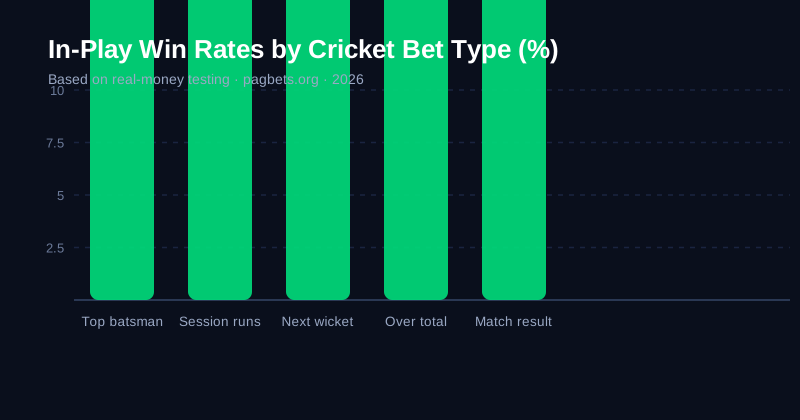
Keep a record of your cricket bets, because the format-specific patterns appear quickly. Many punters discover they are profitable on top-batsman markets and consistently losing on match result, and that knowledge is only visible in the data. Our betting journal guide sets out a structure that makes those patterns visible.
- Stake small on live cricket, around a fifth of your normal amount
- Write your thresholds before the match rather than reacting to it
- Prefer player form markets where the edge is clearer
- Never add to a losing position during a chase
- Record every bet and review by format monthly
- Set limits with our responsible betting tools guide before a series starts