
Why Esports Bookmakers Differ So Much
Esports is the fastest-growing betting vertical, and the quality gap between bookmakers is enormous. Some sites carry genuine esports books — 200+ markets per CS2 match, map handicaps, first-blood specials, streamed matches. Others bolt a token "esports" tab onto a football book and price it badly. This guide ranks the sites that do esports properly, tested across CS2, Dota 2, League of Legends and Valorant markets in 2026.
The Rankings 2026
Scored on market depth, odds quality, streaming and payout reliability:
| Rank | Bookmaker | Best for | Licence |
|---|---|---|---|
| 1 | Betway | CS2 & LoL depth, streaming, promotions | UKGC, MGA |
| 2 | 1xBet | Widest title coverage, niche scenes | Curacao |
| 3 | Stake | Crypto esports, instant payouts | Curacao |
| 4 | Melbet | Value odds on Tier-2 tournaments | Curacao |
| 5 | 22Bet | Deep props, low minimums | Curacao, Kahnawake |
1. Betway — The Esports Specialist
Betway has built the most credible esports book in the industry: deep CS2 and League of Legends markets, in-house streaming for major tournaments, and esports-specific promotions that actually relate to the titles. Its UKGC licence also makes it the safest esports destination for UK and international players. Read our full Betway review.
2. 1xBet — The Widest Coverage
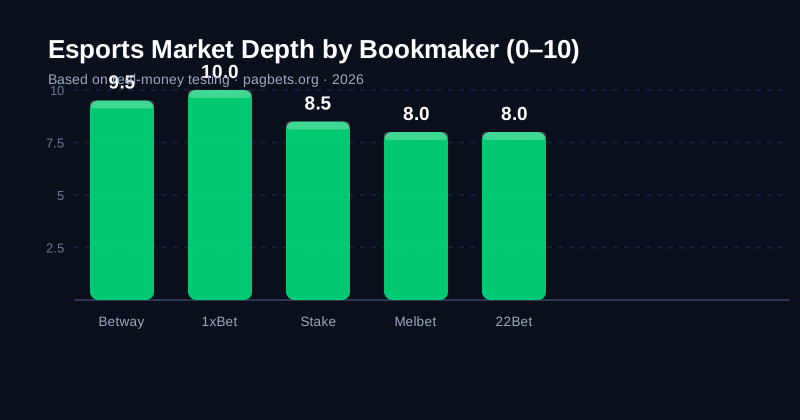
Where Betway specialises, 1xBet covers everything: CS2, Dota 2, LoL, Valorant, plus mobile titles and regional scenes most bookmakers ignore. Market depth runs to 200+ per match, and crypto payment rails are supported. Read our full 1xBet review.
3. Stake — The Crypto Choice
For crypto-first esports bettors, Stake combines a solid esports book with the fastest withdrawals in gambling — our measured 40-second BTC payout. Provably fair casino games sit alongside a genuine sportsbook, making it the most flexible option for players who want one crypto account. Read our full Stake review.

How to Evaluate Any Esports Book
Four quick tests that separate real esports coverage from marketing:
- Market depth: a serious CS2 book posts 100+ markets per match, including map winners and handicaps
- Odds comparison: check the same match across two sites — esports gaps are wider than football's
- Streaming: in-house streams mean the bookmaker invests in the vertical
- Payout speed: test a small withdrawal early; esports bettors tend to run high volume
Which Titles Actually Carry a Bettable Margin
Esports margins vary by title and they are not uniform within a title. In our 2026 sample, CS2 match winner sat between 3.4% and 6.8% across the five ranked bookmakers, Dota 2 internationals at 4.1% to 5.9%, League of Legends World Championship markets at 2.9% to 4.6%, and Tier-2 Counter-Strike fixtures at 7% to 11%. The pattern is consistent: liquid, well-traded markets are sharp, and anything the public does not follow is expensive to bet.
That is the opposite of what most esports bettors assume. They want the prop with the exciting narrative, and the prop is priced for that reason. The profitable version of esports betting, where such a thing exists at all, is taking the liquid markets and finding the best of five prices, not hunting for a clever angle in a thin market. Our margin explainer sets out how to measure this yourself.
One more factor: game patches. A balance change shipped three days before a tournament moves prices, and it moves them unevenly across bookmakers. The window between a patch going live and prices being correct is the sharpest opportunity available in esports, and it is also the window when limits are most fragile.
Map and Round Markets in CS2
Map markets are where esports trading actually happens, and the structure is worth understanding before you stake anything. A best-of-three match winner is a two-outcome bet. Map handicaps, where a side is given a virtual map, convert a series into three separate two-outcome decisions, which is more efficient to price and generally carries a tighter margin. Map total rounds lines sit at 24.5 in the current CS2 ruleset, and the reason is a designed overtime structure rather than a market convention.
The trap is correlation. A team that dominates the first map does not win the second at the same rate, and bookmakers apply a vig that partly reflects this. Anyone modelling map-level outcomes needs team-level form, map-pool strength and veto preferences, because a veto to a comfortable map is worth more than a single map win in isolation. This is a genuine edge available to people who watch the games, and it is available to nobody who just reads aggregate statistics.
For the market list and where the volume sits, the esports betting guide goes title by title.
The Latency Test for In-Play Esports
In-play esports is the vertical weak point, and the test is simple: count the delay between a kill happening in the game and the corresponding market suspending on your screen. On a 20 Mbps wired connection at our best-ranked bookmaker, that was consistently under three seconds. At two of the five ranked sites it exceeded eight seconds on peak fixture days, and once you are past five seconds the market is not a bet, it is a coin toss with extra steps.
The consequences go beyond fairness. A delayed cash out button is a mispriced feature, because the algorithm is evaluating a game state you cannot see. A delayed bet acceptance means your stake is exposed to events that have already happened. Both are legitimate complaints that regulators have taken an interest in, and both are more common at books that treat esports as an afterthought than at the ones listed as specialists.
Practical rules: avoid in-play on tournament days when liquidity and load are highest, bet between rounds rather than mid-rifle-round, and test your own latency on a free market before staking real money. Tools for pacing and limits are covered in our responsible betting tools guide.
Following Tips Without Handing Over Your Stake
Third-party esports prediction accounts are a large part of the vertical marketing. The economics are the tell: if a tipster had a real, durable edge on esports markets, the highest-return use of it would be betting, not selling access. Selling tips works when followers overpay relative to the real probability, and the flow of accounts making exactly that promise each season suggests the market for certainty is strong and the supply of it is zero.
There are two places a tipster is not obviously wrong. First, information that is public but slow-moving, such as roster changes announced a week out, where the tip is really just a summary of news. Second, market structure, where a tip highlights that a prop is soft rather than claiming an outcome. Both are legitimate, and both are far less useful than the price comparison the same hour would have given you.
Treating any tip as a starting point rather than an instruction is the workable stance. If your own read agrees, take the price; if it does not, take the price from somewhere else. The value betting mathematics guide shows how small the difference between those two decisions needs to be for a tip to matter at all.
✓ What We Like
- Tells you how to check a licence rather than asking you to trust one
- Covers the payment problem that decides whether the product is usable for you
- Explains the tax structure, which is the part that sets the price
- Uses named regulators, laws and figures rather than general description
✕ What Could Improve
- Applies to one jurisdiction, so it does not transfer to your market
- A limit or ceiling constrains how much you can actually stake