
Low Scoring, High Consequence
Baseball is the only major North American sport in which a team regularly scores fewer than five runs per game, and that single fact shapes every market in the sport.
When a game has nine runs, each run is roughly 11% of the final total. A single error, a walk with the bases loaded, or one bad pitch can decide the outcome, where in football a comparable fraction of goals comes from several sustained sequences. The consequence is that a game's result is determined by a small number of binary events, each with a wide range of outcomes.
This is why baseball is the hardest major sport to model and why the market is correspondingly efficient. Our value betting guide explains why the most efficient markets are the least rewarding, and the odds movement guide covers how to read the market's assessment.
The Four Core Markets
Baseball has four main markets, and they are priced on very different levels of analytical depth.
Moneyline is the most popular and the most efficient. Run line at -1.5 or +1.5 is the standard handicap. Totals are widely available and carry meaningful information, particularly the first and second half totals. Props are the deepest part of the market and where a serious bettor can find genuine edges, because there are hundreds of individual markets and no single price sets them all.
The practical structure is that the moneyline is priced by the whole market, while individual props are priced largely independently. That independence is what creates both opportunity and the risk of over-betting, because a bettor can take five correlated positions on the same game without acknowledging it. Our bet builder guide covers that correlation risk.
| Market | Format | Liquidity | Value potential | Key research |
|---|---|---|---|---|
| Moneyline | Winner as listed | Highest | Low | Starting pitcher, form |
| Run line | -1.5 / +1.5 | High | Moderate | Scoring profile of both teams |
| Game total | Over/under runs | High | Moderate | Park factors, bullpens |
| First half total | Over/under 9 innings | Moderate | Good | Starting pitcher role |
| Team total | Over/under one side | Moderate | Good | Bullpen quality opposite |
| Player props | Individual performances | Varies | Good | Role, matchup, history |
| Inning totals | Per-inning totals | Lower | Good | Lineup structure |
Why Starting Pitchers Distort the Total
The single most important practical point in baseball totals is that the starting pitcher is roughly half the reason a game's expected score is what it is — and a bettor cannot bet on them.
A strong starter suppresses runs by preventing baserunners, and a weak starter does the opposite. Since the starter is known in advance, the total accounts for them. The problem is that after the starter leaves, the expectation does not automatically adjust, because a bettor has no stake on the relief pitchers who will follow.
This is exactly what the first and second half totals solve. Betting the first half against a strong starter and the second half against a strong bullpen can be a genuinely reasoned position, and it is a strategy that conventional baseball analysis frequently overlooks. Our over and under guide covers the general approach to totals markets.

Bullpens and the Underrated Variable
Bullpen quality is one of the most consistently underpriced inputs in baseball, and it is entirely public information.
A team with an elite bullpen can carry a narrow lead into the eighth or ninth, which is why many close games finish as comfortable wins. A team with a weak bullpen will concede a run or more in the late innings, which is why a narrow lead frequently becomes a loss. Neither of these tendencies is fully reflected in the run line or the total.
Three measures help. Bullpen earned run average gives the overall quality, available relievers tells you whether the closer is rested, and opposing lineup quality against that bullpen this week tells you what to expect. A strong bullpen facing the Yankees or Dodgers is a very different proposition from the same bullpen facing a rebuilding side, and the public frequently does not distinguish.
- Bullpen ERA, the single best measure of late-innings quality
- Available relievers, a tired closer changes a close game
- Opposing lineup, a strong bullpen is worth less against a strong lineup
- Rest days, a bullpen used heavily yesterday is weaker today
- Closer saves in close games, the pattern shows in the run line
- Park factors, some parks inflate totals substantially
Player Props and Where Value Hides
Props are the deepest part of the baseball market, and that depth creates both the opportunity and the danger.
The rule that holds is that value lives in contextual props and disappears in narrative props. A relief pitcher facing a weak lineup in a low-scoring park is a genuine analytical situation, and the data behind it is public. A star batter hitting home runs is a narrative, and it attracts concentrated money on exactly the nights when the price is worst.
Two specific markets deserve attention. Batter-versus-pitcher props are often mispriced because the market underweights historical matchup data that is straightforward to look up, and a hitter who has hit unusually well against one pitcher is a real signal. Home run over/unders are a different matter: they resolve on a single event, which makes them highly volatile, and a bettor who stakes them inconsistently is taking a far larger risk than the price suggests. Our casino volatility guide explains the same reasoning for a one-in-three event.

A Sensible Baseball Routine
The approach that works in baseball is narrower than in most sports, because the efficient markets really are efficient.
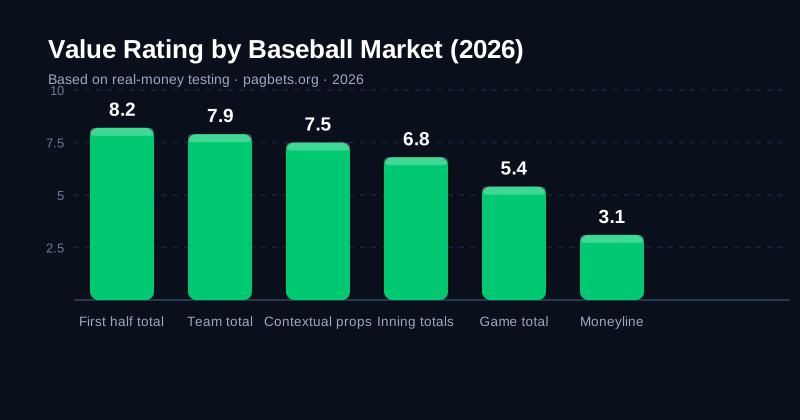
Focus on first and second half totals and team totals, which are less efficiently priced than the game total. Use player props only where you have a specific analytical reason. Avoid the moneyline unless the price is genuinely generous, because it is the most heavily bet market in the sport.
Where in-play baseball can work is the inning totals, which settle quickly and depend on public information — the score, the count, and the bullpen situation. The same caution about speed applies as in every other sport, and our in-play risk guide covers the discipline.
Record every bet over a full season rather than a week. Baseball form is noisy, and a hundred-bet sample across a few months tells you more about your approach than a hot fortnight does. Our journal guide explains how to structure that record.
- First/second half totals, better priced than the game total
- Team totals, bullpen quality is underpriced here
- Props with a specific reason, not narrative props
- Avoid the moneyline, the most efficient market in the sport
- Use ballpark factors, they matter more than most bettors allow
- Record over a full season, weekly results are noise
- Set limits with our tools guide
Park Factors and the Hidden Geographic Edge
A ballpark is not a neutral venue, and the effect is large enough to matter more than most bettors allow.
Every park has a park factor expressed either as a multiplier on runs scored or a run environment number. Yankee Stadium in New York runs well above average, while many pitchers parks sit below it. A team playing half its games in a hitter-friendly park has a materially different home run expectation than the same team on the road, and the total market accounts for this only partially.
The practical application is to adjust your own expectations before you look at the price. If a game is in a high-run park and the total sits at a league-average number, the over is probably short. If a pitcher is on the road in a run-suppressing park, the same pitcher will produce a lower total than his season number, and that adjustment is public information available well before game time.
Park factors also explain why a hitter with a strong home record is not necessarily a better hitter. A large share of that record comes from playing half his games in a favourable venue, and the effect inflates the number without inflating the ability. Our football guide makes the equivalent point about home advantage in a different sport.
Doubleheaders, Day Games and the Schedule Trap
The single most reliable source of value in baseball betting is the schedule context, and it is public information available at the moment the line opens.
Four situations reliably distort a price. A day game after a night game is a genuine physical disadvantage, because a player has travelled overnight. A doubleheader means two games in one day, and the second game starting pitcher and both bullpens are materially weaker than the odds suggest. A team in a scheduled off day loses the advantage of momentum, though the effect is smaller and less reliable.
A getaway day is the most underpriced of the four. A team playing its final game before travelling plays with less urgency and usually a weaker lineup, and a full lineup resting players is a meaningful change. These patterns are well known to sharp bettors and almost entirely ignored by the recreational player, which is precisely what makes them profitable.
The discipline is to check the schedule before anything else, and to treat a normal-looking price as suspect when the context is unusual. Our odds movement guide explains the same principle in the context of a market that has already absorbed a piece of news.
Building a Repeatable Research Routine
Baseball rewards routine more than it rewards insight, and a routine that takes twenty minutes before each game will outperform a complicated system applied occasionally.
The sequence that works is straightforward. Check the starting pitchers and their recent form. Check the bullpens for both teams, including who is available out of the bullpen. Check the park factor and the weather, since wind and temperature both move totals. Then check the schedule context for anything unusual.
Only after those four checks is it worth looking at individual props, and the props worth taking are the ones connected to the work already done. A relief pitcher facing a weak lineup is a direct consequence of the bullpen research. A batter facing a pitcher they historically struggle against is a direct consequence of the starter research. That is a coherent method rather than a collection of hunches.
Record every bet with the reasoning attached, and review the record monthly. Our journal method guide covers the structure, and it is worth being honest in the notes, because a bet recorded with a vague reason cannot be improved upon later.