
The Market That Rewards Numbers Over Drama
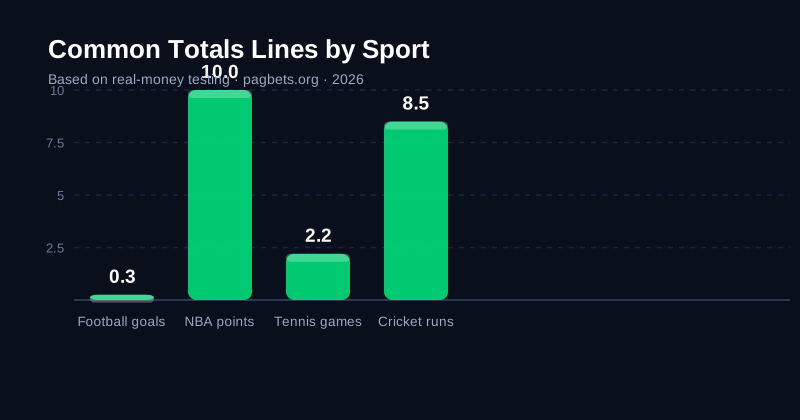
Over/under betting — also called totals — asks one clean question: will the combined score go over or under a line the bookmaker sets? In football it's goals (2.5), in basketball points (228.5), in cricket runs. Totals are the most strategy-friendly market in sports for one reason: the line moves on measurable data — expected goals, pace, defensive ratings — not on narratives. That makes it the natural home for research-driven bettors.

How the Lines Work: Halves, Wholes and Quarters
The half-goal is the standard: over/under 2.5 in football means 3+ goals is over, 0–2 is under, and no result pushes. Whole-number lines (3.0) refund your stake if the total lands exactly on the line. Quarter lines (2.75) split your stake across 2.5 and 3.0 — half the stake on each. Understanding this structure matters because the same "over 2.5" bet can cost different margins at different lines.
| Line type | Example | Exact landing |
|---|---|---|
| Half-goal | 2.5 | No push — win or lose |
| Whole | 3.0 | Stake refunded |
| Quarter | 2.75 | Half stake on 2.5, half on 3.0 |
Football Totals: The Expected Goals Engine
Football totals betting runs on expected goals (xG). The core inputs: each team's xG for and against over the last 6–8 matches, adjusted for opponent strength, plus situational factors — injuries to key attackers or defenders, weather (wind and heavy rain suppress scoring), and motivation (meaningless fixtures open up; relegation six-pointers tighten). Teams whose actual results diverge from their xG are the classic totals opportunities: an underperforming attack priced as if it will stay cold.
- Check each team's xG for/against over the last 6–8 matches
- Adjust for missing strikers, playmakers and central defenders
- Weather: rain and wind suppress totals — check the forecast
- Motivation: dead rubbers trend over, finals trend under

Basketball Totals: Pace and Defensive Rating
Basketball totals respond to two public stats: pace (possessions per game) and defensive rating. Fast-paced teams against weak defences push totals over; grind-it-out teams against elite defences push them under. The structural edges: back-to-back road games suppress totals (tired legs, less transition offence), and blowout risk suppresses fourth-quarter scoring. Our basketball guide covers the full framework.
Cricket Totals: The Pitch Report Is Everything
Cricket totals (match or innings runs) are dominated by one input: the pitch. A flat road produces 350-run ODIs; a turner produces 220-run grinders. The pitch report is public before every professional match, and the market prices it — but the market underweights the first-innings revelation: once the opening overs reveal the true surface, live totals markets lag the evidence. Read the pitch, watch the first five overs, then bet. See our cricket guide.
Live Totals: The Cash-Out Windows
Every goal, basket or wicket shifts the live total, and with it the cash-out value of your bet. The disciplined pattern: plan your cash-out points when you place the bet ("if the score is 2–0 at 60 minutes, I take the profit"), because in-play decisions made on emotion are how totals bettors give their edge back. Our cash-out guide covers the mechanics in depth.
Getting Started With Totals
Pick one sport, build the simple inputs above into a routine, and paper-trade ten totals before risking money. Open accounts at two bookmakers from our rankings so you can take the best line — a half-goal of line value is a real edge. Flat-bet 1–2% of bankroll, log every bet, and let the data do the arguing.