
Three Formulas Cover Everything
Odds calculators seem essential until you realise the entire tool is three formulas: one for returns, one for conversion, one for implied probability. Learn them by hand and you'll calculate faster than any app — and more importantly, you'll understand what the numbers mean while you're comparing prices across bookmakers. This guide walks through all three with worked examples, plus the expected-value formula that turns calculation into decision-making.

Formula 1: Returns and Profit
Decimal odds make returns trivial: return = stake × odds, and profit = stake × (odds − 1). A $30 bet at 2.50 returns $75 total — $30 stake plus $45 profit. The profit formula is the one that matters for comparisons: the same $30 at 2.40 returns $42 profit, so the 0.10 odds difference costs you $3 of profit. Run that comparison before every bet and the calculator has already paid for itself.

| Odds | $10 stake returns | Profit |
|---|---|---|
| 1.50 | $15.00 | $5.00 |
| 2.00 | $20.00 | $10.00 |
| 2.50 | $25.00 | $15.00 |
| 5.00 | $50.00 | $40.00 |
Formula 2: Converting Formats
Conversion is mechanical once memorised. Decimal → fractional: subtract 1 and simplify — 2.50 becomes 1.50, which is 3/2. Decimal → American: above 2.00, multiply by 100 and subtract 100 (2.50 → +150); below 2.00, −100 ÷ (odds − 1) (1.67 → −150). Fractional → decimal: divide and add 1 (6/4 → 1.5 + 1 = 2.50). In practice, set every bookmaker account to decimal odds and conversion disappears — the comparison across sites becomes one subtraction.
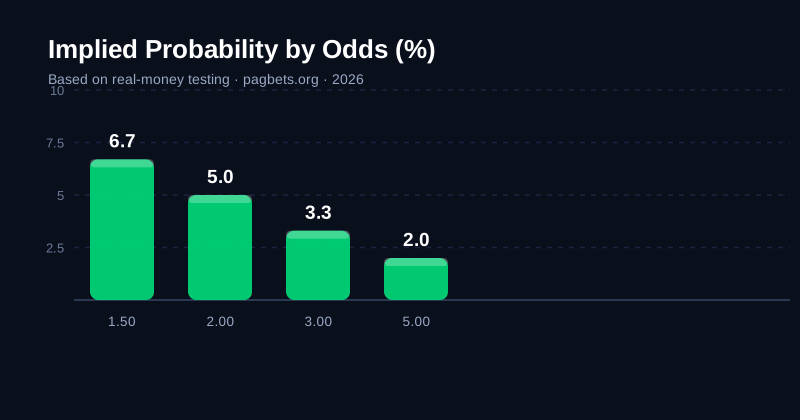
Formula 3: Implied Probability
Implied probability converts a price into the chance it represents: probability = 1 ÷ decimal odds, times 100 for a percentage. Odds of 2.00 imply 50%; 1.50 implies 66.7%; 4.00 implies 25%. The critical application is the margin check: add the implied probabilities of all outcomes in a market and the total always exceeds 100% — a two-outcome market priced at 1.95/1.95 implies 51.3% + 51.3% = 102.6%, so the bookmaker's margin is 2.6%. Lower margins mean better prices; the calculation takes ten seconds and is the fastest quality check in betting.
- 1 ÷ odds = implied probability (2.00 → 50%)
- Sum all outcomes' probabilities — the excess over 100% is the margin
- Margins near 4% are sharp for football; above 8% is expensive
- Compare margins across bookmakers before comparing individual prices
The Master Formula: Expected Value
Expected value turns calculation into decision: EV = (win probability × profit per win) − (loss probability × stake). A $100 bet at 2.50 with your estimated 45% true chance: (0.45 × $150) − (0.55 × $100) = +$12.50 — positive EV, a bet worth making. Negative EV, skip it. The formula requires an honest probability estimate, which is the entire skill of betting — our value betting guide teaches the estimation process in depth.