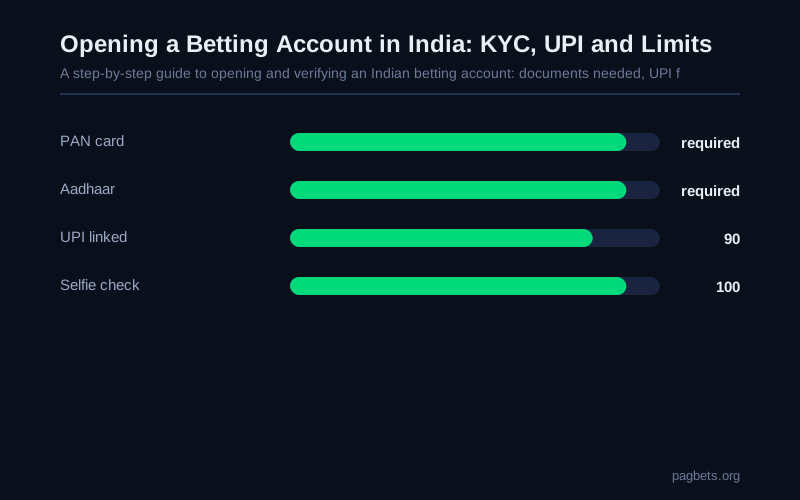
What Opening an Account Actually Involves
Registering a betting account in India takes about ten minutes and is much simpler than it might look. Verifying it properly, and confirming that it will pay out without friction, takes considerably longer and is where problems actually occur.
The four gates every account passes through are the same everywhere: sign-up with an email and password, identity verification, a first deposit through a supported method, and a first withdrawal. The first three are quick. The fourth is the one that tells you whether your chosen operator is real, and it is the one most people skip.
Most bettors open an account during a live cricket match, which is the worst possible timing for something that involves identity documents and payment routing. Open it in a quiet hour instead. Our first bet guide covers the rest of the setup, and and this article covers the account mechanics in depth.
Documents and What Gets Rejected
The table below is drawn from the rejections we have seen across operator support tickets. Address proof causes the majority of problems by a wide margin.
| Document | Accepted as | Typical rejection reason | Fix |
|---|---|---|---|
| PAN card | Identity + address | Blurry photo, glare on the card | Retake on a plain, matte surface |
| Aadhaar (digital / masked) | Identity + address | Masked Aadhaar rejected for address | Upload unmasked or pair with a bank statement |
| Passport | Identity + address | Expired, or photo page only uploaded | Check the expiry date before uploading |
| Driving licence | Identity + address | Address on the licence is old | Add a separate address document |
| Bank statement | Address | Older than 90 days, or not in account name | Request a fresh one from your bank app |
| Utility bill | Address | Not a recognised utility, or over 3 months old | Use electricity, gas, water or broadband only |
| Selfie / liveness | Identity match | Poor lighting, glasses, or holding the ID | Daylight, no hat, ID held beside face |
| UPI ID screenshot | Payment method | Name does not match the account | Use a personal UPI ID only |
KYC: Why It Exists and Why It Blocks Withdrawals
Know Your Customer verification exists because regulators require it, and it is the reason an unverified account cannot be paid out at all.
The legal position is simple: an operator that accepts money from a customer it has not verified carries a much higher risk of being used for fraud, money laundering or identity misuse. That risk is why licences in most jurisdictions require verification before withdrawal rather than before deposit. The practical effect for a bettor is that a balance on an unverified account is money you cannot access.
Verification normally has three parts: identity (who you are), address (where you live, with a recency requirement, usually within 90 days), and a liveness check confirming the person holding the document is the person in it. Address is where most rejections happen, because an Aadhaar or licence may carry an address from years ago.
Two practical warnings. First, submit one document at a time and wait for the confirmation before uploading the next, because a batch upload where one document is wrong usually fails the whole set. Second, take photos in daylight on a plain surface with no glare; the majority of rejected documents are not policy failures but photography failures. Our dedicated KYC guide walks through each document type.
Funding With UPI: The Part to Do Slowly
UPI is the natural choice for an Indian bettor, and it is fast, but the first deposit should be small and deliberate.
Make your first deposit Rs 100 or Rs 500, on a weekday afternoon, when no cricket match is live. You are testing three things: whether your bank approves the payment, whether the operator credits it instantly or routes it slowly, and whether the deposit shows up against the right name. Doing this in a quiet moment means any failure is information rather than frustration.
Deposits through Google Pay, PhonePe and Paytm are usually instant on a ledger route. Some operators route larger amounts through a nodal bank account, which takes hours. Neither is a problem; both are things you want to know before an IPL match rather than during one. Our full UPI betting guide covers the routes and timings in detail, and our Paytm and PhonePe article compares the two apps on real test data.
Also set your bank UPI limits before you need them. If you have never opened that screen in your banking app, your per-transaction cap is probably a few thousand rupees, which will surprise you at exactly the wrong moment.
Limits: Set Them Before You Fund the Account
The most useful thing you do in the first ten minutes of having an account happens before you deposit anything, and almost nobody does it.
Every reputable bookmaker provides deposit limits, loss limits and session or time limits in the account settings, usually under a responsible gambling or account management heading. A deposit limit caps how much you can add in a period; a loss limit caps how much you can lose in a period; a time limit logs you out automatically after a set duration. Setting them at the moment of a losing streak is far too late, which is exactly when most people think about it.
Set them on day one, while you are thinking clearly, and pick values you would not renegotiate in the moment. A loss limit tied to a fixed weekly amount is more robust than a percentage of your balance, because a balance-based limit rises exactly when you have lost and falls exactly when you have won, which pushes in the wrong direction on both counts.
Our guide to betting limits covers how each type works and why the weekly loss cap is the most useful one. The responsible betting tools guide covers what to do when limits are not enough.
Choosing a Site Before You Register, Not After
The account mechanics are identical across operators. What differs enormously is whether the operator you are registering with is genuine, and that is worth checking before you type your card details rather than after.
Our specific concern for Indian bettors is the affiliate problem. A large share of signups in this market arrive through an affiliate link or a paid advert, and affiliates are paid on deposits, which gives them no incentive at all to care whether you withdraw successfully. Some of them are honest and rate operators on payout behaviour. A significant number are not, and a meaningful proportion of the sites they promote are short-lived operations that process a few deposits and never process a withdrawal.
The checks that catch this are all free and all quick. Confirm the licence number on the regulator register rather than on the site itself, which our gambling licences guide covers. Read the withdrawal terms and look for a named processing schedule rather than a range. Check whether the site lists a restricted-countries entry for India, since an operator that openly geo-blocks India and also runs India-targeted advertising has told you something about how it handles obligations. Our rating method sets out the weighting we apply.
Two red flags worth naming specifically. A bonus with a wagering requirement above 40x on a sportsbook is one you should decline rather than work through, because the expected value is heavily negative. And a withdrawal fee described only as an administrative charge, with no amount, is a site that will find reasons to charge you more than you expected.
The Test Withdrawal Is Not Optional
Before you place a bet worth more than your monthly grocery, make a small withdrawal and see what happens.
This is the single highest-value habit in Indian betting, and almost nobody follows it. A withdrawal on a fresh, verified account tells you several things at once: whether the operator pays, how long it takes, whether your UPI ID or bank account is accepted, whether your name matches, and whether the stated fee was honest.
Operators that pass this test are rare enough that running it is worth the fifteen minutes. Operators that fail it include those with no visible processing schedule, those that charge a withdrawal fee larger than a realistic first deposit, and those that convert cash withdrawals into bonus credit with a wagering requirement attached.
Do the test early, while a failure costs you Rs 500 rather than Rs 50,000. Our guide to choosing a bookmaker covers the other checks worth running, and the fast withdrawals guide sets out realistic timeframes.
The Legal Position, Briefly and Honestly
Opening an account with an offshore operator serving Indian customers sits in a complicated legal space, and it would be dishonest to pretend otherwise. Wagering on money with a bookmaker is prohibited in the large majority of Indian states under the Prevention of Gambling Act, 1867 and the state acts that never repealed it, and the 2025 Online Gaming Act reinforced that at the federal level while adding specific offences around promotion and facilitation. UPI will happily process your payment, but payment rails are neutral conduits and always have been. Our guide to state-by-state betting law covers the position in full. We describe how to open an account safely and how to avoid fraud; we cannot tell you it is legal where you live, and anyone who does is guessing.
A Day-One Checklist
Six steps, in order, that together take about an hour and remove almost every preventable problem.
- Register with your real details. Real name, own email, own phone. A nickname here will cause a payout refusal later.
- Complete KYC before depositing. PAN or passport for identity, a fresh bank statement for address, a daylight selfie.
- Set deposit, loss and time limits in the account settings while you are thinking clearly.
- Deposit Rs 100 via UPI off-peak and time how long the credit takes.
- Withdraw Rs 100 or 500 and confirm it arrives. Record how long it took and what it cost.
- Only then play. If the round trip works, the account is real and you know its timings.
What to Do When Verification Fails
Verification rejections are common and mostly fixable, and the right response is to fix and resubmit rather than to abandon the account and open another one.
Read the rejection reason if the operator gives one. Most support teams do, and the reason usually maps directly to a fix from the table earlier in this article: an out-of-date address document, a blurry image, or a name mismatch. Resubmit with the corrected document and keep the reference number of the first submission.
Do not open a second account on the same operator to work around a rejection. Duplicate accounts are a standard trigger for an account review and for withdrawal refusal, and operators share fraud data across brands. If you genuinely have two accounts by mistake, contact support and ask for one to be closed rather than funding both.
If the operator stops responding after a rejection, that is itself the answer, and it belongs in your decision about whether to use them at all. Our guide to spotting fake betting sites covers the escalation pattern to watch for, and our complaints policy explains what we do when a listed operator does not respond.
The Bottom Line
Opening a betting account in India is easy. Registering accurately, verifying cleanly, funding through UPI in your own name and confirming that the operator pays are the parts that decide whether the experience is a good one.
Do all four in the first hour, in the order above, before a single bet is placed. If an operator passes the Rs 100 round trip and pays without argument, you have learned more about them than any review can tell you.