The World's Biggest Cricket Market
India is cricket betting's global capital — IPL season produces the deepest cricket markets on earth, and international bookmakers compete hardest for Indian players. The legal picture is the market's defining complication: betting law is mostly state-level, only a handful of states license operators, and most Indian bettors use internationally licensed offshore sites — a patchwork where your position depends on your state. This guide covers the reality, the rankings and the payments, honestly.

Our India Rankings 2026
Weighed for Indian players — cricket depth, payment access and withdrawal reliability:
| Rank | Bookmaker | Why it suits Indian players |
|---|---|---|
| 1 | 1xBet | Deepest IPL/cricket markets, crypto + e-wallets |
| 2 | 22Bet | 200+ cricket markets, UPI via aggregators |
| 3 | Bet365 | Sharpest odds + streaming, most trusted brand |
| 4 | Melbet | Strong bonus, deep cricket coverage |
| 5 | Mostbet | UPI support, Aviator popularity |
| 6 | Stake | Best crypto rails, instant withdrawals |
Payments: UPI, Crypto and the Practical Routes
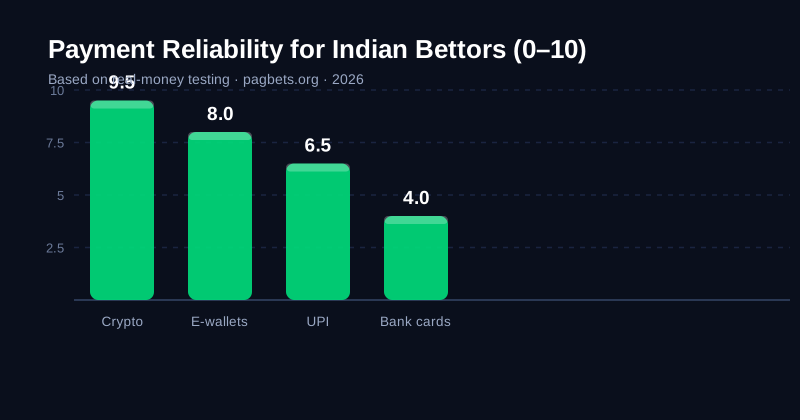
Indian payment access ranks as follows from our testing. Crypto is the most reliable — deposits and withdrawals settle fast without Indian banking friction. E-wallets (Skrill, Neteller, AstroPay) are the traditional route and widely supported. UPI appears at several operators through aggregators — the most convenient method for Indian bettors where available, but subject to availability changes. Bank cards work for deposits but are the slowest withdrawal route. The practical pattern most Indian bettors converge on: UPI where supported, crypto where it isn't.
Cricket Coverage: IPL and Beyond
Indian betting revolves around cricket, and the market-depth question matters: 1xBet and 22Bet post 200+ markets per IPL match including session betting, toss and player props; Bet365 offers the sharpest prices and streams; Melbet and Mostbet sit between. Beyond the IPL, the same sites cover internationals, BBL and domestic competitions. Our IPL strategy guide and cricket rankings go market-by-market.

Safety Habits for Indian Bettors
The offshore reality adds risk management responsibilities: verify every licence at the regulator (our routine), start with small deposits until the first withdrawal completes, prefer crypto for both directions, and withdraw regularly rather than holding large balances offshore. These four habits convert the format's risks into manageable ones — and they're the same rules we apply in our own testing.
Related reading: our Paytm and PhonePe for Betting guide covers the same ground from a different angle.
Why the Payment Method Matters More Than the Odds
In the Indian market the binding constraint on an operator is rarely the odds, and it is almost always how money moves.
UPI is the rail almost every Indian player uses, and an operator that does not support it is not really in the market regardless of what its sportsbook offers. Card deposits are the fallback and they fail in a specific way: a pre-authorisation that works at one operator is declined at another, usually because the bank applies its own gambling policy. Our the payment methods guide covers how each route settles, and the Paytm guide covers the Indian apps specifically.
The State-by-State Picture Is Less Settled Than It Looks
The headline position in India is that gambling is not permitted at the federal level and several states have their own rules, which is true and less useful than it sounds.
The practical position for an individual in 2026 is that the federal prohibition on gambling is enforced unevenly, several states regulate specific games, and the interaction between them is not settled. What this means in practice is that the legal exposure sits with the player rather than the operator, and that a player treating the position as clear-cut is relying on a simplification. Our the state-by-state guide covers what each state actually does, and the Pakistan comparison covers the neighbouring position.
Tax and Deductions on Indian Betting Winnings
India's position on taxing betting winnings is unusual in one specific respect: for most casual bettors there is nothing to pay. Individual gains from casual betting are not chargeable under the head used for professional income, and the distinction between casual and professional turns on frequency, size and intent rather than on profit alone. Someone with a handful of cricket bets a season sits well outside the professional definition; someone treating it as income is the case the system was written for.
The complication is that winnings at offshore bookmakers arrive as a balance rather than a salary, and nobody deducts at source. That does not make them untaxable; it makes the assessment the player's responsibility, and for the large minority of winnings above the professional threshold it is a real liability. Our tax on winnings guide sets out how the thresholds work in the jurisdictions where one exists.
The practical consequence for Indian bettors is bookkeeping rather than filing. Deposit records and per-bet statements from your bookmaker are the evidence, and because most operators produce a full export on request, the cost of keeping them is a monthly five-minute exercise. A player withdrawing at a crypto-first bookmaker and converting to rupees should record the rupee value on the withdrawal date rather than the stake date, because that is the figure any computation would use.
Where tax does apply, the operator usually withholds at a stated rate on withdrawal above a threshold, and the receipt is the document that matters. Several Indian-facing operators withhold at 10 or 20 percent depending on the amount. Our rating methodology treats published and honoured tax treatment as part of the trust category for exactly this reason: an operator that withholds clearly is telling you something about how it handles obligations it would rather avoid.
A word of caution on the thresholds themselves: they have moved more than once, and the professional-versus-casual distinction is judged on conduct as much as on amounts. A player who wins occasionally and withdraws normally has a materially different position from one who runs systematic volume. Our fake betting site guide is unrelated to tax but is the first routine we would run before depositing at any offshore operator.
Comparing Prices Across Indian-Facing Bookmakers
Indian bettors have an unusual advantage: the bookmakers serving them price the same cricket matches very differently. IPL match-winner markets at 1xBet, 22Bet, Bet365 and Melbet can differ by three to five percentage points in implied probability, which is far more than the spread between the same operators in European football. That gap is not a rounding difference or a stale feed — it reflects different risk exposure and different customer mixes.
The practical method is to check two books before every significant cricket bet rather than one. Compare the best available price on the market you actually want, not the headline match-winner price, because margins differ by market and the worst-priced market is usually a popular one. Our margin guide shows how to convert three prices into a single comparable number, and the conversion takes about twenty seconds per match.
On a 10,000 rupee stake at three percentage points, the difference in expected return is 300 rupees per bet. Add that across twenty cricket bets a week and the annual figure is meaningful, which is why we give odds quality a 25 percent weight in our methodology. The uncomfortable part is that the sharpest book in cricket is rarely the one with the biggest bonus, so price and promotion pull in opposite directions.
Our value betting mathematics guide covers how to tell whether a price difference is an edge or simply two books disagreeing, and it is worth reading before treating any gap as free money. A five percentage point difference on a market where both books are wrong by three points is not value; it is a transfer from whoever reads that match better than the assumption allowed for.
Time the comparison to a fixed point. Opening odds, prices an hour before the match and prices at the toss can differ by more than the gap between two operators, which is why a price recorded at kickoff is the only one you can compare honestly. Record the timestamp alongside the number, and our margin guide explains why the arithmetic is meaningless without it. Our value betting guide covers the full method.
Betting From a Phone on Indian Networks
The Indian betting market runs on a payment rail that barely touches the app, which is exactly why the app quality matters more than the odds. UPI handles money in seconds, so the bettor is spending far more of their time inside the sportsbook interface than inside a banking app. A bettor placing twenty bets a week loses more to a sluggish bet slip than they gain from a tenth of a point on one of them.
That is why we weight the interface separately in our testing. On a mid-range Android handset — still the majority of Indian devices — the practical differences between operators are loading time on the live markets, whether the bet slip survives a screen rotation, and whether a failed odds request produces an error or a silent no-bet. Those three failures generate the complaints that arrive at our inbox most often from this market, and none of them appear in a marketing comparison.
Our mobile betting guide covers the platform differences, and our casino app rankings cover the same ground for the game lobby where Aviator-style titles dominate. One Indian-specific point deserves emphasis: an app that caches odds while offline and then submits them on reconnect is a genuine hazard rather than a convenience, because the bet is accepted at a price you never saw. Our live betting guide covers what a suspended market should do.
There is also a tax angle nobody mentions on the app side, and it is simple. UPI settles in rupees, crypto settles in dollars, and an account that mixes both holds two balances that have to be reconciled before a withdrawal. Our payment methods guide covers why keeping one currency per account is worth more than the convenience of switching. Choose the account currency once, at registration, and leave it there.
One feature genuinely changes the mobile experience and is worth looking for: bet slip persistence, meaning an interrupted request is recoverable rather than lost. Operators that build for high-volume markets increasingly ship it, and those that do have fewer support tickets about vanished bets than their support volume would predict. Our casino app rankings apply the same test to the game lobby.
✓ What We Like
- Tells you how to check a licence rather than asking you to trust one
- Covers the payment problem that decides whether the product is usable for you
- Explains the tax structure, which is the part that sets the price
- Uses named regulators, laws and figures rather than general description
✕ What Could Improve
- The cheaper alternative is unprotected, and the article is honest about that
- A limit or ceiling constrains how much you can actually stake