The Decision That Shapes Every Bet
Your bookmaker is the foundation of every bet you'll place — the odds you get, the speed you're paid, the limits you face. Most bettors choose by bonus size and marketing. This guide offers the alternative: the eight-step checklist our testing team uses, in order of importance, distilled from auditing 100+ operators with real money.
Step 1: The Licence (Non-Negotiable)
Everything else is downstream of the licence. A UKGC or MGA licence means a regulator exists who can force payment; a Curacao licence is legal but offers thinner protection; no licence means no recourse at all. Verify the licence at the regulator's register — never on the bookmaker's own page, where fake badges live. Our fake-site guide has the full verification routine.
Step 2: Odds and Margin
Odds quality compounds over every bet you place. The measure is margin: the gap between the implied probabilities of a market and 100%. In our 2026 audits, Bet365 ran 3.8% margins on major football, the industry average sat near 4.5%, and niche markets exceeded 8%. A one-point margin difference on $10,000 of annual turnover is $100 of expected value — for zero effort beyond choosing the right site. Our odds guide explains the calculation.
Step 3: Payout Speed and Methods
Winning feels different when the money arrives the same day. Our measured withdrawal times: crypto 40 seconds (Stake), e-wallets 6–24 hours, PayPal 18–48 hours, cards 1–5 days. Match the methods to your habits — if you deposit by card but withdraw by crypto, both must be supported. The full measured table lives in our payment guide.
Step 4: The Bonus, After the Maths
Evaluate bonuses by real value after wagering, never by headline size. A 125% bonus with 35x wagering on deposit+bonus is often worse than a 100% bonus with 25x on bonus only. Calculate the expected cost to clear, check the maximum-bet rule and time limit, and only then compare. Our bonus guide teaches the full arithmetic in ten minutes.
Step 5: Markets and Features You'll Actually Use
The deepest sportsbook is useless if it lacks your sport. A cricket specialist needs 150+ markets per match (1xBet, 22Bet); an esports bettor needs proper CS2 and LoL coverage (Betway); a streamer needs live streaming (Bet365 leads). List the three features you genuinely use — streaming, cash out, bet builder, specific sports — and check each before depositing.
- Your sports covered with real depth, not token markets
- Live streaming if you bet in-play
- Cash out and bet builder if you use them
- Mobile app quality if you bet from a phone
Steps 6–7: Support and App
Support: test live chat before depositing — one real question, timed. Sub-two-minute responses with real answers indicate an operator that takes customers seriously; a webmail-only address is a warning sign. App: the app is where most betting happens. Check stability ratings, test the bet slip speed, and confirm the app matches the desktop feature set — some operators quietly trim features on mobile.

Step 8: Fit — The Step Everyone Forgets
The final check is personal: does the site fit how you actually bet? A bonus hunter's ideal site differs from a streamer's. Most experienced bettors settle on two or three accounts — one tier-1 operator for trust and sharp odds, one for depth or crypto, one specialised for their sport — and compare prices before every bet. Start with our rankings, where all eight checks are already run, and verify the licence yourself for anything else.
Red Flags That End the Evaluation Immediately
Several problems disqualify a site before the checklist matters, because each one requires you to trust the operator's own words. A licence badge with no number, or a number that does not resolve on the regulator's register. Withdrawal requests that ask for a 'verification deposit' larger than your balance. A bonus that must be wagered before your first withdrawal rather than after. Affiliate-style landing pages impersonating a known brand with a lookalike domain. None of these are edge cases in our reviews; each has been seen repeatedly across cloned sites.
Two softer flags deserve a second account and a small deposit rather than abandonment. Support that takes more than a day to answer a pre-deposit question about minimum stakes. And a sportsbook whose margin on your sport sits 3–4 points above the best price in the market, on the excuse of a feature you do not use. We weight all of this explicitly in our ratings methodology, and none of our ranked sites carry an unresolved flag.
Testing Payout Speed Yourself in 48 Hours
Payout speed is the claim most often exaggerated and the one most easily tested without gambling. Put a small amount in — £20 is enough — and request a withdrawal to a method you would genuinely use. Time it from click to arrival, and time the KYC separately, because a fast payout after a slow verification is still a slow payout. Our measured results: crypto 40 seconds, e-wallets 6–24 hours, PayPal 18–48 hours, cards 1–5 days.
Run the test on the method you would actually withdraw to, not the fastest available. A site that pays instantly to a new e-wallet and takes four days to a bank transfer has told you how it will feel on a bad day. The full measured table, including which operators reverse fees on small withdrawals, is in our payment methods guide.
Two Accounts, Not Five: Managing Multiple Bookmakers
The FAQ advice is two or three accounts, and the failure mode is always the same: opening a fourth for a promotion, then losing track of balances, verification states and bonus expiry dates. The workable system is one account per function, funded on a fixed date each month rather than per bet. Sharp odds at one tier-1 operator, depth and props at a second, and a third only if you have a genuine specialism.
Give each account a job and stop using it for anything else. The cost of a spare account is not the deposit — it is the mental overhead of five different bet slips and five support relationships. Two accounts, one spreadsheet comparing prices, and a rule that any price difference under 0.05 is not worth the click. The live-market arguments for holding a second account are in our cash out guide.
When the Sharpest Site Is the Wrong Choice
A 0.3% margin advantage is worth having only if you will actually use the product. If you bet once a week on a mobile, the deciding factors are app stability and a bet slip that does not lose your selections, and a mid-tier site with a smoother app will beat a sharper competitor you abandon after two mis-taps. The same logic applies to streaming: if you watch the match and bet from the same screen, streaming quality is worth more than four-tenths of a percent.
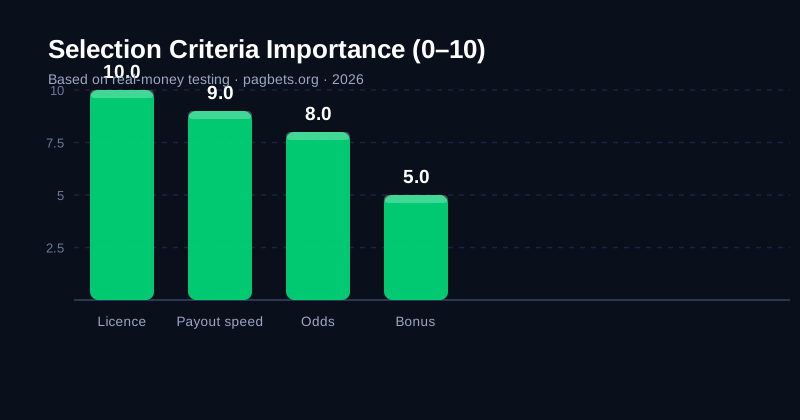
Honest ranking: licence first, then payout speed to the method you use, then the features you will genuinely open, then odds. Most bettors put odds first and end up with a marginally cheaper bet made through a site that frustrates them into fewer bets — which is the wrong trade. The scoring that reflects this ordering is in our ranked sites, where the tools in our limits guide are a scored criterion too.
The Order of the Checklist Matters More Than the Items
Most bettors check the promotion first and the licence last, and that ordering causes most of the problems.
The licence comes first because it determines whether anything else matters. Then the withdrawal test, because it is the only irreversible risk in the relationship. Then the margin, because it compounds on every bet. Then the product, because it is what you will actually use. The promotion is last and it is last because a bonus at a licensed operator with fast payouts is worth more than a larger bonus at one without.
Our the licences guide covers the first step and how we rate bookmakers covers the full sequence.
✓ What We Like
- Tells you how to check a licence rather than asking you to trust one
- Covers the payment problem that decides whether the product is usable for you
- Explains the tax structure, which is the part that sets the price
- Uses named regulators, laws and figures rather than general description
✕ What Could Improve
- A limit or ceiling constrains how much you can actually stake


