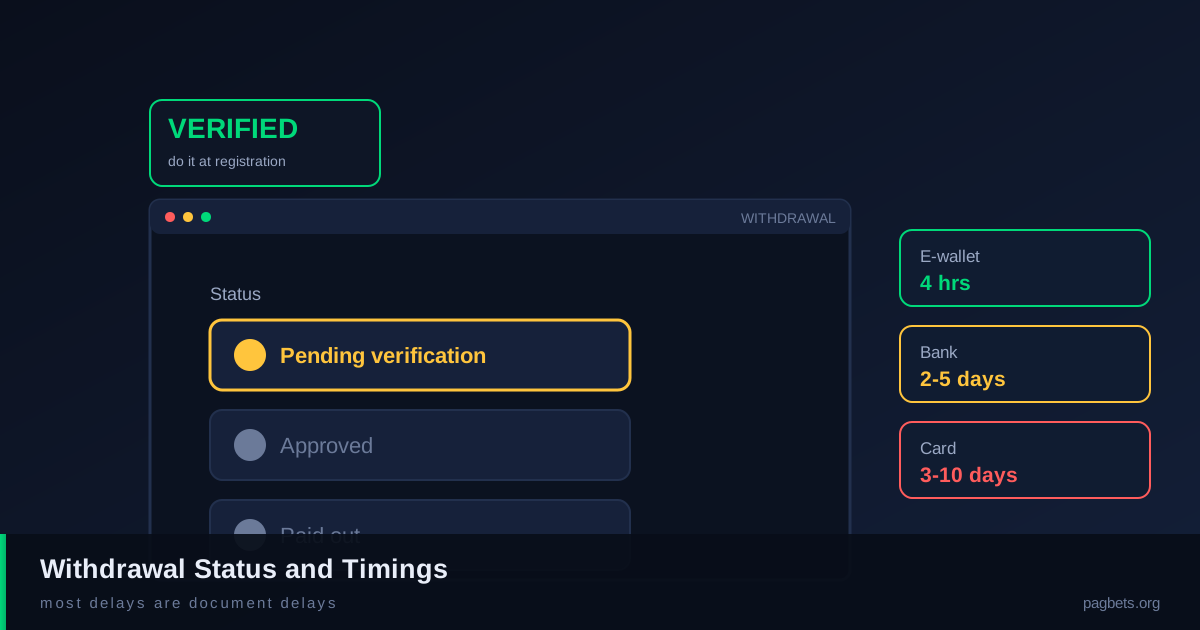
Most Delays Are Verification, Not Processing
When a withdrawal takes days, the instinct is to blame the payment provider. In practice the provider is rarely the problem.
The far more common cause is that the account is not fully verified, so the operator cannot legally process the payment and is waiting for a document. The player sees a pending status and assumes a queue. It is usually a missing photograph of a card, an address document older than ninety days, or a name that does not match the account name.
All of that is preventable before the withdrawal is ever requested. Our the KYC guide covers exactly what to upload.
Withdrawal Time by Method
These are typical ranges for a fully verified account at a reputable operator.
| Method | Typical time | Notes |
|---|---|---|
| E-wallet (Skrill, Neteller, PayPal) | 1 to 4 hours | Usually the fastest |
| Instant banking | 1 to 24 hours | Not offered in every market |
| Mobile financial service | 1 to 24 hours | Regional, account name must match |
| Debit card | 3 to 10 days | Often deposit-amount only |
| Bank transfer | 2 to 5 working days | Safe, reliable, slower |
| Crypto withdrawal | 10 minutes to 24 hours | Network fee and confirmation time |
| Unverified account, any method | Add 2 to 7 days | Often indefinite |
What Speeds a Withdrawal Up
Four things, all of them free, and all of them best done before you ask.
- Complete verification early. Upload identity and address documents before your balance grows, not after.
- Use the same method you deposited with. Operators are markedly faster when the withdrawal method matches the deposit method, and mismatches are a common trigger for a review.
- Do not change payment details mid-session. This is a standard anti-fraud signal.
- Withdraw during business hours. A request made at the weekend may not be actioned until Monday, which looks like a delay and is not one.
The Name Match Rule
The single most common reason a withdrawal is rejected is a name mismatch. The name on the bank account, the e-wallet account, the crypto wallet and the casino account must all be the same. A withdrawal to a family member account is refused at most operators, and a change of surname after verification requires fresh documentation. Check this before requesting rather than after, because a rejected request adds days and, at some operators, triggers a review.
The Triggers That Cause a Review
Every operator has automated rules about which payments get looked at by a person, and knowing them helps.
The common triggers are a first withdrawal above a threshold, a withdrawal method that has not been used before, a bonus being active with a requirement not yet cleared, a large ratio of deposit to play before cashing out, and any request shortly after a failed payment. None of these mean wrongdoing. They mean a human will look, which takes one to three days.
The behaviour that most reliably avoids a review is boring: deposit normally, play normally, withdraw to the method you used. Our the fake sites guide covers the operator evaluation side, and the payment methods guide covers choosing the method in the first place.
Why Withdrawal Speed Is a Legitimacy Signal
It is worth treating fast, reliable withdrawals as a criterion rather than a convenience.
An operator that takes four days on an e-wallet for a verified account is telling you something about how it is run. A licensed operator publishes its processing times and is required to meet them. An unlicensed one publishes nothing and meets nothing, and a delayed withdrawal is frequently the first symptom of an operator that is already in difficulty.
Our how we rate bookmakers covers the testing method behind our scoring, and how to choose a bookmaker covers the practical checklist.
Fees, Minimums and Limits
The cost side is as important as the time side, and it varies a great deal.
Typical withdrawal fees run from nothing to around 2 percent on cards, more on some e-wallets, and a flat network fee on crypto. Minimum withdrawal amounts commonly run between 10 and 30, which matters most for small balances because a 30 minimum on a 20 balance is money you cannot get out. Maximum limits are usually far higher than deposit limits, so a large win is rarely the problem.
One structural difference is worth knowing: some operators will only return a card withdrawal to the original deposit amount, with the rest paid by another method. That catches people out regularly. Our the payment guide covers the differences method by method.
A Practical Routine
Speed is decided before you request the money.
- Verify the account as soon as you register, while nothing is at stake.
- Deposit using one method and keep using it.
- Clear any bonus requirement before withdrawing, or expect a review.
- Check the minimum withdrawal, fees and any deposit-amount restrictions before choosing a method.
- Request during business hours and use the fastest available method for your balance.
- Never change the payout account to something new at the moment of request.
What to Read Before Requesting
Our the KYC guide covers document preparation, and the security checklist covers the account setup that prevents most problems. Between them, they remove almost every cause of a delayed payout, and both take fifteen minutes at registration rather than an afternoon at withdrawal.
Our payment methods guide covers how each method behaves on withdrawal, which differs noticeably between a local wallet and an international e-wallet.
Why Processing Times Are Published and Often Misleading
An operator that publishes a two-day processing time is stating a target, and a good operator also states the median actual time.
The gap between them is where the real experience lives. A one to three working day figure usually describes the queue for a fully verified account with no complicating factors, and the median is closer to the top of that range than the bottom for anything above a few hundred.
What changes the figure most, in order of magnitude, is verification status, then whether the withdrawal method matches the deposit method, then the amount relative to the account history, then the day of the week. None of those are under the operator's control in a way that should produce a long delay, and an operator that is consistently slower than its published figure on simple requests is a warning sign about how it is run.
Our how we rate bookmakers covers the testing method, and the security checklist covers what to verify before depositing rather than after.
The Partial Withdrawal Trap
Most operators allow a partial withdrawal, and it is routinely used in a way that quietly costs the player money.
The mechanism is a wagering requirement. Withdrawing part of a balance usually means the remaining balance keeps the requirement attached, so the player gets some money now and still has turnover to complete before getting the rest. A player who withdraws fully, where the operator allows it, gets the money and closes the requirement.
The practical consequence is that a partial withdrawal is usually a worse deal than a full one unless the immediate need is genuinely urgent, because the requirement continues to run on the remainder. It is worth checking the terms on the specific operator rather than assuming, since implementations differ.
Our the wagering guide covers how requirements attach to a balance, and cash out strategy covers the related in-play version.