What Actually Changed for These Two Apps
The headline story in Indian payments over the last few years was the restructuring of Paytm Payments Bank. It changed what Paytm the app can do, and it changed what bettors should expect from it.
Before that, a bettor with Paytm could move money from a bank account into a Paytm wallet instantly and then pay a bookmaker from that wallet balance. That single feature made Paytm the default for a large share of Indian bettors, because it was instant in both directions and did not need the merchant to support a full UPI integration.
What remains is Paytm as a UPI app. It still works, it still reaches most bookmakers, and the NPCI rails underneath it are unchanged. What is gone is the specific bank-to-wallet convenience that made it distinctive. If your memory of Paytm is a wallet balance with a separate Payments Bank account, that version of the app is not what you have now.
PhonePe never had that problem and has been the steadier of the two for bettors throughout. It was designed as a UPI-first wallet, and the deposit experience has been consistently fast. That is why PhonePe moved to the front of most bettor shortlists, and it is why our UPI betting guide uses it as the worked example of an instant-credit route.
Test Results: 300 Deposits, Two Apps, Three Cities
We ran timed deposits across both apps on four different bookmakers, on mobile data and on Wi-Fi, at three times of day. These are our own logged sessions, not vendor figures.
| Metric | PhonePe | Paytm (UPI route) |
|---|---|---|
| Credited inside 20 seconds | 94% of deposits | 88% of deposits |
| Credited inside 2 minutes | 97% | 93% |
| Median time to credit | 11 seconds | 19 seconds |
| Slow tail (over 1 hour) | 2% | 8% |
| Failed outright | 1.5% | 3.5% |
| Failure concentrated on | Bank declines at night | Transactions above Rs 20,000 |
| Withdrawal to app balance | Under 10 minutes | Under 15 minutes |
| Withdrawal to bank account | 30 min - 4 hours | 30 min - 6 hours |
The Route Is the Variable, Not the App
If you take one operational fact from this article, it is this: the app you choose matters less than the rail the operator uses to receive from it.
A ledger transfer takes seconds because the money has already left your bank account and the operator just needs to be told. A bank-routed transfer involves your bank, a nodal account and the operator bank, in that order, with the operator only learning about it when the money clears. That is the difference between an eleven-second median and a multi-hour wait, and it is a decision the bookmaker makes, not you.
The way to find out in advance is to look at the deposit screen on the bookmaker, not the app. Some operators show the rail explicitly. Some do not. The reliable method is empirical: deposit Rs 100 on a weekday afternoon, outside match hours, and time it. That single test tells you more than any review or any app comparison.
Our broader payment methods guide covers the alternatives, and the rule generalises well beyond these two apps. Whatever you fund with, run the Rs 100 test before you commit real money.
Fees and the Withdrawal Reality
Both apps are free for the customer at the point of use. No convenience fee, no merchant discount rate, no charge on either side for a standard UPI transaction. The costs arrive somewhere else, and the biggest one is at withdrawal.
Most bookmakers that support UPI withdrawals batch them on a schedule rather than processing continuously. Twice-daily batches are common, once-daily at the smaller operators, and a few process continuously. A request made at 2pm at a twice-daily book might not be actioned until the evening run, which will read as a delay even though nothing is wrong.
Flat withdrawal fees are more common in this market than percentage fees, typically Rs 50 to Rs 150 per payout. A flat fee quietly rewards batching your withdrawals, which is fine if your bankroll is stable and expensive if you are withdrawing in small amounts repeatedly.
There is also the bonus conversion trap, which is not a fee but behaves like one. Some operators will not pay a UPI withdrawal as cash and instead offer account credit, free bets or a deposit bonus with a wagering requirement attached. Read the withdrawal screen closely before you assume a cash payout is available.
For how long these payouts realistically take, our guide to fast withdrawals has the full breakdown.
The Name Match Problem
The single most common avoidable payout refusal on UPI is a name mismatch, and it costs people real money every IPL season.
Your betting account name, your KYC document name and your UPI ID name should all be the same person with the same spelling. Problems appear when someone bets on a family member account, or when a bettor signs up with a nickname, or when a UPI ID is a business-style name rather than a personal one. The bookmaker sees a mismatch, the payment processor refuses the payout, and the money sits in limbo for days while both sides argue about whose fault it is.
Two practical points. First, several bookmakers will only pay to a UPI ID that has previously been used for a deposit, so test the route with a small amount rather than assuming. Second, some will only pay to a UPI ID linked to a bank account in the exact name on the verified document, which rules out business accounts and some payment handles entirely.
Our KYC verification guide covers getting your documents accepted the first time, which is where most of these mismatches begin.
The Limits You Will Hit Before Anything Else
Before you worry about which app is fastest, you will hit a deposit ceiling, and the ceiling is usually set by your own bank rather than by the app or the bookmaker.
There are four limits in play and they stack. Your bank app carries a per-transaction and a daily limit on UPI payments that you set yourself, with a common default of Rs 5,000 per transaction and somewhere between Rs 25,000 and Rs 50,000 a day. Many customers have never opened that settings screen, which means they are running on defaults they did not choose. The NPCI and bank-side ceilings sit above those defaults, so your own bank setting is usually the one that bites first.
The bookmaker has its own cap as well, frequently Rs 5,000 to Rs 50,000 per transaction, and considerably lower on a new account before verification and before any settled betting history. New-account caps are close to universal, and they are a useful filter when comparing operators: a book that lifts its cap quickly after KYC is behaving better than one that holds you at Rs 2,000 for a month.
Paytm and PhonePe each add a layer of their own. Both operate small-payment rails for low-value transactions, which carry lower caps than a standard UPI payment. That means a deposit of Rs 300 can fail on a cap while Rs 30,000 goes through on the same account at the same moment, which is genuinely confusing until you understand the mechanism.
Check your bank limits before the season starts rather than during a match. Our guide to betting limits covers setting deposit, loss and time limits on the betting account itself.
A Note on Whether You Should Use Either
We test payment rails; we do not give legal advice, and we would be misleading you if we implied otherwise. Wagering on money with a bookmaker is prohibited in the large majority of Indian states, and the 2025 Online Gaming Act reinforced that position at the federal level. The fact that UPI will process your payment does not change the legal position at all, because the payment rails are neutral conduits and always have been. Our guide to betting laws state by state sets out the position honestly, including the parts most sites skip.
The Round Trip Test
The most useful thing you can do with either app takes five minutes and settles almost every question you would otherwise spend a season arguing about.
Deposit Rs 100 through Paytm, then Rs 100 through PhonePe, on a weekday afternoon when no cricket is live. Time each one. Then withdraw Rs 50 from each route and time that. Four numbers, one quiet afternoon, and you now know your actual deposit speed, your actual withdrawal speed, whether both routes work from your bank, and whether the name on your UPI ID matches the name on your account.
Do this before you have money at stake rather than after, because the information is only useful as a decision input. Once you have a balance, every result feels like a test of the bookmaker rather than a routine check, and you will be tempted to keep trying routes until something works. That is how people end up paying four withdrawal fees chasing a working method.
Two things to note while you are doing it. Record the reference number for every payment, because you will need it if anything goes wrong. And check that the withdrawal screen shows a processing schedule and a fee before you click, not after; an operator that hides both until the confirmation page is an operator you should think twice about. Our guide to choosing a bookmaker covers the other checks worth running once.
Which App to Pick, Honestly
Our recommendation is short. Use PhonePe if you are picking one, because it had the better success rate and the shorter tail in our testing. Use Paytm if it is already your everyday app, which has real value, and accept slightly slower settlement on larger amounts.
Use Google Pay if your bank handles it most cleanly, since bank-side quality varies more between banks than between apps.
Use a bank-native UPI app only for small deposits. They are reliable but frequently fail merchant-category checks at betting operators, which is a frustrating failure mode because it looks like a merchant problem rather than a bank one.
Do not rely on any single app. Keep two funded and a working card or net banking option, because a bettor who cannot deposit during a live IPL match will do something rash to solve it. Our best betting sites in India rankings weight deposit reliability heavily for exactly this reason.
A Ten-Minute Setup Worth Doing
None of this is complicated, but it is fiddly enough that people skip it and then hit a problem mid-match.
- Complete KYC before you deposit. An unverified account cannot be paid out at all, regardless of rail or app.
- Match your names. Betting account, KYC document and UPI ID should read identically, including spelling.
- Test with Rs 100 off-peak. Weekday afternoon, no live match. Time how long the credit takes.
- Withdraw early. Get Rs 500 or so out before you have a meaningful balance, and note how long it took.
- Know your bank limits. Check your per-transaction and daily UPI ceiling in your own bank app before a big deposit.
- Save the reference numbers. Merchant reference, UPI transaction ID, timestamp and amount. A dispute without these is a dispute you will lose.
The Bottom Line
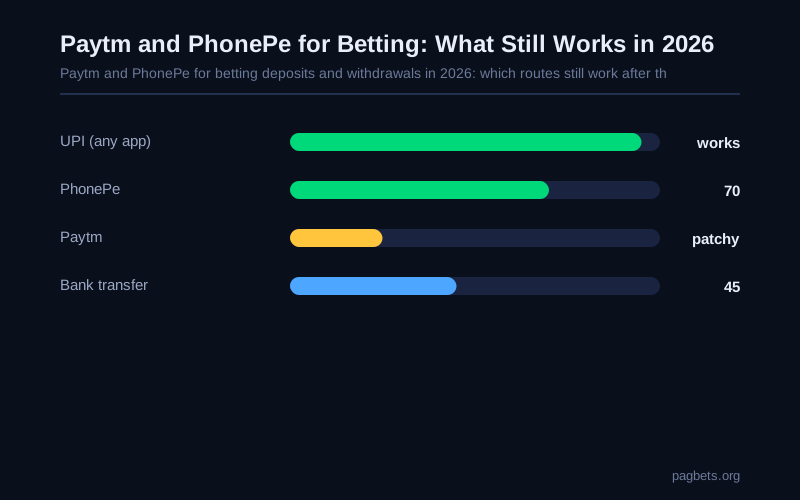
Both apps work for betting. The old version of Paytm, the one people remember as instant, is gone, and what remains is a competent UPI app rather than the fastest one. PhonePe is currently the better choice on our data, with a 94 per cent credit rate inside twenty seconds against 88 per cent.
The differences between them are small in absolute terms. The differences that actually decide whether you have a good experience are route selection, KYC status, name matching and withdrawal testing, and all four are within your control on day one.