Why Casino KYC Exists
Identity verification is an anti-money-laundering requirement, not a marketing decision.
Regulators in every licensed market require operators to know who their customers are before allowing deposits, primarily to stop laundering, to prevent someone else using an account, and to ensure winnings reach the person who earned them. An operator that skips verification is operating illegally in every jurisdiction that requires it, which is one of the fastest ways to identify an unsafe site.
Our the site's own KYC policy explains the same reasoning from our side, and the licences guide covers where the requirement comes from.
The Four Rejection Reasons
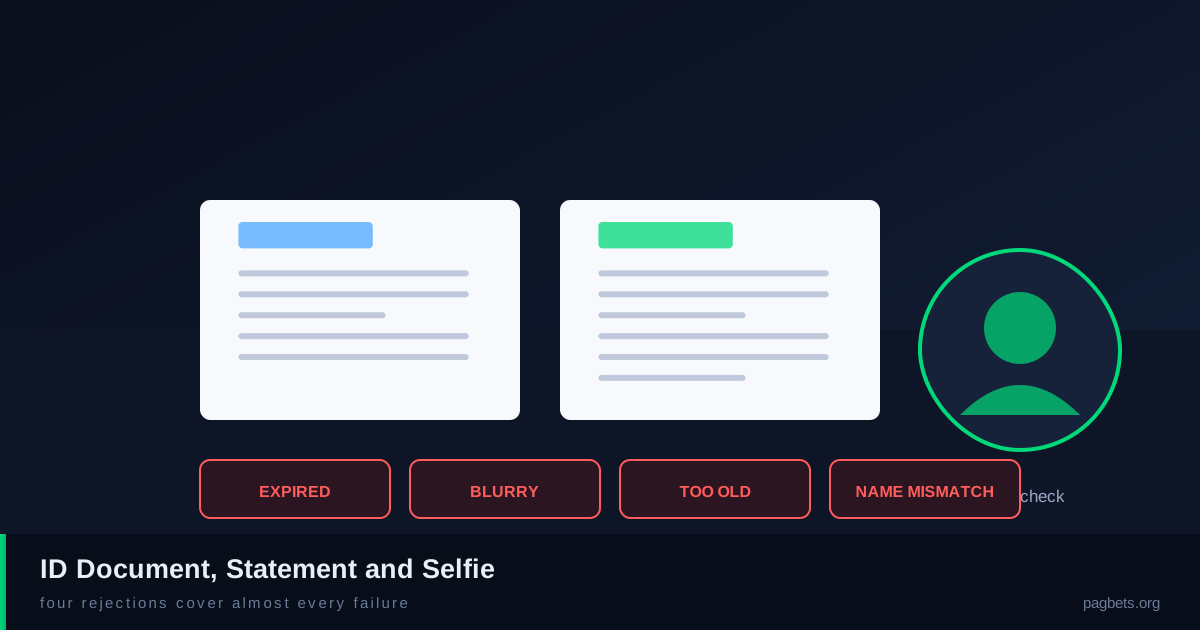
Between them these account for almost every failed verification.
| Reason | Frequency | Fix |
|---|---|---|
| Expired document | Very high | Check the expiry date first |
| Blurry or dark photo | Very high | Original photo, flat surface, daylight |
| Address proof over 3 months old | High | Use a statement dated recently |
| Name mismatch on account | High | Use your name exactly as printed |
| Screenshot of bank app | Moderate | Download a PDF statement instead |
| Cropped document corners | Moderate | All four corners visible |
| Noted or damaged document | Moderate | Replace it if you can |
How to Photograph a Document Properly
Most rejections are photography problems, and they are fixed with four things.
Use a flat surface with good, even light, and avoid shadows falling across the document. Photograph the original in colour, not a scan of a photocopy, and not a screenshot. Make sure all four corners are visible and the text is readable when zoomed. And check the expiry date before you upload, because an expired document fails instantly and automatically.
Our the security checklist covers the account setup that prevents most of these problems before they occur.
Proof of Address: The Document That Causes Most Delays
Address proof has a strict recency requirement, usually three months, and it is the most common avoidable rejection.
Accepted documents vary by operator but usually include a utility bill, a bank statement, official government correspondence, a council tax or equivalent bill, or a benefit statement. A bank app screenshot is almost always rejected, because it is not an original document, and a PDF downloaded from online banking is usually accepted.
The other requirement is that the name and address on the document must match the account exactly. A statement in a family member's name is rejected at most operators even where you share the address.
Selfie and Live Checks
Most operators now require a selfie or a short live video check, which is a step up from document uploads alone.
The check compares the face in the identity document against the face in the selfie, and a live check adds movement instructions such as turning your head. These are genuinely effective at preventing document misuse, and they rarely fail on a legitimate document, because the failure mode is a mismatch rather than a quality problem.
What does cause problems is photographing yourself in poor lighting, wearing a hat or sunglasses, or using an old document photo where your appearance has since changed significantly. Our the payment guide covers what happens after verification completes.
What an Operator Should Do With Your Documents
A legitimate operator states a retention period and deletes documents once verification and any regulatory obligation have passed. Under GDPR and equivalent regimes, you can request deletion, and a legitimate operator will comply. An operator that will not state a retention policy, that asks you to send documents by email rather than through a secure upload, or that cannot be traced to a named licence holder is a reason to stop. Our the fake sites guide covers how to check.
Verify Early Rather Than at Withdrawal
The timing of verification determines how fast you get paid, and this is entirely under your control.
An operator cannot withdraw to an unverified account, so an unverified balance is money you do not have. Submitting documents at registration, while there is no balance and no urgency, means the verification completes quietly and the first withdrawal is immediate. Waiting until you want to withdraw means a one to three day pause at exactly the point where you want the money.
Our the fast withdrawals guide covers the timeline, and the comps guide covers what verification unlocks in loyalty terms.
If Verification Fails Twice
A second rejection on a document you believe is valid is a signal worth taking seriously.
The first thing to check is whether the operator's requirements page specifies something the general guidance does not, because individual operators set their own rules within the regulatory framework. The second is whether the document is genuinely current and genuinely an original. The third is the name match.
If all three check out and the rejection persists, contact support and ask for the specific reason in writing. An operator that cannot explain a rejection is not operating to a standard you want your money held at. Our the complaints policy covers the escalation route, and how to choose a bookmaker covers what to check before depositing.
A Practical Routine
Verification is a fifteen minute task that should be done once, properly, at registration.
- Photograph the original in colour, flat surface, daylight, all corners
- Check the expiry date before uploading anything
- Address proof within three months, a PDF statement not a screenshot
- Name must match exactly, as printed on the document
- Do it at registration, not at withdrawal
- Keep a copy, a rejected re-upload is faster with the same file
Why Verification Is Not a Formality
It is tempting to read KYC as an obstacle designed to slow withdrawals, and that reading is wrong in a way that matters.
The requirement exists because operators are legally obliged to know who holds an account. That obligation is what makes the account recoverable if it is stolen, and it is what allows a player to prove a winnings claim. An unverified account is an account that no one can prove ownership of, including the person who opened it.
There is also a practical anti-fraud effect. Identity checks are why multi-account bonus abuse is now uncommon at licensed operators, which is a benefit to the ordinary player even though the check costs them ten minutes.
Our the fake sites guide covers the operators that skip verification and what that signals, and the licences guide covers where the requirement is enforced.
What Verification Unlocks, and What It Does Not
Completing verification changes what an account can do, and it is worth knowing exactly what changes.
It unlocks withdrawal, access to higher deposit and withdrawal limits, access to certain payment methods, and sometimes higher VIP tier requirements that assume a verified account. It does not unlock a better return, a bonus, or better odds, and no operator will suggest otherwise without being misleading.
So the argument for verifying early is entirely about the withdrawal path and the limits, not about any gameplay benefit. Our the loyalty guide covers which tier benefits genuinely require verification, and the withdrawals guide covers the practical timing.
Documents by Country, and Which Ones Always Work
The accepted document list varies by operator, but the reliable categories are consistent and worth knowing in advance.
Identity: a passport is universally accepted and easiest, because it does not expire quickly and the photo and machine-readable zone are already there. A national identity card or driving licence works at most operators. A birth certificate is generally not accepted because it has no photo and no expiry, which is the wrong shape for an identity document. Address: a bank statement or utility bill dated within three months is the standard. Official government correspondence, a council tax bill and a benefit statement are usually accepted. A tenancy agreement is accepted at some operators and refused at others.
A passport plus a recent bank statement is the combination most likely to be accepted first time, and it is worth having both photographed properly before registering. Our the payment methods guide covers the documentation side and how to choose a bookmaker covers what to check before depositing.