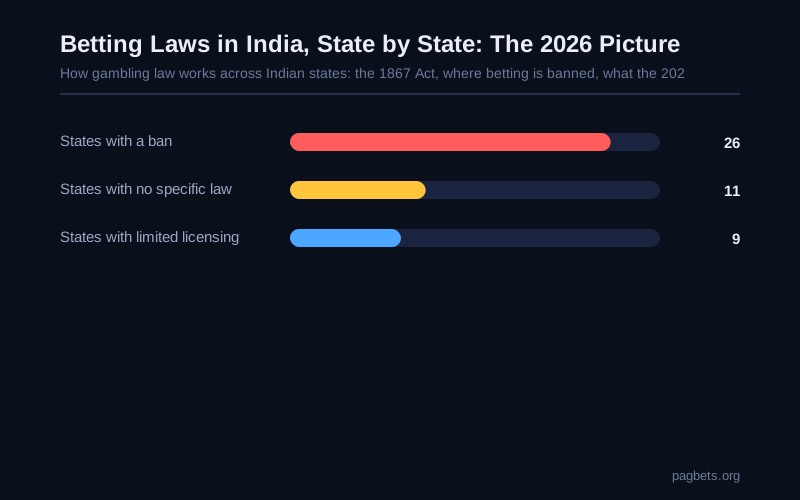
There Is No Single Indian Betting Law
The question sounds simple and the answer is genuinely complicated, because India legislates gambling at the state level under a central framework that is nearly 160 years old.
The starting point is the Prevention of Gambling Act, 1867. It is a short document. It prohibits wagering on games of chance, makes gaminghouses and instruments of gaming offences, and — critically — lets each state repeal or amend it. It also leaves a narrow exception for horse-racing prizes and skill-based games with prize money above a state-set threshold. Crucially, it says nothing about the internet, because it predates it by a century.
In practice, each state and union territory has its own gambling act, most of them passed in the 1960s and 1970s, and most of those still prohibit wagering on games of chance with no adaptation for online play. So the operative question is never about India as a whole. It is about where you live, what your state act says, and what the Supreme Court or the High Court in your region has recently decided about online money gaming.
What the 2025 Online Gaming Act Changed
The biggest legal shift of the past two years was federal rather than state, and it went in a restrictive direction.
The Online Gaming Act, 2025 gave a single definition to online money gaming and did three notable things. First, it created an express prohibition on online money gaming by or with users within India, with a defined penalty structure rather than leaving it to state discretion. Second, it made the promotion, facilitation and hosting of online money gaming, including running an account-handling service or an advertising intermediary, a separate offence. That second limb is the one that reshaped the advertising business, because it puts a legal question directly in front of anyone running an affiliate programme or a paid social campaign.
Third, it required operators to verify identity and age, and introduced deposit and withdrawal caps. Those requirements borrow heavily from an earlier amendment wave, particularly the 2022 amendment to the IT Act, which inserted Section 69A. That section gives the central government the power to block a betting site or app on a 36-hour notice from an authorised officer, on the grounds of public interest and national security. Section 69A is the reason a domain registered in one country and served from another can still be inaccessible in India within a day.
The Act also preserved state power, which is why the patchwork survives. States can legislate further, and several already have. Where a state has its own framework, that is the one that governs its players.
Where Each Major State Stands
A working summary of the position for adults in each state. "Prohibited" describes the general legal position, not the certainty of enforcement, which varies enormously in practice.
| State | Legal position | Notes for bettors |
|---|---|---|
| Assam | Prohibited, enforced actively | The Assam Cowrie Proceeds Act extends to gambling instruments and is used in practice |
| Odisha | Prohibited, enforced actively | Odisha Act on Gambling; strictest state regimes alongside Assam |
| Telangana | Prohibited, plus online-specific ban | The 2020 amendment gave the state an online-gambling framework of its own |
| Andhra Pradesh | Prohibited, plus online-specific ban | The 2020 amendment allows state regulation of online games of chance |
| Tamil Nadu | Prohibited | The 1996 amendment was challenged and struck down, leaving the 1960s position intact |
| Kerala, Karnataka, Maharashtra | Prohibited | State acts amended around 2012-2020 to cover online games expressly |
| West Bengal | Prohibited, with licensed exceptions | The Calcutta Act allows licensed fairs, lotteries and prize competitions |
| Delhi, Uttar Pradesh, Bihar, Rajasthan | Prohibited | Standard state gambling acts; enforcement varies widely |
| Punjab, Haryana, Uttarakhand, Himachal | Prohibited | Standard acts, no online-specific amendments of note |
| Gujarat, Madhya Pradesh | Prohibited | Standard acts; the Madhya Pradesh position has been litigated repeatedly |
| Sikkim | Repealed, licensed regime | The Sikkim Repealing Act 1975 ended the ban; a state licence body exists |
| Nagaland, Mizoram, Arunachal, Meghalaya, Manipur, Tripura | Varies, several licensed regimes | Northeast states retain independent gambling legislation |
| Goa, Daman and Diu | Prohibited | Offshore casinos operate for foreign nationals, which is a different regime entirely |
| Jammu and Kashmir, Ladakh | Prohibited | Previously under the search-and-seizure provisions now reserved to central government |
Why the Payment and Settlement Act 2017 Gets Misread
Ask why betting is still treated as unlawful despite UPI being everywhere and the Supreme Court having examined payment intermediaries, and this Act is usually offered as the answer. It is the wrong answer.
The Payment and Settlement Act, 2017 was a consolidation and reform of payments law. It gave the Reserve Bank of India authority over payment and settlement systems, it is the legal backbone under which NPCI operates UPI, and it contains consumer protection provisions around failed transactions and grievance redressal. It contains no provision legalising gambling, and it was never intended to.
The 2018 Supreme Court decision in the Paytm Payments matter is where the confusion usually comes from. The court held that a payment intermediary is a neutral conduit: its job is to move money, and it is not obliged to investigate what the customer is paying for. That is a meaningful protection for UPI rails and banks. But the same judgment was explicit that this neutrality does not determine whether the underlying wager is lawful. A neutral pipe is not a permission. Payments regulation tells you how money moves; gambling law tells you whether you should have moved it that way.
There is a practical consequence worth stating plainly. Because banks and UPI providers are generally neutral, your payment will usually go through even when the underlying transaction is not permitted. A successful deposit tells you nothing about legality, and it should not be read as an implied approval.
The TDS Layer Nobody Expects
Even setting legality aside, the tax treatment is more concrete than most players expect, and it is federal rather than state.
Section 194N of the Income Tax Act, inserted in 2020 and amended since, requires an operator to deduct tax at source on payments of winnings from online gaming. Where the total in a financial year crosses Rs 10,000, TDS applies at a flat rate of 30 per cent on the face value of the payout, whether the winner is a resident individual, a non-resident or a professional. The deduction happens before the money reaches you, through any mode, which includes UPI, wallet, bank transfer and crypto settlement.
The mechanics matter more than the rate. If you withdraw Rs 50,000, your betting balance is debited Rs 50,000, TDS of Rs 15,000 is deducted, and your bank receives Rs 35,000. Your betting history will usually show the gross, your bank statement will show the net. That mismatch is the single most common reason players assume they have been short-changed.
Claiming it back is straightforward but not free of friction. The operator issues a TDS certificate annually, and the amount becomes a credit against tax due on your total income, not a refund in itself. If your total income sits below the basic exemption limit, you effectively recover the whole amount. If you are a higher-rate taxpayer, you recover only the difference between the 30 per cent flat rate and your own slab rate. Our detailed breakdown of tax on betting winnings works through the arithmetic with real numbers, and it is worth reading before your first large withdrawal rather than after.
What This Means Before You Play
Being honest about the position: the general legal position in India is that wagering on money with a bookmaker is prohibited in the large majority of states, and the 2025 Online Gaming Act reinforced that at the federal level while adding new offences around promotion and facilitation. Nobody working in this market will tell you otherwise, and any review site claiming otherwise is either wrong or selling something. Offshore operators serve Indian customers under foreign licences in a regulatory grey zone that Indian courts have not resolved. That is a description of the environment, not a recommendation, and the legal risk sits with the individual, not only with the operator.
None of that tells you whether a particular site is safe to hand money to, which is a separate question with checkable answers. Our guide to gambling licences explained covers how to verify one, and payment methods for betting covers what happens to your deposit if the operator is not what it claims.
Enforcement: What Actually Happens
Published case law and reporting point to a consistent pattern of uneven enforcement rather than either blanket tolerance or blanket suppression.
Historically, enforcement has concentrated on the operator side: arrests of bookmakers, seizure of accounts and prosecution of rackets. Individual participants have been prosecuted less consistently, and courts have often treated private social wagering between friends leniently, particularly where the stakes are trivial. Skill-based gaming has been treated more favourably than chance-based gaming, which is the argument behind the rummy, poker and fantasy positions discussed in our rummy betting guide.
Several High Courts have heard petitions on online money gaming, and the trend has not been towards striking down the bans. The pattern of judicial reasoning, where petitions have succeeded, has generally been on procedural grounds such as lack of authority or delegation, rather than on the merits of whether online wagering should be permitted. Where state amendments have been struck down, the original 1960s-era act has usually been restored, which means the outcome is not obviously more permissive.
What has changed is payment infrastructure and app-store enforcement. Section 69A blocking orders and the withdrawal of apps from official stores mean that a banned product is now materially harder to reach than it was five years ago, which reduces visibility while leaving the underlying law unchanged.
Why Every Major Operator Offers a Block List
If you register at an international bookmaker and browse the India entry in the list of restricted countries, you will find a pattern. The block usually covers India as a whole, and often names specific states separately as an additional line.
That is not boilerplate imprecision. It is the operator working out its exposure. Under the 2025 Act, offering and facilitating online money gaming to users in India is itself an offence, and a geo-block is the cheapest available evidence that an operator takes the obligation seriously. An operator that serves Indian players openly is making a deliberate decision that it is either licensed somewhere it should not need to be, or willing to carry that risk.
There is a legitimate commercial reason for the block list too, which operators rarely say out loud: India is a high-volume, high-churn, low-margin market with heavy bonus costs and a persistent withdrawal-complaint profile. Serving it is profitable but messy. Blocking it is cheap. So when you see a site that both blocks India and simultaneously runs Hindi-language advertising aimed at India, that contradiction is worth noting, and it is a useful signal when you are assessing whether a site is genuine.
Our guide to spotting fake betting sites covers the checks that reveal this kind of behaviour, including the tell of a site whose restricted-country list contradicts its own advertising. It helps to know what a real operator looks like before you compare, so our rating method is worth a read as well.
What to Check Where You Live
If you want your own position rather than a national summary, four steps will get you there.
- Find your state gambling act and read the sections on gaminghouses and instruments of gaming. Most state websites host the bare Act as a PDF.
- Search your state High Court for recent online gaming petitions and judgments. The pattern of results in the last two years is the most reliable guide to how strictly applied it currently is.
- Check the central position, meaning the 1867 Act plus Section 69A of the IT Act plus the 2025 Online Gaming Act, since those apply regardless of state.
- Check your payment provider terms, because many banks and wallets prohibit gambling transactions in their customer agreements even when they process them.
The Realistic Position
India is not a legal betting market and is not moving towards becoming one. The 2025 Act closed routes rather than opening them, and the state patchwork means that even a future change would produce four or five different regimes rather than one national one.
What that means in practice is that any bettor in India is making a judgement about their own exposure, using offshore operators, with no recourse to an Indian regulator and no guarantee that a dispute will be enforced. That is a fact about the market rather than an argument for or against it, and it is the honest starting point for anyone reading a review on this site.
If you read the rest of this site, read it with that in mind: we rate operators on whether they hold a real licence, whether they pay, whether their markets are fair and whether their terms are honest. Those are all real questions with checkable answers, and they are the ones that decide whether you get your money back. The legal question is the one we cannot answer for you.