
The Goal of a First Bet
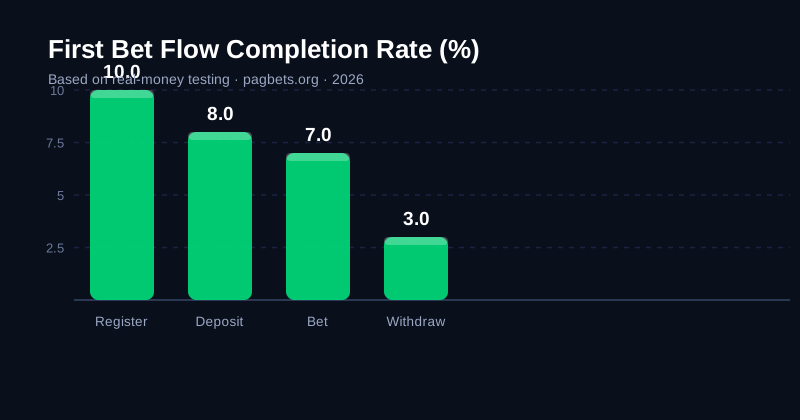
Your first bet should be boring, small and successful — not in the sense of winning, but in the sense of completing the full loop without confusion: register, deposit, bet, settle, withdraw. Every step of that loop teaches something a guide can't. This walkthrough covers each step in order, with the beginner mistakes that cost people time and money on their very first day.

Step 1: Choose a Licensed Site (Not a Bonus)
Start with any operator from our rankings — each is licensed, tested and verified. The licence is the whole ballgame: it's what guarantees you'll be paid. For a first bet, Bet365 (trust and sharp odds) or Betway (simplest interface) are the classic choices. Bonus size is irrelevant to this decision — see Step 4.
Step 2: Register and Verify Immediately
Registration takes minutes: name, address, date of birth, email. Then do the step most beginners skip: complete KYC verification right away — passport or ID photo, proof of address, sometimes a selfie. Completing it now, before any withdrawal request, removes the single most common first-time frustration. Our KYC guide explains the documents and how to pass first time.
Step 3: Deposit Small
Deposit the minimum — $5 or $10 — using whichever method you'll realistically use later. The deposit is practice for the withdrawal, and it confirms the payment rails work before any real money rides on them. Skip the bonus for this first deposit: bonuses add terms and lock funds, and a first bet should be maximally simple.

Step 4: Understand the Odds Before Touching the Bet Slip
Before placing anything, read the odds properly. Decimal odds are simplest: stake × odds = total return. A $5 bet at 2.00 returns $10 (your $5 back plus $5 profit); at 1.50 it returns $7.50. The bet slip will show your potential return before you confirm — read it, and never confirm a bet whose potential return you couldn't calculate yourself. Our odds guide covers all three formats in depth.
- Decimal odds: stake × odds = total return (2.00 doubles your money)
- The bet slip shows potential return before you confirm — read it
- Favourites have low odds; underdogs high — neither is "better" by default
- Never confirm a bet you can't explain in one sentence
Step 5: Place the Bet, Then Watch It Settle
Pick one market — match winner on a game you'll actually watch — and stake the minimum. Watching a small bet settle teaches more about odds movement and settlement than any article. Win or lose, the loop is complete, and the next step closes it.
Step 6: Withdraw (Yes, Even a Small Amount)
The final step most beginners skip: withdraw — even $10 — to prove the full loop works. This tests the payout method, surfaces any verification gaps while the stakes are trivial, and builds the habit of treating winnings as real money. Withdrawal times vary by method; our payment guide shows what to expect.
The Beginner Mistakes to Skip
Three mistakes define bad first days. Skipping KYC — solved in Step 2. Bonus confusion — solved by skipping the bonus on the first deposit. Staking too big — the first bet is tuition, not investment; if losing it would hurt, it's too big. Skip all three and your first day ends with a working account, a completed loop, and the foundation for everything in our guides section.
Your First Bet Should Be Small and Should Be About Something You Know
The conventional advice is to bet small, and the part that matters more is to bet on something you have an actual view about.
A first bet on a team you follow, at a price you checked, for an amount you would not notice losing, teaches the mechanics without teaching impulsivity. A first bet on a five-leg accumulator with a bonus attached teaches neither and costs the bankroll. Our the bankroll guide covers the sizing, and this guide covers the rest.
What to Do After Your First Bet
Record it, and the recording is the part that turns a first bet into a process.
Write down the price, the stake, the selection and the reason. Nothing else is needed at this stage. After twenty bets you have a record that shows whether your reasons were good, which is information no bonus and no tipster will give you. Our the journal guide covers how to keep one.
Deposits, Limits and Setting Up Safely in Ten Minutes
Before your first deposit, set the limits. Every regulated operator provides deposit limits, loss limits and session reminders in account settings, and they take effect immediately. A £50 weekly deposit limit set on a Tuesday costs nothing and permanently removes the decision from a Saturday night. Do it at registration, not after the first bad week. Add reality checks where offered, and set a loss limit alongside the deposit limit, because a deposit cap alone still permits one long losing session.
Deposit with a method you can also withdraw to. That sounds obvious and it is the most common first-deposit mistake: funding with a card and then trying to withdraw to an e-wallet never verified in your name will fail at KYC, and the failure arrives after your winnings are already on the balance. Card deposits are instant and universally supported; e-wallets are fastest to withdraw; bank transfers are slowest but carry the highest limits. Our licensing guide explains what each regulator requires.
Keep the first deposit at the minimum the operator accepts and treat it as a payment test rather than a betting stake. The purpose is to confirm that money arrives, that the balance displays correctly, and that the withdrawal route works before anything meaningful is at stake. It also leaves you with a small bankroll you can afford to lose entirely, which matters more than it sounds. Our bankroll guide covers keeping the sportsbook and casino pots separate from the start.
Finally, decide in advance what happens if you win. Most beginners have no plan for a win, and an unplanned win becomes a larger stake by default, which is the fastest route from a lucky £15 to a £200 loss. Write one sentence before you start: if the balance reaches four times the deposit, withdraw half and stop. Our bookmaker selection guide covers the payment and KYC checks worth doing in the same ten-minute session.
Set the limits before you deposit, not after. Every one of them takes under a minute from the account settings, and doing it while the balance is still empty is the moment you are most likely to pick sensible numbers. Reasonable defaults for a first month are a weekly deposit limit equal to the amount you could lose without it affecting anything you have planned, plus a loss limit at roughly the same figure. Both can be raised later without a cooling-off period, and both should be.
Reading Odds on Real Bets, With Examples
Work through three concrete prices until the arithmetic is automatic. A £10 bet at 1.80 returns £18 — £10 stake plus £8 profit — implying 55.6% probability. A £10 bet at 4.50 returns £45, implying 22.2%. A £10 each-way bet at 5/1 with a quarter place part means £5 on the win at 5/1 and £5 on the place at 1.25, returning £30 on a win and £11.25 on a place. Every figure appears on the bet slip before you confirm, and if your own calculation disagrees with the slip, stop and work out why.
Fractional odds need one extra step. 5/1 means £5 profit per £1 staked, so a £10 bet returns £60; 7/2 means £7 profit per £2, so £10 returns £45; 1/1 is even money at 2.00 decimal. The trap is reading 5/1 as five times the money back rather than five times profit, and the slip is where that confusion becomes expensive. Our margin guide shows how to convert between formats if you prefer one of them.
Understand implied probability and the margin together. Three outcomes at 1.95, 3.60 and 4.50 imply 51.3%, 27.8% and 22.2% — a total of 101.3%, and that 1.3% is the margin built into the book. Divide each implied probability by the total and you have the market's own view of fair probability, which is the number to compare against your own estimate. Our value mathematics guide covers the calculation in full.
Start with markets where your knowledge is genuine — a team you follow, a horse you have an opinion about, a match you will watch from kick-off. Short prices are not safer bets and long prices are not better ones; a price describes probability, not quality. A first bet on a game you intend to watch teaches you settlement rules, in-play pricing and the emotional experience of holding a position, and that education is worth more than the outcome.
One practical check before you confirm: work out what the market implies and ask whether your own view is materially different. If you think a team is a 55% chance and the market says 60%, you have found roughly a 9% edge at that price, which is a bet worth taking. If you think they are a 58% chance and the market says 60%, the edge is under 4% and probably not enough once you account for the margin. Our value betting guide covers how to set that threshold properly rather than guessing at it.
How to Review Your First Fifty Bets
Keep the record simple: date, event, market, selection, price, stake, result, and one sentence of reasoning. Fifty rows in a spreadsheet is all it takes, and the reasoning column is the one that matters. Without it, a review tells you your football bets won 54% at an average price of 2.10, which is genuinely informative once you compare it with closing prices. With it, you can see whether losses came from wrong reasoning or from right reasoning at prices that were merely unlucky.
The first review question concerns price quality, not results. Compare the average price you took with the closing price on the same selections. Beating the close on a meaningful share of bets is the earliest reliable evidence that you are doing something well, and it appears long before profit does. Our value betting guide explains why a 54% strike rate at 2.10 says far more than a 60% strike rate at 1.50.
The second question concerns market selection. Which markets produced your best results, and did you bet the ones you claimed to specialise in? Beginners routinely spread across six sports and acquire six surface-level opinions. The correction is to pick two markets and three to five bets a week for a month, which costs nothing and is worth more than any system sold to you. Our margin guide explains why narrow specialisation beats broad coverage once research time is counted.
The third question concerns your reaction to losses, which is the only one that determines whether you continue safely. If a losing streak led to bigger stakes, a bonus grab, or a session you had already decided to end, the record shows it — and that is the finding that should change your behaviour. Fifty bets is the minimum sample for a technical review and a much better sample for an emotional one. Most beginners who keep a record for three months end up betting less, not more, because it makes the costs visible.
Do the review in writing, not in your head. A review conducted while remembering your bets is a review conducted through the most flattering possible selection of them, and the distortion is invisible from the inside. Thirty minutes with the spreadsheet will produce conclusions you will not enjoy and will act on, which is the entire purpose. Our free bets guide covers the arithmetic behind the price column, which is the hardest part of the sheet to populate accurately.
✓ What We Like
- Tells you how to check a licence rather than asking you to trust one
- Covers the payment problem that decides whether the product is usable for you
- Explains the tax structure, which is the part that sets the price
- Uses named regulators, laws and figures rather than general description
✕ What Could Improve
- A limit or ceiling constrains how much you can actually stake


