
The Most Important Fact About Any Betting Site
Every serious question about a bookmaker — will I be paid, who do I complain to, what are my rights — has the same first answer: check the licence. But licences are not created equal. A UKGC licence carries the enforcement power of a national government; a Curacao licence is legal but lighter; a fake licence is worthless. This guide explains what each major regulator actually means for your money, and how to verify any licence in five minutes.
The Protection Ladder
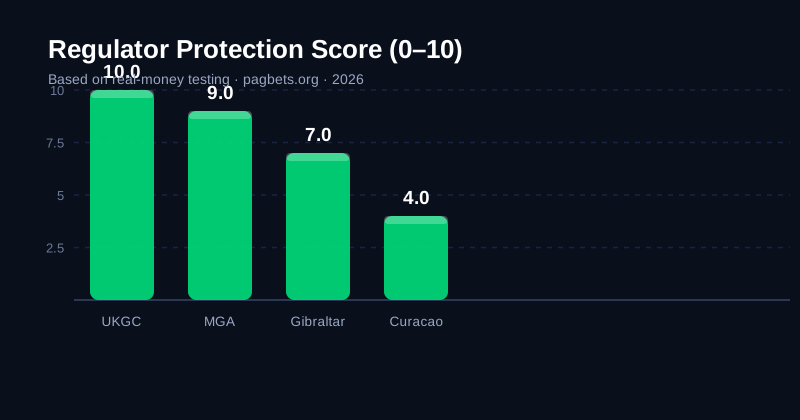
Regulators rank by what they can do for you. At the top: the UK Gambling Commission — strictest rules in gambling, binding dispute resolution, and fines large enough to matter. Close behind: the Malta Gaming Authority, the gold standard for international operators, with formal player-protection rules and real enforcement. In the middle: respected smaller regulators — Gibraltar, Isle of Man, Kahnawake. Lower: Curacao eGaming, legal and widely used, but with slower processes and softer enforcement. At the bottom: no licence at all, which means no recourse whatsoever.
| Regulator | Player protection | Dispute power | Common users |
|---|---|---|---|
| UKGC | Highest | Binding rulings, heavy fines | UK-facing bookmakers |
| MGA | Very high | Formal ADR, real fines | European international sites |
| Gibraltar / IOM / Kahnawake | High | Formal processes | Established operators |
| Curacao | Moderate | Slow, softer enforcement | International crypto & global sites |
What a Licence Actually Protects
A licence protects three specific things. Funds: tier-one regulators require customer funds to be segregated from operating funds — your balance survives the operator's bankruptcy. Fairness: games and odds must meet audited standards. Recourse: a formal complaints path that ends in a regulator who can rule against the operator, fine it, or revoke its licence. The difference between tiers is mostly the strength of that third pillar — and it's the one that matters when something goes wrong.
The Five-Minute Verification
Verification takes five minutes and defeats most scams: find the licence number in the footer, open the regulator's own register, search the number, and confirm the operator name matches the site exactly. Fakes copy badges; they can't copy entries in a public register. Regulators' registers are free and searchable — UKGC, MGA and Curacao eGaming all publish theirs. Our fake-site guide covers the routine with screenshots of what to look for.
- Find the licence number in the site footer
- Open the regulator's own register (not the site's badge)
- Search the number — the operator name must match
- Check which jurisdiction's licence covers your country

Licence Tier and Practical Betting
How should tier affect your behaviour? On tier-one sites (UKGC/MGA), standard stakes are well protected — the regulator is genuinely on your side. On Curacao sites, the operator may be excellent (many are) but the safety net is thinner: start smaller, verify KYC immediately, withdraw regularly, and prefer operators with long payout histories. Our rankings mark every site's licence and factor it directly into the trust score — see our methodology for the weighting.