Why This Guide Exists
We test bookmakers for a living, and the fake sites we encounter in 2026 are disturbingly good: cloned designs, stolen licence numbers, live chat staffed by real people whose only job is to stall withdrawals. The damage is total — when an unlicensed site refuses to pay, there is no regulator, no complaints body, and usually no company to sue. This guide is the checklist we run ourselves before we ever deposit a test dollar. Run it before you deposit yours.
Step 1: Verify the Licence — at the Regulator, Not on the Site
Every legitimate bookmaker displays its licence in the footer. Every fake one does too. The difference is verification: take the licence number shown and search it on the regulator's own register — the Malta Gaming Authority, the UK Gambling Commission, and Curacao eGaming all publish searchable databases. If the number doesn't appear, doesn't match the site name, or the regulator's site looks like a copy, you've found a fake.
- UK Gambling Commission — strongest player protections
- Malta Gaming Authority (MGA) — gold standard for international sites
- Curacao eGaming — legal but fewer protections; verify the operator matches
- Gibraltar, Kahnawake, Isle of Man — smaller but legitimate regulators
Step 2: Check the Domain and Company
Run the domain through a WHOIS lookup. Fake sites are typically registered within the last 12 months, often through privacy registrars, while established bookmakers have years or decades of history. Then check the operator name in the footer against a web search — a real company has news coverage, complaints (every bookmaker has some), and a corporate trail. A company that exists nowhere except its own site is a shell.
The 12 Warning Signs
Any single red flag below deserves caution; three or more is a walk-away. These are drawn from the scam patterns reported to us and observed in our own testing since 2020.
- 1. Licence number that fails verification at the regulator
- 2. Domain registered in the last year
- 3. Bonus of 200%+ with no visible wagering terms
- 4. Wagering of 40x+ applied to deposit AND bonus
- 5. Withdrawal limits of a few dollars per day/week
- 6. Withdrawals "pending" indefinitely after you win
- 7. Support that exists only as a webmail address
- 8. Terms that change after you deposit
- 9. KYC requests that repeat endlessly with new documents
- 10. No responsible gambling tools anywhere
- 11. Aggressive deposit pressure ("bonus expires in 10 minutes")
- 12. Payment methods that deposit fine but never withdraw
The Withdrawal Pattern That Exposes Most Scams
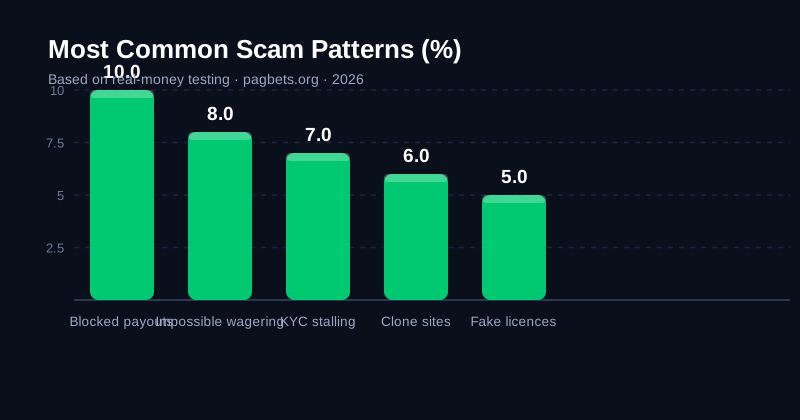
Fake sites share one signature behaviour: deposits work perfectly, withdrawals never complete. The playbook is consistent — small withdrawals succeed to build trust, your first meaningful withdrawal triggers "additional verification", the documents are somehow never acceptable, and support's tone shifts from sales to bureaucracy. Legitimate operators process withdrawals within published timeframes (our measured times across ranked sites: crypto minutes, e-wallets hours, cards days — see our payment guide). If your withdrawal sits "pending" beyond the published maximum, you're likely being stalled, not processed.
Copycat Sites and Clone Domains
2026's most common scam is the clone site: a near-perfect copy of a real brand on a lookalike domain (bet365-bonus.com, stake-verify.net). These sites exist to harvest logins and deposits. Defence is simple: type the domain yourself, check the padlock and certificate details, and never arrive through links in unsolicited emails or messages. Our ranked links point only to official domains.
The Five-Minute Verification Routine
Before depositing at any new site, run this routine — it takes five minutes and covers the checks above in order:
- 1. Licence: copy the licence number, verify at the regulator's register
- 2. Domain: WHOIS lookup — age, registrar, and does the name match the brand
- 3. Terms: read the withdrawal policy and bonus terms fully — both are short
- 4. Support: ask live chat one real question and time the response
- 5. Reviews: search "[brand] withdrawal complaint" and read what others hit

Where to Bet Safely Instead
You don't have to run this routine alone. Every bookmaker in our rankings has already passed it: licence verified at the regulator, real-money deposits and withdrawals tested, support audited, and a documented methodology you can read on our ratings page. Start there, and keep this checklist for everything else.