Pace Is Not Outcome
The central analytical point in motorsport is that the fastest car frequently does not win the race. A driver with a marginal pace advantage can be undone by a single pit stop cycle, a safety car, a slow tyre stint, or traffic from a car ahead running a different strategy.
That is a different problem from football, where the best team usually wins. In motorsport the variance is structural rather than incidental, and it means the market is genuinely less efficient at forecasting the race than the qualifying result.
It also means a driver or team with a strong race record is more informative than one with a strong raw pace figure, because race record already incorporates strategy management. Our method-of-victory guide covers the equivalent idea in a different sport.

Strategy Is the Deciding Variable
Modern racing is won on tyre degradation and pit timing rather than on outright speed. A driver who can nurse a hard compound for twenty laps saves a pit stop, and that saved stop is frequently worth more than the tenths of a second a newer tyre would provide.
The practical consequence is that pit stop timing matters more than pit stop speed in most modern races. Undercutting a rival by two tenths a lap is usually less valuable than a driver pitting a lap before their rival and inheriting a gap they can manage. The market understands this better than it understands pace, and the overround on the race market is correspondingly wider.
Weather compounds the problem. A rain arrival that is forecast to arrive at lap 30 is a genuine event for a bettor monitoring conditions, and it changes the strategy of every team simultaneously.
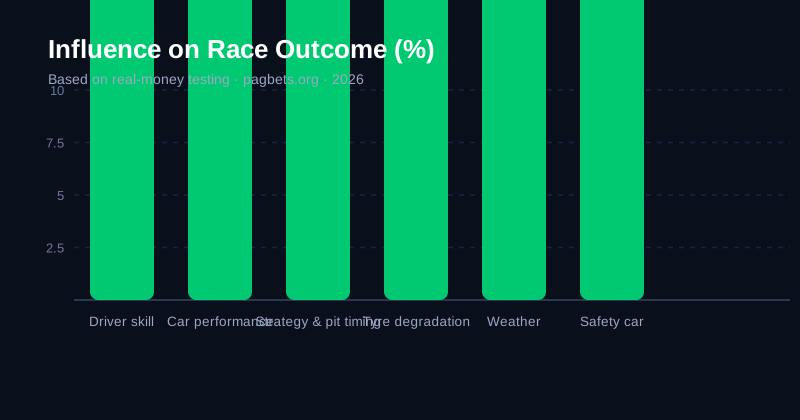
| Factor | Influence on outcome | How to research it | Market efficiency |
|---|---|---|---|
| Driver skill | High | Head-to-head records, wet-weather form | Well priced |
| Car performance | High | Qualifying gap, upgrade pattern | Well priced |
| Strategy | Very high | Tyre choice, pit timing data | Underpriced |
| Pit stops | High | Stop duration, undercut windows | Moderate |
| Tyre degradation | High | Compound performance by circuit | Moderate |
| Weather | Variable | Forecasts, race timing | Poorly priced |
| Safety car | Low but high impact | Difficult to predict | Random |
Qualifying Versus the Race
Qualifying is a single flying lap, or a short sprint in some formats, and it is the most reliable motorsport market available. It is decided almost entirely by car performance and the driver's ability to find a clear track, with a low probability of mechanical or weather intervention.
The race is a different proposition entirely, incorporating strategy, traffic, reliability, weather and a large variance component. A driver who qualifies second and wins four races from there is demonstrating race management rather than pace, and that is a genuine and predictable skill.
A sensible approach is to use qualifying as the base assessment of relative pace, then adjust for race-specific factors. Our research guide covers the same principle in a different sport: start from the data most people have, then layer on what they do not.
Live Betting and the Depth of Markets
Motorsport is one of the few sports where in-play betting rewards genuine analysis rather than merely fast reflexes. A race runs for one to two hours, the order changes repeatedly, and the information that matters is public: gap estimates, tyre ages, pit stop counts and weather radar.
That makes markets like fastest lap and finishing position genuinely interesting live, because a car at the back on a fresh tyre with a clear track is a realistic fastest-lap candidate, and the price frequently does not reflect that immediately.
The difficulty is execution. The window between a leading car pitting and the market repricing is small, and the same speed requirement that makes live motorsport attractive makes it the easiest sport in which to over-bet. Our in-play risk guide sets out the discipline.

Reading a Race Weekend Properly
Motorsport offers more publicly available information than almost any other sport, and a weekend's worth of it arrives before the race.
Each session produces data that narrows the picture. Free practice shows long-run pace and, more usefully, whether a car is managing tyres well over a stint. Practising and qualifying establish single-lap and short-run pace. The race itself, of course, is the outcome being priced.
Three details are worth watching specifically because they are public and predictive. Tyre choice announced on the grid signals strategy: a soft compound on Saturday suggests the team expects a low-degradation race and a long first stint. Longest-run data from practice indicates degradation rate, which is the single best predictor of whether a one-stop or two-stop race is likely. And qualifying position matters more than in most sports, because a car starting behind has to find clean air, and traffic costs real time over a full stint distance.
The weather forecast is the other major input, and it is worth checking the timing against the race rather than merely the conditions. A shower forecast for hour 40 of a 90-minute race is frequently the difference between a dry-race favourite and a wet-race specialist.
The Markets With the Widest Margins
Not every motorsport market is priced to the same standard, and the difference is worth knowing before committing to a race night.
Race winner and qualifying carry the most liquidity and therefore the tightest pricing. A race winner market on a Grand Prix typically has a modest overround, because the money is there and the models are sharp.
Fastest lap is priced differently. It depends on track position, tyre age and timing-chart position in ways that are difficult to model, and it is therefore priced with a wider margin than its apparent sophistication suggests. It is also one of the few motorsport markets with genuine live value, because the state variables are public and the live repricing is imperfect.
Number of pit stops and finishing position of a mid-grid driver are the ones to treat most carefully. They attract less money, are harder to forecast, and are frequently priced with a margin wide enough to consume any analytical edge entirely. A mid-grid driver finishing outside the top ten is an outcome most punters cannot forecast better than the price implies.
Where Race Position Comes From
Finishing position markets in motorsport reward a specific analytical approach, and it is worth setting out.
A driver's qualifying position is the strongest single predictor of finishing position, because passing is expensive and a driver starting at the front simply does not need to. Across most recent seasons, a driver starting in the top three finishes in the top three more often than any other relationship in the sport, and the correlation weakens considerably below that.
Beyond grid position, three further inputs matter. Long-run pace relative to the car ahead determines whether a driver can pass at all, since a car without the pace to complete a pass on track will not. Expected points position from practice indicates finishing pace. And weather timing can reverse an entire grid in the first few laps if the forecast is accurate.
The practical approach is to build a finishing-position estimate from grid position, adjust for qualifying pace delta and expected points position, then compare with the market. A driver priced to finish considerably lower than that estimate is either being marked down for a reason worth understanding, or is genuinely value. Our value betting guide covers how to tell the difference.
A Realistic Approach
Because the race market incorporates so much variance, the realistic way to bet motorsport is to focus on the markets that isolate a specific skill. Qualifying, fastest lap, and finishing position of a single driver are all cleaner than the overall race winner.
Where you back the race winner, base it on race-specific indicators rather than qualifying form alone. A driver's recent race finishes with varied strategies, their tyre management history and their pit timing under pressure are more relevant than their lap time deficit.
Set a small stake, and treat the volume of available markets as a risk rather than an opportunity. Motorsports attract a great deal of money, and the races themselves contain a number of genuinely unpredictable elements. Our bankroll management guide covers the staking side, and choosing an operator matters here because market depth varies considerably.
- Prefer qualifying and fastest lap, cleaner markets
- Base race bets on race form, not qualifying alone
- Track tyre choice announcements, they reveal strategy
- Use live fastest-lap markets carefully, repricing is fast
- Watch weather timing against the race clock, it changes everything
- Stake small, variance in motorsport is structural
- Set limits via our responsible betting tools