
The Idea Almost Nobody Starts With
Most beginners treat bankroll management as an advanced topic to worry about once they are 'good enough'. That is precisely backwards. Bankroll management is what allows you to become good enough, because without it a single ordinary losing streak can end your betting before you have learned anything.
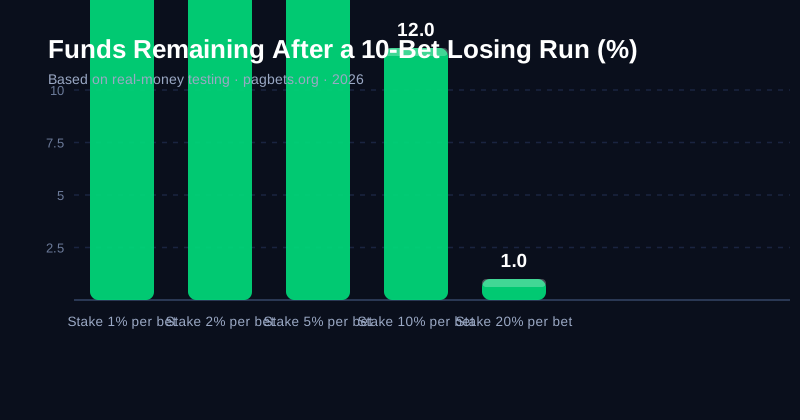
Even a punter who wins 55% of their bets at evens prices will lose money over a long run if they stake too much on any individual selection. The arithmetic is unforgiving: a run of ten losses at 5% of your bankroll removes roughly 40% of your funds. At 2%, the same run removes around 18% and leaves you perfectly able to continue.
Setting Up the Bankroll
Your bankroll should be money you can genuinely afford to lose. Not money earmarked for a bill, not money you would need to borrow back, and not money you are emotionally attached to. If losing it would change how you live, it is not your bankroll.
Next, give it a horizon. A bankroll with no time limit becomes a way of postponing a decision indefinitely. Decide whether this is the amount for this month, this quarter or this year, and set a firm stop-loss at the level where you reassess rather than continue. Deciding your limit while you are calm is far easier than deciding it while you are chasing.
- Use only disposable money — never money needed for living costs
- Keep it separate from your everyday account so the total stays visible
- Set a time horizon for the bankroll before you start
- Define a stop-loss in advance and treat it as a decision, not a suggestion
- Decide your unit size as a percentage, not a fixed cash amount
Flat Staking and Why It Works
Flat staking means betting the same amount on every selection: one percent, two percent, whatever you have decided, every time. It sounds almost too simple to be a strategy. That simplicity is precisely its strength, and it is the reason professional bettors return to it whenever they feel themselves becoming overconfident.
Flat staking removes the two most expensive mistakes in betting — staking too much when confident and too little when uncertain. It also makes your results interpretable. If you lose money on flat stakes, the problem is in your selection process, and that is a problem you can actually work on. If you lose money on variable stakes, the problem may simply be your staking.

Sizing Up or Down With Confidence
Once flat staking is automatic, you can add one dimension. A unit system lets you stake one unit on a standard selection and two units on one you rate more highly. The important rule is that the range stays narrow — one to two units, never one to ten. Wide ranges mean that on your worst day you will find yourself staking far more than you planned on precisely the selections you were least sure about.
There is a genuine risk here that beginners underestimate. Confidence scales are notoriously unreliable, and a punter who stakes more when they feel sure is often staking more in exactly the situations where they are most overconfident. If you adopt unit staking, cap the maximum at double your standard stake and review results honestly.
| Confidence | Unit stake | Sensible use |
|---|---|---|
| Standard selection | 1 unit | Most bets — your normal case |
| Strongly favoured | 1.5 units | Occasionally, when the case is clear |
| Exceptional value | 2 units | Rarely — a handful of times a month |
| Never | 3+ units | Outside any sensible plan |
What a Losing Run Looks Like
Losing runs are normal. Even a profitable strategy will produce sequences of eight, ten or more consecutive losses, because variance does not care about your edge. What distinguishes a bettor who survives from one who quits is not the run itself but what they do during it.
The most common failure is escalating. After three losses it feels obvious that the next one must win, so the stake grows. This converts a manageable loss into a ruined account, and it is worth understanding that the belief driving it — that losses 'mean' a win is due — has no basis in probability. Independent bets do not owe you anything after a loss.
Separating Your Betting Bankroll From Your Life
The most practical piece of bankroll management has nothing to do with formulas. It is putting the money somewhere that makes the total visible. Too many punters keep betting funds mixed into a general balance, and the practical consequence is that they cannot tell how much remains. Losing track of the number removes the feedback loop that would otherwise prompt sensible behaviour.
A separate account, or at minimum a separate payment method, creates a natural checkpoint. Before each session, you transfer a specific amount in. When it is gone, it is gone, and the boundary is unambiguous. This is much harder to maintain when betting funds sit alongside rent money, and much easier to review at the end of a month.
It also helps to remove the emotional weight of the total. A bankroll figure should be a piece of information you consult, not a source of anxiety you avoid. If opening the betting balance reliably produces a feeling of stress, that is worth taking seriously — our responsible betting tools guide covers the practical steps, and professional support is always available through the options on our responsible gambling page.
When to Increase Your Stake, and Why Usually Not Yet
There are two very different questions here: when is it allowed to increase your stake, and when is it wise. The permission is straightforward — never after a loss. A stake increase that follows a losing run is the single most reliable route to ruin, because it converts a normal statistical fluctuation into an account-ending event.
The wisdom question is harder, and most answers are 'later than you think'. An increase is only justified by evidence accumulated over a meaningful sample, which for most people means several months of a flat-staked record showing a genuine positive result. Even then, a modest increase is appropriate. The purpose of a larger bankroll is to support larger stakes without changing your percentage risk, not to chase a bigger return.
There is a common misreading here worth naming. A run of eight wins does not demonstrate an edge; it demonstrates that eight wins in a row happened. A punter with a genuine 55% strike rate will experience eight-win runs regularly, and raising stakes on the strength of one is raising stakes on variance. The journal approach in our betting journal guide exists precisely to distinguish these two situations.
A System You Can Start on Monday
A workable beginner system is short enough to actually follow. Separate a bankroll you can afford to lose. Set a stop-loss of 25% of that bankroll, after which you stop and reassess regardless of how you feel. Stake two percent on every bet. Keep a written log of every wager with the reason for the selection. Review the log once a month and read it properly.
That is the entire system. It will not make you rich and it is not intended to — it is designed to keep you in the game long enough to find out whether you have an edge. Everything else — markets, research, sharpening your judgement — becomes possible only once the survival part is solved.
- 2% flat stake on every single bet, without exception
- 25% stop-loss triggers a break and a full review
- No stake increases after losses, ever
- One written note per bet: selection, price, reason
- Monthly review of both results and process
- Set account limits early using our responsible betting tools guide