
Why MMA Markets Are Different
MMA is the most individually-determined major sport. There are no teammates, no substitutions and no tactical changes from a coach mid-fight. Two fighters step into a cage or a ring and the outcome is the sum of everything they do and everything they refuse to do.
That makes results highly predictable in a way team sports are not. A dominant striker stays dominant, a strong wrestler keeps taking opponents down, and a defensive fighter continues to be difficult to beat. The problem for bettors is that the market knows this too, which makes the match winner among the most efficiently priced markets in any sport.
The opportunity therefore sits elsewhere — in markets that depend on how a fight ends rather than who wins. Our UFC betting guide covers the specifics of major promotions, and the value betting guide explains how to verify a price is genuinely worth taking.

How MMA Markets Are Structured
MMA bouts are typically three rounds for a standard fight and five for a title fight or a non-title main event, with championship fights occasionally extending to five regardless.
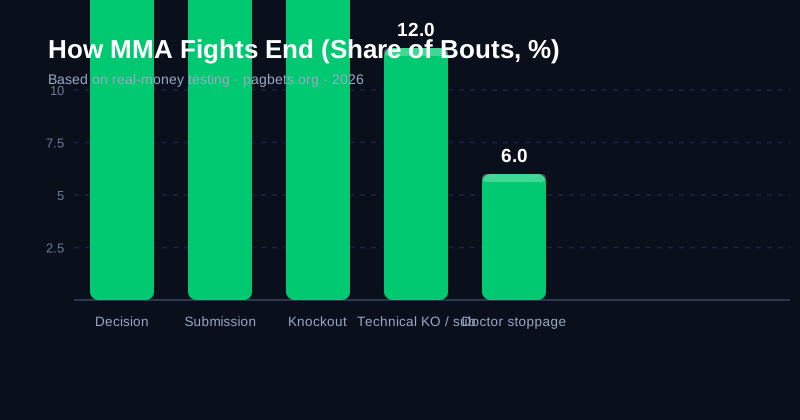
The match winner market covers all three official outcomes plus a draw, which is rare in any individual sport and which is why a draw price exists at all. The method of victory market breaks the result down into knockout, technical knockout, submission, technical submission, decision and doctor stoppage. The round totals market asks how long the fight runs.
On most fight cards, the method and round markets are offered on the main event only, while the match winner is available on every bout. That reflects where the money sits as much as where the analytical interest is.
| Market | What it asks | Typical margin | Payout shape | Best for |
|---|---|---|---|---|
| Match winner | Who wins, incl. draw | Tight | Long on underdogs | Least value usually |
| Method of victory | How the fight ends | Moderate | 20/1 to 100/1 | Good — specific judgement |
| Over/under rounds | How long the fight runs | Moderate | Around 1.7–2.2 | Best in sport |
| Fight to go the distance | Reaches the final bell | Moderate | Around 1.6–2.0 | Good with style reads |
| Props (strikes, takedowns) | Individual stat leaders | Wide | Highly variable | Treat as entertainment |
Judging Fight Length Is the Core Skill
The over/under rounds market is decided almost entirely by style, not by who is the better fighter. A wrestler facing a striker produces a very different expected fight length from a striker facing another striker, regardless of which fighter you think will win.
Work through it in stages. Wrestling versus striking: the wrestler will usually look to take the fight into the later rounds, so the total tends higher and a decision becomes plausible. Two strikers: the opposite — a knockout risk that shortens fights, and the over becomes harder. Two grapplers: the most variable, because a stalemate can persist or a submission can end it at any moment.
The single most useful judgement is whether either fighter has a reason to finish early. A fighter competing for the last two fights of a contract has a strong incentive to produce a finish, which raises knockout probability regardless of their style. Our in-play betting guide covers how this plays out as a fight develops.
- Wrestler vs striker: fight usually goes longer, decision likely
- Striker vs striker: finish risk high, over is difficult
- Two grapplers: highest variance, hard to project
- Title fight (5 rounds): total naturally higher, adjust the line
- Contract fighter: finish incentive raises KO probability
- Ground fighter vs striker: rate of significant strikes decides the market
Why Method of Victory Is Underpriced
Method markets are popular with the public, but the popularity is concentrated on narratives rather than on accurate pricing. A fighter known for knockouts attracts method-of-victory money because his finishes are memorable, not because the price is right.
Two specific errors recur. The first is under-pricing the decision for a dominant wrestler against a defensive fighter — the market over-estimates the knockout chance because the wrestler is famous for finishing people. The second is over-pricing the submission for a wrestler whose submission wins came against opposition with poor grappling defences.
The corrective is to look at how a fighter wins, not how often. A striker with eight knockout wins where six were opponents who walked into a straight left is a worse knockout proposition than their record suggests. Our market structure guide is the natural next step after this one.
What the Closing Line Tells You
UFC cards attract enormous betting volume, and the closing line is correspondingly informative. A fight that has drifted from 2.10 to 2.60 over the day has had money on the other side, and on a major card the market is among the sharpest anywhere in sport betting.
Movement on MMA is usually driven by two things: injury news, particularly a fighter withdrawing or a reported problem days before a bout, and public narrative, which can move a price on a promotional story alone. A sharp, early and sustained move is more meaningful than a late spike, for the same reason as in any other sport.
Beating the closing line consistently is the most reliable measurement of whether your research is adding anything. Our betting journal guide explains how to record it.

Weight Classes and Why the Division Matters
Weight classes are the most reliable way to improve accuracy in MMA, and they are more predictive than a fighter's overall record.
A fighter who has spent an entire career at welterweight and is making a debut at middleweight is moving up a division, and the effect is predictable. Cutting weight is a form of controlled damage, and the consequences compound: reach disadvantage, slower recovery between rounds, a depleted cardio base, and a greater likelihood of a leg or cardio problem ending a fight. Fighters moving down to featherweight from bantamweight usually arrive with genuine physical advantages, and it is why a few making their debut look excellent.
The exception worth noting is a fighter who has previously competed at the lower weight and is returning. Weight cuts are not cumulative in the way people assume — a fighter who has cut repeatedly is not permanently damaged — but the time required to cut to weight increases with each cut, and that time is the real cost.
Weight class also determines the pace of a bout, which feeds directly into the round market. Fighters competing at a division they are a cut lighter than tend to pace conservatively for a full fight, because a long bout at a lighter weight is genuinely difficult. Our live betting guide covers the discipline required to trade these situations.
A Sensible Way to Bet MMA
Pick a small number of markets and learn them rather than spreading across everything. Method of victory and round totals repay study, because both depend on specific style judgements that can be developed over a season of watching.
Record your reasoning, and review after every card. Style judgements are only reliable with evidence, and the pattern of which markets you handle well will appear in the record long before it appears in the balance.
Whatever you bet on, size it small relative to other sports. MMA has a genuine knockout factor that produces variance well beyond what a fight market appears to offer, and a run of results that would be unremarkable in football can be severe here. Set limits with our responsible betting tools guide, and if the betting stops feeling like entertainment, our responsible gambling page lists support options.
- Learn method and round markets, not just the favourite
- Judge style before name, style decides fight length
- Use the closing line as your benchmark, record every price
- Avoid stat-leader props, the margin is very wide
- Watch whole cards, style reads need repetition
- Stake small, knockout variance is severe
- Set limits via our responsible betting tools before a big card