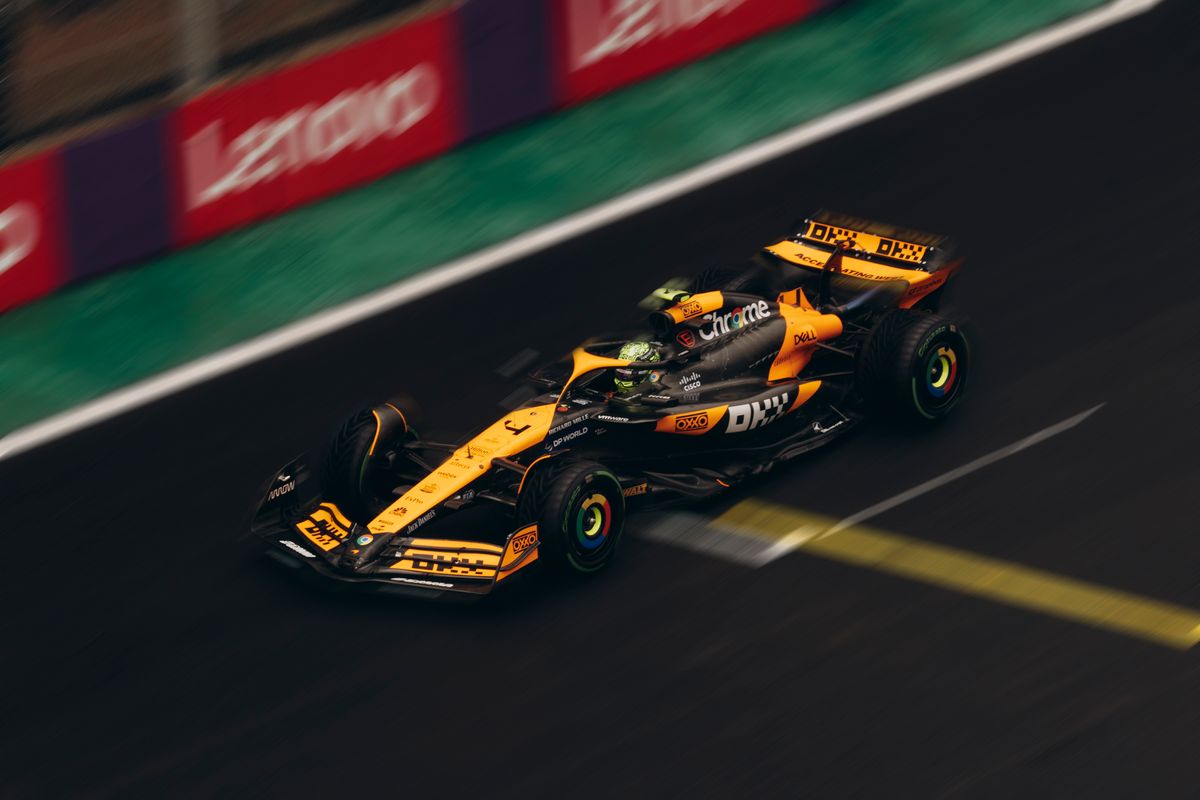
The Most Data-Rich Market in Betting
Formula One produces more usable public data than almost any other sport, and the direct consequence is that its markets are among the most efficiently priced.
Practice and qualifying times, sector splits, tyre compounds, stint lengths, pit stop durations, gap to car ahead, weather — all of it is reported in real time and all of it feeds the price. A market with this much visible information is a market where a casual bettor is on the back foot.
That does not make F1 unwinnable, it makes the edges small and the inputs specific. Our motorsport betting guide covers the broader category, and the trading guide covers the approach that fits a data-rich sport.
The F1 Markets and What Predicts Them
F1 markets range from the race winner, which is tight, to the championship, which is loose.
Predictability falls as the number of events and the number of things that can go wrong rises.
| Market | Predictability | Key input | Why |
|---|---|---|---|
| Qualifying winner | High | Form over last 4 sessions | One car, one lap |
| Podium finish | Medium-high | Grid position and car pace | Three from a strong field |
| Race winner | Medium | Grid plus tyre strategy | Needs pace and luck |
| Points finish | Medium | Finish-rate history | Broader than podium |
| Fastest lap | Low | Tyre age and traffic | Highly situational |
| Championship outright | Low | Season-long projections | Many failure points |
Grid Position Is the Most Underrated Variable
The most useful single input in F1 betting is qualifying position, and the reason is a physical constraint rather than a statistical correlation.
Overtaking requires a substantial pace advantage, because without aerodynamic downforce a following car is running in dirty air, which costs it performance. Two cars of similar pace rarely pass each other on track. A car that is substantially quicker will usually get past.
So qualifying position is not just a proxy for pace — it directly determines the difficulty of every overtake the rest of the race. Our qualifying guide covers the effect in a different sport where the same asymmetry exists.
Tyre Degradation Is What Changes the Expected Order
If qualifying sets the grid, tyre strategy sets the finishing order, and it does so in a way that is well documented before the race.
Modern tyres degrade faster and the circuit determines how fast. A high-degradation circuit punishes a long first stint heavily, which means the optimal strategy is circuit-specific and largely predictable from the previous years at that circuit.
Two public inputs carry most of the signal. The stint lengths drivers ran at the last few races on the same compound, and the compound selection itself, which is usually announced an hour before the race and which frequently reflects a planned two-stop rather than a one-stop.
Safety Car and Weather Are the Genuine Wildcards
Two things can invalidate a well-researched F1 view, and both are worth pricing in rather than ignoring.
A safety car compresses the field randomly, and it can turn a dominant race into an ordinary one or the reverse. The effect on a single result is close to a coin flip, which is why a bettor with a strong qualifying read should be cautious about staking heavily on a race with a high safety-car probability on a street circuit.
Rain has a much larger effect. Wet conditions change the competitive order substantially, because tyre grip differences amplify and the setup teams chose for a dry race is wrong. Rain is forecast, and the forecast is public, but it is the least reliable input in the sport.
A Sensible Routine
F1 rewards preparation because the market is efficient, and a five-minute routine covers most of it.
Check qualifying position and the sector breakdown rather than just the headline time, because a fast sector three is a stronger signal than a good lap. Check tyre stint history at the same circuit and compound. Check compound announcements for a two-stop signal. Then check the weather forecast for anything that will change grip.
Avoid the championship outright unless you are modelling it properly, and prefer qualifying-linked or podium markets where the field is smaller. Our the limits guide is worth reading, because a consistent F1 approach gets noticed.
- Qualifying sectors, not just the lap time
- Tyre stint history at the same circuit
- Compound announcement, a two-stop signal
- Weather forecast for grip change
- Be careful in rain, the order inverts
- Prefer podium to race winner for predictability
- Set limits with our tools guide
The DRS Window Is a Tactical Decision, Not a Privilege
Many bettors treat DRS as a fixed advantage granted to a driver. It is not, and understanding why changes how the race is read.
A driver may activate DRS only when within a set time gap to the car ahead, and that gap is measured in seconds rather than car lengths. So the advantage is only available to a car that is close enough, and the availability depends on the battle rather than on the driver.
The consequence is that a driver in clean air with a large gap has no DRS available and must pass on pace alone. The same driver, once within the window, can deploy it and complete the pass. A live bettor should therefore track not the gap in metres but the gap in seconds, because that is the threshold that matters.
This creates a genuinely useful live signal. A driver about to enter the DRS zone is a driver with a specific tool about to become available, and that is a situation the live price frequently has not yet reflected. Our the in-play guide covers how to act on such a signal.
Qualifying Format and What It Reveals
Modern qualifying is three knockout sessions, and the format tells a bettor something that a single lap time cannot.
Each session eliminates the slowest driver at the bottom. A driver who does not reach Q2 was outqualified on a single lap run in deteriorating conditions, which is a weak signal about underlying pace. A driver who reaches Q3 and is eliminated there was faster than the entire field in the preceding session and still could not match the front.
The most useful information is the gap to the car ahead in the same session, because sessions are run on the same fuel load and the same track conditions. A driver a tenth off the pole time is materially closer to pole than one four tenths off, and the headline position does not convey that.
Our the table tennis guide covers the same principle in a sport with a knockout qualification format, and the odds movement guide covers interpreting the gaps.
The Constructors Market Is a Different Animal
Constructors championship betting is less popular than the drivers market and behaves quite differently, so it is worth a short section of its own.
A constructor's points are the sum of two cars, which means two drivers rather than one. That materially reduces the variance, because one driver having a bad weekend is half the effect rather than all of it.
It also introduces a correlation that the drivers market does not have. Two teammates on the same team at different circuits will frequently have a similar weekend, because the car is the shared factor. A constructor's score is therefore more predictable than either driver individually, and the market frequently prices it as though the two were independent.
That is the analytical opening, and it is a genuine one rather than a story. Our the baseball guide covers the same structure in a sport where team results are similarly the sum of correlated individuals.
Qualifying Trim and the Undercut Trap
Q1 and Q2 are run on soft tyres and the session ends before the fuel window opens, which produces times that are not representative of the race pace.
So a driver who is faster than the car ahead in Q1 may still be slower over a race distance on the same fuel. The reason is that soft tyres overheat quickly and the degradation curve after ten laps is steeper than the outright time difference suggests.
The practical bettor's conclusion is that Q3 matters more than Q1 or Q2 for the grid position, because Q3 runs on the hardest tyre the team has that weekend. A driver who reaches Q3 is on representative rubber. Our the motorsport guide covers the format differences in more detail.