Two Different Kinds of Limit
The phrase 'bet limit' covers two separate restrictions that are constantly confused. The maximum bet is the largest stake a book accepts on a selection. The maximum payout is the most it will pay out if that bet wins. They work together and the second is often the one that surprises people.
Consider a book that accepts a £5,000 stake but caps payouts at £4,000. A £5,000 bet at 2.00 would win £5,000 profit, but the cap means only £4,000 is paid. This is precisely why professional punters split larger stakes across several books — not for convenience, but because a cap silently reduces a winning bet's return.
Where Limits Come From
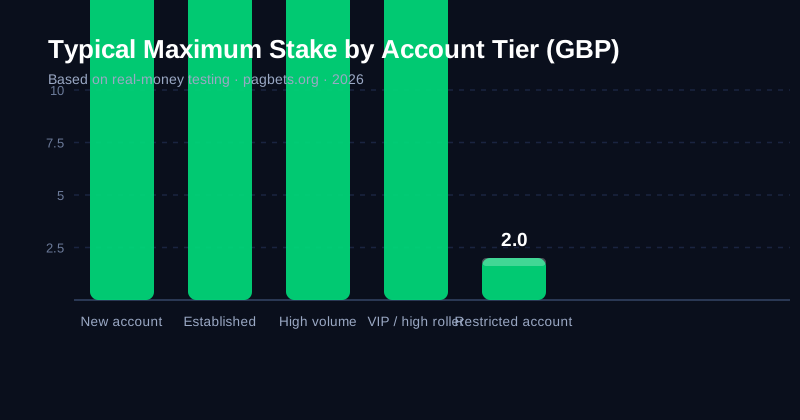
Every book builds limits around the risk it is willing to carry on any single outcome. A heavily-backed favourite on a major fixture carries enormous liability, so the limit on that selection will be far lower than on an obscure match. Limits also scale with your own account history, which is the mechanism by which a book reduces exposure without telling you directly.
The scaling is usually progressive but not always linear. New accounts often start with moderate limits, rise as turnover accumulates, and fall again if results turn. Accounts that bet rarely but accurately can find their limits cut surprisingly quickly, because the book judges exposure from the pattern of your selections rather than the size of your deposits.
- New account: modest limits while the book establishes your pattern
- Established, low-volume account: limits often rise with turnover
- High-volume account: the highest limits available
- Restricted account: limits reduce, often without explanation
- Popular fixture: tighter limits than an obscure match at the same operator
How to Find the Limits Before You Bet
Limits are usually visible in the bet slip, though not always clearly. Adding a large stake to a selection frequently triggers a message such as 'maximum stake accepted: £250' before the bet is placed, which is the most reliable way to discover a limit in practice. Some books publish their limit tables in the help section, and a few will tell you directly if you contact live chat.
The habit worth building is to find the limit before committing, particularly for any bet you consider larger than your normal stake. Discovering a limit at the moment of placing a bet is inconvenient; discovering it after a winning bet has been partially voided is expensive.

What Getting Limited Actually Tells You
Being limited is uncomfortable, but it is also information. It means the book has concluded that your betting is costing it money over time, which is a more objective assessment of your results than your own account balance. Many punters who reach a restriction are winning and treat it as a problem; it is arguably a validation.
The genuine problem is what people do next. The predictable responses — opening a second account, or deliberately placing bets to look recreational — are how terms of service get breached and accounts get closed, and closure is strictly worse than a limit. The productive response is to decide whether the strategy you are running is one you want to continue at reduced stakes.
| Situation | What it usually means | Reasonable response |
|---|---|---|
| Limit lowers slightly | Normal account management | Accept and continue at new stake |
| Limit cut sharply | Book has identified profitable play | Reduce stakes or change approach |
| Bet voided as void stake | The book has voided a strategic bet | Stop and reassess entirely |
| Account closed | Terms breached or profit recognised | Do not open another account |
Reading Your Own Limit as Information
The most useful response to being limited is diagnostic rather than emotional. A limit cut is the book telling you, in unambiguous terms, that your betting has been costing them money consistently. That is a more objective assessment of your results than your own account balance, and it deserves to be treated as useful information rather than as a personal slight.
From there the question is whether your approach still works at the smaller size. This sounds obvious and is frequently ignored. A strategy that produces a worthwhile return at £200 may produce nothing meaningful at £10, because the research time is identical while the return is not. Recognising this quickly is valuable, because it stops you grinding a method that has stopped paying.
It is also worth being clear about the boundary. Spreading a stake across several legitimate accounts is ordinary practice. Opening a second account with the same operator to work around a restriction is a clear breach of terms, and the predictable outcome is closure, which is strictly worse than a limit. Our guide to choosing a bookmaker covers what to assess beyond the headline bonus.
Why Withdrawal Speed and Limits Are Related
Limits and withdrawal speed are usually discussed separately, but at a serious level of betting they are two aspects of the same thing: how much exposure the operator is willing to carry. An operator that suspects your account is profitable has reason to be cautious in both directions, and the practical consequence is that a reduced limit often arrives alongside slower withdrawals or additional verification requests.
This is not misconduct on the operator's part — verifying withdrawals is entirely standard and protects customers as well. But it is a real cost, and it should be priced in. A large withdrawal queue during a period when you need the funds is a materially worse position than the same delay would be if you had not been heavily restricted.
The practical lesson is to keep betting with more than one operator, so that no single account is carrying your entire bankroll. It also argues for withdrawing profits periodically rather than accumulating them indefinitely. Neither practice is about distrusting any individual book; it is simply not sensible to have a single point of failure in your finances.
Multiple Accounts and Where the Line Sits
Most operators prohibit holding more than one account per person, and enforcing that is straightforward through identity verification, payment method matching and device fingerprinting. The rule is not a technicality, and treating it as one is the most consequential mistake a limited bettor can make.
What is permitted is ordinary multi-book usage. Opening accounts with several different operators, each within its own terms, is how the betting industry has always worked and is not restricted. The distinction is entirely about whether you are using separate books or multiple accounts with the same book.
Some players operate in a grey area, using different payment methods to suggest they are different people. This is a breach, it is detected more often than operators let on, and the consequence is closure with any balance withheld. The expected value of that manoeuvre is negative, because a closed account with funds retained is strictly worse than a limit you dislike. Our guide to identifying reputable operators covers what a fair set of terms actually looks like.
Working Comfortably Inside Limits
If your limits have been reduced, the honest question is whether your strategy still works at the smaller size. Many do not: an edge that produces a meaningful return at £500 becomes marginal at £20, because the fixed effort of researching a bet is the same either way. Recognising this early is valuable, because it stops you grinding a strategy that no longer earns its time.
Spreading a stake across several books is legitimate and effective, provided each book permits it. It is not permitted to hold multiple accounts with the same operator to work around a restriction, and that is a clear breach rather than a grey area. The reasonable version is simply checking your limits, planning your largest bet in advance and choosing your book accordingly.
- Check the maximum stake in the bet slip before committing
- Ask live chat about payout caps on larger odds
- Plan large bets in advance rather than discovering limits live
- Split across operators where each account is legitimate
- Never open a second account with the same book to bypass a limit
- Keep stakes within limits set in our responsible betting tools guide