
Why Bankroll Management Beats Betting Skill
Ask any bookmaker what separates the customers who last from the customers who bust, and the answer is rarely luck or knowledge — it is money management. A losing streak of ten bets is statistically guaranteed over a long enough timeline, and the only question is whether your bankroll survives it. Bankroll management is the answer: a fixed set of staking rules that keeps you solvent through variance.
This guide covers the system we recommend after six years of testing bookmakers: how to size a bankroll, the two staking methods that work, stop-loss rules, and the psychological traps that break discipline.
Step 1: Build a Real Bankroll
A bankroll is money you can lose without consequence — not rent money, not savings, not borrowed funds. The moment you bet money that matters, decisions stop being rational and staking rules collapse. Our house rule: the bankroll is funded once, from disposable income, and never topped up mid-month.
- Decide a monthly entertainment budget you can afford to lose
- Move it to a separate e-wallet or account used only for betting
- Never borrow to bet, never deposit rent or bill money
- If the bankroll reaches zero, stop for the month — no exceptions
Step 2: Flat Staking — The Simplest Working System
Flat staking means betting the same fixed amount on every wager: typically 1–2% of your initial bankroll. With a $500 bankroll, that is $5–$10 per bet, every bet, whether you are on a hot streak or a cold one.
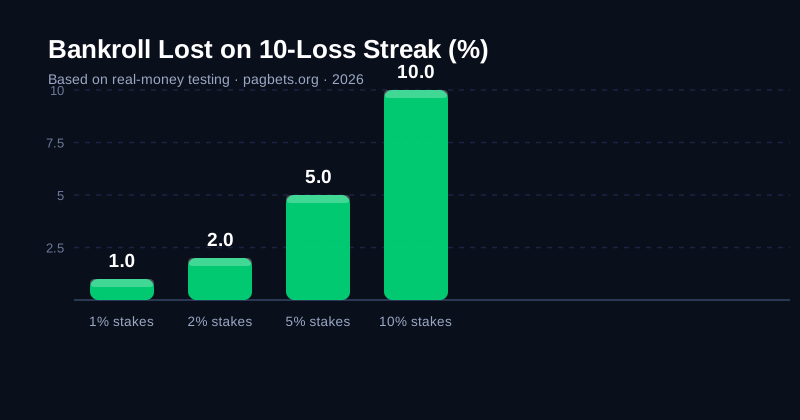
Why it works: a 10-bet losing streak at 2% costs 20% of your bankroll — painful but survivable. The same streak at 10% per bet costs 100% and ends your month. Flat staking doesn't promise profits; it promises survival, and survival is what lets good decisions compound.
| Stake % of bankroll | 10-loss streak cost | Result |
|---|---|---|
| 1% | 10% | Minor setback |
| 2% | 20% | Survivable |
| 5% | 50% | Serious damage |
| 10% | 100% | Bankroll gone |
Step 3: Percentage Staking — The Upgrade
Percentage staking is flat staking with a recalculating stake: bet 1–2% of your current bankroll before each bet. After losses your stakes shrink automatically, which slows the bleed; after wins they grow, which compounds profits. It is slightly more maths but strictly safer than fixed stakes.
Most professional bettors use a variant of this, adjusting the percentage by the size of their estimated edge. For recreational bettors, a flat 1–2% without edge adjustments is the honest version.
Stop-Losses: The Rules That Save You From Yourself
Staking rules are useless without stop rules. Our recommended set, refined over years of testing sessions:
- Daily stop-loss: close the app when you're down 5% of your bankroll today
- Weekly review: Sunday night, download your betting history and look at it honestly
- Monthly cap: never deposit more than your predetermined monthly budget, no matter how good the weekend looks
- Tilt protocol: after two consecutive losses in live betting, stop live betting for the day — live bets punish emotion fastest
The Chasing Trap (And Why Martingale Fails)
Chasing — doubling stakes after losses to "win it back" — is the most expensive idea in betting. The martingale logic assumes unlimited bankroll and unlimited table limits; reality provides neither. A 10-loss streak at even money happens roughly once in every 1,000 sequences, and when it does, a martingale bettor is staking 1,024 units to recover one.
The correct response to a losing streak is the opposite: smaller stakes (percentage staking does this automatically), a stop-loss, and a review of whether your selections actually had value.

Bankroll Management and Bonuses
Welcome bonuses interact with bankroll rules in one important way: bonus funds usually cannot be withdrawn until wagering is cleared, so your real bankroll is your deposit while the bonus is a separate balance. Never deposit more than your budget just to unlock a bigger bonus — the 125% offers at Mostbet or 1xBet only make sense if the deposit itself was within your plan. Our bonus maths guide explains the wagering arithmetic.
Putting It Together: A Sample System
A concrete example. Bankroll: $300 (your monthly entertainment budget). Staking: flat 2% = $6 per bet. Daily stop-loss: -$15 (5%). Weekly cap: 20 bets. At the end of the month, withdraw any profit above $300 and reset. That system will not make you rich — no staking system can, because staking does not create edge — but it will keep you betting next month, and next year.
Final Rule: Bet Like a Business
Businesses survive because they plan for losses before they happen. Your betting should work the same way: fixed budget, fixed stake size, fixed stop-loss, fixed review cadence. Write the rules down, follow them for a month, and compare the results with your previous month of undisciplined betting. Most bettors we've guided through this process are surprised by how much less they lose — and how much more they enjoy betting.