
The Arithmetic Behind Every Accumulator
Everything about accumulator betting follows from one rule: the odds multiply. Three legs priced at 1.50, 1.80 and 2.00 give you 5.40, and your stake wins only if all three are correct. The probability follows the same logic in reverse — roughly 67% times 56% times 50% gives about 19%.
This is the trade that defines the market. You are exchanging a large amount of probability for a larger amount of price. The question is never whether the price is big; big odds are automatic. The question is whether the accumulated probability is still high enough to be worth the price on offer.
How Many Legs Before It Stops Working
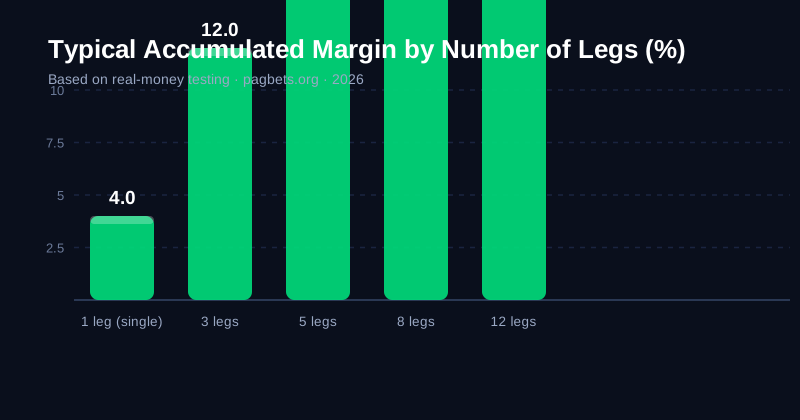
Each additional leg removes a meaningful slice of your chance. Start with a selection at an even chance of 50% and add four more at the same price, and your chance of winning falls to about 3%. At twelve legs, it is well under 1% — which is why a twelve-fold priced around 200.0 still seems tempting and is very rarely a good bet.
The practical guidance most experienced punters settle on is three to six legs. Below three you are often better off with singles, because the bookmaker's margin compounds with each leg. Above six, the accumulated margin becomes the dominant problem: a 4% margin on each of eight legs becomes roughly 36% on the overall bet, which quietly consumes most of the value you thought you had.
| Legs | Typical chance of winning | Typical combined margin | Practical verdict |
|---|---|---|---|
| 1 | Around 45–50% | 4% | Best for value |
| 2–3 | Around 20–25% | 8–12% | Workable |
| 4–6 | Around 5–10% | 16–24% | Needs strong legs |
| 7–10 | Around 1–3% | 28–37% | Margin dominates |
| 11+ | Below 1% | 40%+ | Rarely justified |
Same Game Builders Are Not Two Bets
Modern bet builders allow multiple selections from a single fixture, and this is where most confusion comes from. Combining 'home win' with 'over 2.5 goals' feels like two separate opportunities, but both are decided by the same match and largely by the same goals. They are correlated, not independent.
Correlation sometimes works in your favour. If your read is that a team will dominate and win comfortably, then a same game builder pairing their win with a goals total is two expressions of one strong opinion, and the combined price may understate your conviction. It is dangerous when you combine selections that are mechanically linked in a way you have not considered — backing a favourite to win and the same match to go under 2.5 goals is not a free doubling of odds.

How to Build a Selection Worth Combining
The best accumulators are not collections of long shots. They are collections of short prices that you believe are slightly too short — each leg individually unremarkable, but each one better than its offered price. If a leg only makes sense at 5.00, it does not belong in the accumulator, because you will need all the other legs to compensate for how unlikely it is.
A workable method is to start with your strongest single selection, then add legs at 1.40 to 1.65 that you would happily back alone at a modest stake. Keeping legs inside that range means your accumulator's failure is driven by normal variation rather than by one improbable pick, and it keeps the compounded margin in a manageable range.
- Start from your strongest view, not from a long price
- Keep most legs between 1.40 and 1.65 to limit compounded margin
- Avoid legs you would never back alone, no matter how tempting the price
- Check for correlation in same game builders
- Prefer 3–6 legs, not 12
- Treat accumulators as fun, and stake singles with your main bankroll
When Accumulators Are the Wrong Choice
There are situations where a single is clearly better than an accumulator, and recognising them is part of using the market well. The most obvious is when you have one genuinely strong view and three others you would not back alone. A four-leg accumulator built around one conviction and three coin flips is strictly worse than a single on the conviction, because the three weak legs add margin and reduce probability without adding anything you believe.
A second case is when the marginal leg is a long shot added to reach a round number. Punting from a five-leg at 30.00 to a six-leg at 60.00 for a staked doubling has a poor ratio of additional risk to additional return, and the round-number appeal is psychological rather than mathematical.
A third case is when you are building the accumulator to qualify for a promotional offer rather than because the selections are collectively sound. A bonus that requires a minimum accumulator leg count is a genuine product decision by the bookmaker, and meeting it with selections you would not otherwise take converts an incentive into a cost.
The discipline is to build the accumulator from the legs outward — start with the best selection and add only those that improve the overall bet — rather than starting with a required leg count and filling it.
Free Bet Stacking and Where It Genuinely Helps
Bet builders have one clear strategic use that is well worth understanding: converting a free bet into guaranteed value. A free bet returned as stake-not-returned, offered on a market such as match result, can be laid or bet on the exchange, and the result is a small but reliable return with no financial risk.
The same principle applies to bookmaker credits, matched betting and free bet offers generally, and it is genuinely the most reliable way to extract value from them. The difference with a bet builder is that the accumulator structure is a constraint rather than a strategy — the free bet is forced into a multi-leg market, which increases the chance of losing it.
Where that matters is in deciding how to use a free bet at all. A free bet that can be used on a single outcome is worth more than one restricted to a three-leg accumulator, because the accumulation is a tax on the effective value. Before accepting an offer, check whether single use is permitted — our free bet guide covers the mechanics in full.
Reading Accumulator Prices as a Signal
Accumulator prices carry information that is easy to miss. If a book offers a five-leg at a price that implies a probability clearly below what the individual legs would suggest, the margin on that market is unusually wide — which sometimes means the market is thin, and sometimes that the book is protecting itself against a correlated pattern it has spotted.
This is a genuine reason to be cautious with same game builders in particular. When the combined price is worse than the legs would justify, something is being priced that the algorithm is wary of, and that is not a good sign for the bettor. By contrast, an accumulator price that looks generous relative to its legs often reflects a genuinely thin market with limited liability, which is a better environment for value.
The practical check is simple arithmetic that most bettors never do. Estimate the probability of each leg from its price, adjust for margin, multiply them, and compare with the offered accumulator price. If the accumulator is worse than your estimate of the true product, there is no value in it, however appealing the number looks.
Staking Accumulator Bets Properly
Because accumulators win infrequently, the temptation to stake more on them is strong and wrong. An accumulator that wins once in eight is perfectly viable as a small recreational bet and a poor way to deploy a bankroll. If your accumulator strategy is genuinely profitable, it will be profitable at a small flat stake; if it only works at a large one, it is not profitable, it is simply high variance.
The sound approach is to stake accumulators at a fraction of what you stake on singles, and to accept that most of them will lose. Our accumulator betting guide covers the mechanics in more detail, and the staking discipline in our bankroll management guide applies directly.