
The One Idea Behind Professional Betting
Every profitable bettor in the world is doing the same thing: buying outcomes for less than they're truly worth. That's value betting — and it's the entire professional edge, stripped of jargon. You don't need to win most of your bets; you need the bets you win to pay more than the risk deserved.
This guide explains the maths, the estimation process and the discipline, with the tools we use when auditing bookmakers' odds ourselves.
Expected Value: The Maths That Decides Everything
Every bet has an expected value (EV): the average profit or loss if you placed it a thousand times. The formula: EV = (win probability × profit) − (loss probability × stake).
Example: $100 at 2.50 odds, where your analysis says the true win chance is 45%. Profit on a win is $150. EV = (0.45 × $150) − (0.55 × $100) = $67.50 − $55 = +$12.50. Positive EV bets make money on average; negative EV bets lose it. The bookmaker's margin guarantees most bets are negative EV — your job is to find the exceptions.

| Odds | Your true probability | EV on $100 stake |
|---|---|---|
| 2.50 | 45% | +$12.50 (value — bet) |
| 2.50 | 38% | -$5.00 (no value — skip) |
| 1.80 | 60% | +$8.00 (value — bet) |
| 1.80 | 50% | -$10.00 (no value — skip) |
Estimating True Probability: The Hard Part
The formula is easy; the honest probability estimate is the entire skill. Three estimation methods work for non-professionals. Market consensus: take the average odds across several bookmakers as the market's probability, then bet where one bookmaker's price implies meaningfully less. Model-based: build a simple model from a few predictive stats (for football: expected goals; for cricket: venue-adjusted batting strength). Specialist knowledge: in markets you follow deeply, your informed estimate can genuinely beat the market — this is where recreational bettors have a real shot.
- Write your probability estimate BEFORE looking at any odds
- Be brutally conservative — most bettors overrate their own edge
- Specialise: one league, one market, followed deeply, beats surface knowledge everywhere
- Log every estimate and compare it with results quarterly
Closing Line Value: The Proof You're Doing It Right
How do you know your estimates are any good? Track closing line value (CLV). If you consistently bet at prices better than the closing line — the final odds before kick-off — you're beating the most efficient market price, and that's the standard professional proof of edge. Bet365 publishes closing lines automatically; most bookmakers let you export your bet history for comparison.
A bettor with 51% winners at prices that beat the close is profitable. A bettor with 55% winners who consistently pays above closing prices is still losing value. The percentage of winning bets is vanity; CLV is the metric.
Where Value Actually Appears in 2026
Value isn't evenly distributed. In our testing it concentrates in four places: niche markets (lower-tier football leagues, T20 cricket outside the IPL, obscure tennis tours) where bookmaker models are thinnest; early lines, before sharp money corrects them; promotional boosts, where the bookmaker subsidises the price deliberately; and cross-bookmaker gaps, where one site's price on a market lags the consensus. The mainstream markets — Premier League match winners, Champions League outrights — are priced to within fractions of a percent and offer almost nothing.
The Value Bettor's Daily Process
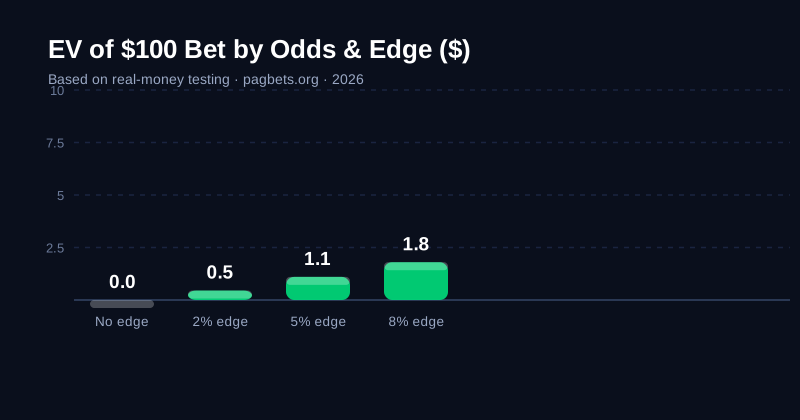
Process beats inspiration. The routine: pick your specialist markets, estimate probabilities first, scan 2–3 bookmakers for the best price, bet only when your estimate beats the best available odds by a margin you've defined in advance (2% is a sensible starting threshold), stake flat at 1–2% of bankroll, and log everything. Thirty minutes a day of this — most of it logging — outperforms four hours of instinct.
The Honest Limitations
Value betting has a ceiling for most people: bookmakers limit or close accounts that consistently beat the closing line, edges shrink as markets get smarter, and true skill takes months to develop. What it reliably delivers is something better than profit: a process that converts betting from a negative-EV hobby into a nearly break-even discipline — and for the few who genuinely specialise, a modest long-term edge.