
Why Prices Move at All
A betting price is not a statement of fact. It is a risk management tool, and it changes for two broad reasons. The first is new information: team news, a weather forecast, a late injury, a change of venue. The second is new money: someone has staked, and the bookmaker adjusts the price so that the liability on that side stays within tolerance.
Understanding which of the two is happening matters more than most beginners realise. If a price drifts because a bookmaker is trimming liability, that tells you very little. If it moves because a well-informed stake arrived hours ago, that is a signal worth acting on — though never on its own.

Opening Line, In-Play and Closing Line
The opening line is the first price published. It is usually a broad estimate based on public information and the book's own model. It is rarely sharp on its own but it is a useful baseline for measuring how much the market has moved.
The closing line is the last price before suspension. It carries the most information because by that point all money and all news have been absorbed. When a line has moved from -0.5 to -1 and stayed there for several hours, the market has settled on a firm view. When it swings late and violently, something specific happened.
| Stage | What it represents | How much to trust it |
|---|---|---|
| Opening | First public estimate, book model only | Low on its own |
| Early move | First meaningful money or news | Worth watching |
| Mid-week | Informed money has largely landed | Moderate to high |
| Closing | Final fully-informed price | Highest |
| In-play | Live, reacts to the match itself | Very situational |
Shortening, Drifting and Steam
Three terms describe almost everything you will see. A price that shortens is falling in decimal terms — 2.40 becomes 2.00 — because money has arrived on that selection. A price that drifts is rising, usually because money has gone elsewhere or the bookmaker is reducing liability on a selection that attracted too much.
Steam is the sudden, sharp move that happens when a large stake lands. A team steaming from 2.00 to 1.75 in a few minutes is a market reacting to meaningful money. Steam is a warning as much as a signal: it often means the price has already moved past the point of value, and chasing it is how beginners give away their edge.
- Shortening: money on that selection, or new information supporting it
- Drifting: money away, or the book trimming risk
- Steam: a large stake landing quickly — often already too late for value
- Suspended: the market has closed, usually because of a team news alert

Margin, Overround and Why Prices Are Never Fair
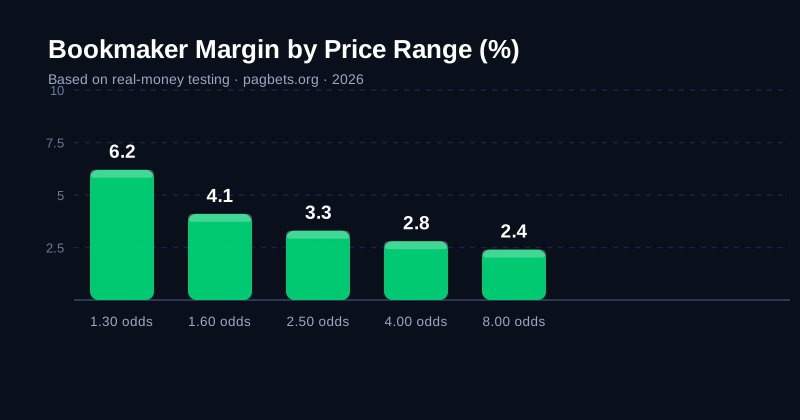
Every book has a margin built into the prices, which is why a market's implied probabilities add up to more than 100%. A three-way market priced at 2.10, 3.40 and 3.80 implies roughly 48%, 29% and 26% — a total of 103%. The extra three points are the bookmaker's edge.
For a bet to be a value bet, your own estimate of the probability has to be higher than the implied probability after you allow for the margin. That is the whole discipline. It is also why a small movement matters: a price moving from 2.00 to 1.95 removes implied probability, and if your own number has not changed you have just made a slightly worse bet.
What Movement Tells You About a Match
Patterns of movement carry information that no single price does. A team that opens at 3.00, drifts to 3.40 and then shortens sharply to 2.80 has told you something quite specific: an early move away from the team was reversed by stronger counter-information. That is a different signal from a steady one-way drift, and experienced traders treat a reversal as more meaningful than a smooth trend.
Timing is the second layer. A movement at 10am often reflects early-morning news and recreational money. A movement in the final ninety minutes before kick-off is typically the result of informed money, because those bettors have had the full day to assess team news and can be certain of their final line-up. A late, sustained move is worth more than a large early one.
Finally, treat the market as a check on your own thinking rather than a substitute for it. If the price disagrees with your assessment, the most valuable question is not 'who is right' but 'what am I missing'. Most price movements that appear to contradict a confident view turn out to reveal information the view did not account for — frequently a minor injury that changes a tactical assumption.
How to Keep an Eye on Line Movement Efficiently
You do not need to watch prices continuously to benefit from them. The most efficient routine is to check twice: once when the market opens, and once in the final couple of hours before kick-off. Those two checks capture the opening baseline and the closing consensus, which is the pair that matters most.
Where a price has moved dramatically in between, a third check is worthwhile, and it is also the point at which a reason should be identifiable. A team moving from 2.50 to 2.00 overnight has usually had a clear cause — a team news report, a venue change, or a significant market. If you cannot name the cause, treat the move as noise rather than as information.
Keeping a simple note of the opening and closing price for the markets you follow takes under a minute per match and becomes a reference base over a season. Comparing your own assessments against those recorded prices is how you discover whether your judgement is genuinely better than the market's, or whether you simply remember your good calls and forget the bad ones.
A Worked Example of Reading a Price
Take a mid-sized league fixture where the home side opens at 2.60. You assess the match and consider the home team worth 2.30 — a small but real edge. Over the following two days the price drifts to 2.80, which on the surface suggests the market disagrees with you more strongly.
Check the timing before reacting. The drift happened gradually through the afternoon rather than in a single move, which usually points to distributed recreational money rather than a specific piece of news. The closing price settles at 2.75. On a market with typical margin, a closing price of 2.75 implies a probability of roughly 36%, which is close to your own estimate and comfortably better than the 2.60 you were offered.
That is a value bet: your assessment, taken before the market finished adjusting, produced a price better than the eventual consensus. The edge here is not dramatic and it is not the kind of movement that appears in betting tips. It is a few points of price, available because you formed a view earlier than the market settled. That is the ordinary, unglamorous version of beating the market, and doing it consistently is the whole discipline.
Turning Movement Into a Process
The mistake is treating movement as a tip. The better approach treats it as one input among several, weighed alongside team news, form, motivation and your own read of the match. A price that moves for a reason you understand is useful. A price that moves for a reason you cannot identify is noise.
A workable routine is short: check the opening line, note the current line, look for movement that is early and sustained rather than late and sudden, and then ask whether your own assessment justifies the price on offer. If you cannot articulate why a price moved, do not trade on the fact that it moved.
- Before the market opens, write down your own fair price for the match
- Check the opening line and note the difference from your estimate
- Track movement and ask what could have caused it
- Prefer early, sustained movement over late spikes
- Never chase a steamed price expecting it to keep falling
- Review results monthly using the closing line as your benchmark
- Set limits with our responsible betting tools so that analysis never turns into chasing