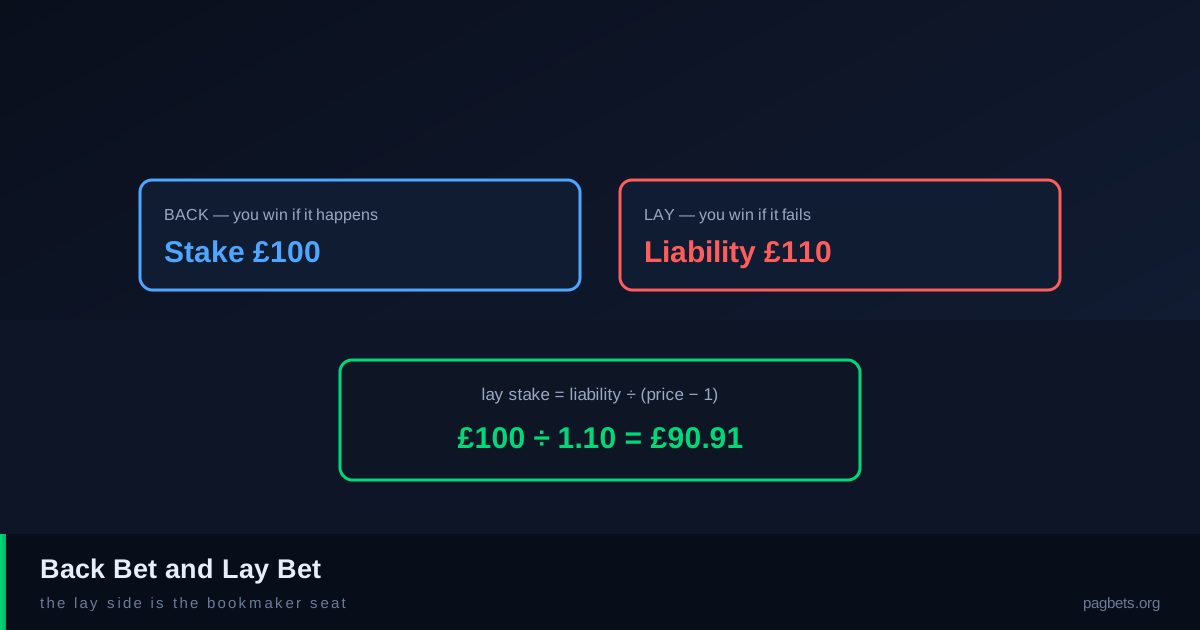
A Lay Bet Means You Are the Bookmaker
Every betting transaction has two sides and you only ever see yours. Back at the book and you are the customer: you pay a stake, you receive the stake back plus winnings, and the bookmaker carries the risk. Lay at the exchange and you are the other half of that. You set a stake, the exchange works out what you owe if you are wrong, and you take the role that every recreational bettor thinks they are taking.
That is genuinely the concept, and it is where the useful behaviours come from. When you lay, you are thinking about what has to happen for you to be wrong, which is the question the bookmaker asks every time it accepts a back bet. The instinct that says "I am right, therefore I should back" is exactly backwards. If your edge is real, you should be taking the other side of it.
The second consequence is the one that produces the discomfort. Laying is asymmetric by construction. The most you can win is a stake you chose. The most you can lose is a liability the exchange chose, and it is usually several times larger. That asymmetry is the source of both the mis-selling and the misjudgement. The full exchange mechanics are in our betting exchange guide; this page is about the lay bet itself.
Lay Stake Versus Lay Liability: The Two Numbers
This is the bit that makes beginners quit, so let us make it clear. You set the lay stake. The exchange calculates the lay liability. They are not the same, and the liability is always the bigger number unless the lay odds are 1.01.
You win the lay stake if the selection loses. You pay the lay liability if it wins. Both formulas in one line: liability equals lay stake times (lay odds minus one).
At 2.00 the two are identical, which is exactly why 2.00 is a special number in betting. At 2.20 a lay stake of 100 gives a liability of 120. At 3.00 it gives 200. At 10.00 it gives 900. The further from evens you go, the more brutal the ratio, and that is the mechanical reason high-odds sides are hard to trade.
The skill that matters is thinking in liabilities rather than stakes, because the liability is what your bankroll absorbs. If your bankroll is 500 and you want at most 200 at risk, your lay stake at 3.00 is 200 divided by 2, so 100. Not 200. Our bankroll management guide is worth reading alongside this because the two ideas are inseparable.
Lay Stake, Liability and the P/L
One reference table covering most of what you will ever lay. The final column is what you collect if the selection wins, at 2 per cent commission on winnings only.
| Lay odds | Lay stake | Lay liability | P/L if selection loses | P/L if it wins (after 2%) |
|---|---|---|---|---|
| 1.20 | 100 | 20 | Plus 100 | Minus 20 |
| 1.50 | 100 | 50 | Plus 100 | Minus 50 |
| 2.00 | 100 | 100 | Plus 100 | Minus 100 |
| 2.20 | 100 | 120 | Plus 100 | Minus 120 |
| 2.50 | 100 | 150 | Plus 100 | Minus 150 |
| 3.00 | 100 | 200 | Plus 100 | Minus 200 |
| 4.00 | 100 | 300 | Plus 100 | Minus 300 |
| 15.00 | 100 | 1400 | Plus 100 | Minus 1400 |
| 1.25, liability 100 | 80 | 100 | Plus 80 | Minus 100 |
| 3.00, liability 500 | 250 | 500 | Plus 250 | Minus 500 |
A Worked Trade, Start to Finish
Lay a 2.20 shot for a stake of 100. Liability is 120. Exchange commission is 2 per cent on winnings.
The selection wins. Your lay bet loses. You pay 120. Commission is not charged because you made no profit. Net minus 120.
The selection loses. You win 100. Commission takes 2. You receive 98. Net plus 98.
So you are risking 120 to win 98. That is the honest description of a lay bet at 2.20, and it is why "the exchange gives you 2.20 so lay bets are free money" is a misunderstanding. The price is 2.20 because that outcome is less likely than half. Break-even is 45.5 per cent, and the exchange margin means it needs a little more than that. Your job is to believe the true probability is meaningfully below 45.5 per cent.
Note the asymmetry running the other way. Because commission only comes off wins, the two outcomes are never symmetric even at 2.00. Winning costs you 2 per cent of the stake; losing costs nothing beyond the liability. On frequent small trades that adds up faster than most people expect.
Exchange Commission, and When It Makes Laying Wrong
Exchange commission is the largest hidden cost in lay betting and it is not comparable to a bookmaker margin.
Commissions run from 2 to 5 per cent at the major exchanges, and a few operate on no commission with a marginally wider spread instead. The difference matters enormously for high-frequency small trades, which is the matched-betting and scalping end of the market, and much less for a handful of considered positions over a season. At 5 per cent, a 2.00 lay of 100 returns 95 when it wins. At 2 per cent it returns 98. Over a hundred trades that is a 300-unit swing, which is the whole bankroll of a small account.
There is a subtler effect that catches experienced traders. Because commission only applies to wins, a high rate makes you systematically prefer the outcome in which you win the smaller amount. If a bookmaker offers 2.10 and the exchange offers 2.00 on the other side, the 2.10 looks like a better lay because of the commission. Net of it, the 2.00 side can be the better trade. Always net out commission before deciding, because a calculator that ignores it will send you to the wrong side of the market fairly often. Our margin guide explains why the same economic pressure appears differently at a book and at an exchange.
Why Liability Makes Laying Feel Bigger Than It Is
A lay of 100 at 3.00 puts 200 of your bankroll at risk, which feels like a huge bet, and the emotion that generates is why most people never lay. It is also, in a specific sense, a misreading.
Your exposure is 200. Your expected loss is 200 multiplied by the probability the selection wins. At 3.00, break-even is 33.3 per cent, so if you believe the true probability is 30 per cent, your expected value is 0.70 times 100 minus 0.30 times 200, which is plus 10. On an expected basis you are risking 200 to make 10. The variance is enormous and the expected gain is small.
That is the real trade-off, and it is why professional traders are extremely picky about lay prices. The same lay on something you rate at 28 per cent gains 16 with a similar standard deviation, and the difference between those two positions is the whole discipline. Value betting mathematics is the long version of that sentence.
The other thing the large number does is hide the small one. At 1.20 a lay of 100 risks 20 to make 100, which sounds like a gift and is not, because 1.20 implies an 83 per cent chance and you would need to beat that to profit. Low-odds lays have a much better liability-to-reward ratio and a much worse win rate requirement, and beginners consistently have this backwards.
Three Reasons to Lay, in Order of How Often They Work
Laying is a tool, not a stance. There are three situations where it is the right call, and a long list where it is a bad habit.
Taking a price on something you rate shorter than the market. This is the pure use. If your model says the true probability is 44 per cent and the exchange offers 2.00, break-even is 50, so lay. No view on the result beyond the probability estimate, and no correlation to worry about because you are not modelling the opposing side. This is the best of the three by a distance.
Fading a market overreaction. A red card, a sending-off, a late injury, a price move on news you think is already in the number. If a team go down to ten men and their price collapses from 1.90 to 1.20, part of that is real and part is an overreaction you can lay. The test for telling them apart: ask what the price would be if you scored the event yourself.
Insurance and matched exposure. Laying is how you hedge a position you already hold, which is the whole basis of matched betting and the reason a bonus converts to cash. Our matched betting guide runs the full arithmetic. The cost of that insurance is the qualifying loss, a known, small, certain cost, which is exactly what makes it worth paying.
What laying is not is a way to feel clever. Laying a team because their fans booed them, or laying every favourite on a losing day, is a systematic way of paying commission to a market that has already made money.
Lay Bet Versus Short Betting
These get confused constantly and they are not interchangeable, though they are the closest available substitutes.
A lay bet is you standing as the bookmaker. The exchange sets the price, you choose your exposure, and if you are wrong you lose exactly the liability. Your loss is capped and the outcome is binary.
A short, in the sense of shorting a price on an exchange, is selling a bet to somebody who wants to take it. Structurally the same trade with a different counterparty profile: you are on the other side of a specific trader rather than the exchange book. If that trader disappears mid-position, your exposure changes.
Three differences matter. Exposure: with a lay you know your exact liability at the moment you place it, with a short it can shift with subsequent trading. Availability: lay odds exist on more markets and more often, shorts on fewer. Price quality: shorts can occasionally be marginally better on popular markets and markedly worse otherwise, while lay odds are the public exchange price for everyone. Learn the lay first. It has one number to think about, and that number is fixed the moment you click. Everything else is a variation on it, including the market-making version in our sports trading guide.
Eight Mistakes That Cost Real Money
Every one of these is common, and the first three account for most of the losses I have seen from new layers.
- Staking the lay stake instead of the liability. Entering 500 at lay odds 3.00 because that is the amount you can afford risks 1,000. Always check the liability field.
- Laying first, backing second. Place the lay on the exchange, then the back. If the price moves in the gap, a back-first sequence leaves you naked on a directional position.
- Backing outside the price limit. Add a generous limit to the back bet. If the price has moved past it the bet is void, not a loss, and you have laid at a price you no longer like.
- Laying too low a price. At 1.20 you need an 83.3 per cent hit rate. People lay at short prices precisely when they are nervous, which is the wrong time to need that.
- Ignoring commission when comparing sides. Calculate net of commission, not gross. The book price and the exchange price are not comparable at face value.
- Fading a price move without a reason. A price that has moved 30 per cent has almost certainly moved for a reason. Laying a move you do not understand is laying a coin flip with commission attached.
- Confusing void with refund. A back bet that pushes refunds the stake, a lay bet that voids releases the liability, and if one side refunds while the other voids you can end up naked.
- Not checking exchange limits. Lay stake and liability limits exist and are lower than you expect on niche markets. A rejected lay is an unmatched exposure, and the default limits are shown in the bet slip.
How to Start Laying Without Ruining Yourself
A short, boring process that works.
One. Open an exchange, complete verification before you need it, and check the commission rate on your account specifically rather than the advertised headline rate.
Two. Paper lay twenty bets. Record the odds, the liability, your reasoning and the probability you assigned. After twenty, check how often your price beat the exchange break-even. If it did not, you are not ready.
Three. When you start for real, stake in liability terms at 1 to 2 per cent of bankroll. At 3.00, 2 per cent of a 1,000 bankroll is 20 of risk, which is a lay stake of 10. Small on purpose. Your first ten real lays should be so small that you would not notice losing all of them.
Four. Log every lay with the exchange price, your estimated probability, the implied probability and the closing line. The closing line is the nearest the market ever came to agreeing with you, and the only objective measure of whether you are good at this. Our journal method page sets out the format.
Five. Raise stakes only when your closing-line record over at least fifty lays is positive. Not your profit record, which variance will flatter, but the closing line, which will not.
Laying will feel strange for the first twenty trades, because you are on the other side of the instinct that betting markets are built to exploit. That discomfort is the point. The exchanges exist to take that side from people who will take it, and being comfortable there is the entire skill.
The Summary
A lay bet is you offering to pay the liability if the selection wins and take the stake if it loses. Lay liability equals lay stake times (lay odds minus one), and it is the number that should drive every decision. Lay when your probability estimate beats the exchange break-even, lay to hedge something you already hold, and lay to fade a move you believe is overdone. Use the back and lay arithmetic together when the two prices leave a gap, the way the arbitrage guide sets out, and be honest that the gaps are small and getting smaller.