Losing Runs Are Arithmetic, Not Punishment
The most useful thing anyone who bets can learn is that losing runs are a mathematical certainty rather than a sign of poor judgement. Even a strategy that wins 55% of its bets will produce long sequences of losses, because variance does not care about your edge.
The scale surprises people. A bettor with a 55% strike rate, placing 100 bets a week, should expect a run of ten losses roughly once a year. A run of six losses happens several times a month. These are not signs that something is wrong — they are what the strategy looks like most of the time.
This matters because the belief that a losing run means something is what drives escalating stakes. If losses are understood as ordinary, the urge to chase them largely disappears. Our bankroll management guide covers the arithmetic in full.
Why Chasing Feels Rational
The belief behind chasing is straightforward and logically wrong: that a series of losses means a win is now more likely. Independent events have no memory, so ten losses in a row does not make the eleventh more likely to win.
The reason the belief feels convincing is that it is intuitive in other domains. In a physical sequence, a run of bad luck can genuinely suggest an improvement. In betting, there is no mechanism by which previous results affect future ones, and the feeling is purely psychological.
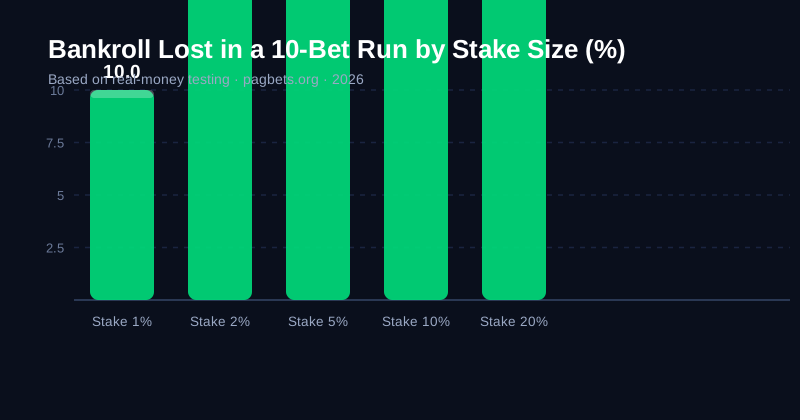
What makes chasing dangerous is the arithmetic of the stake increase. A ten-bet losing run at 2% of your bankroll costs roughly 18% of it. At 5% stakes it costs around 40%. At 10% it costs 65% and you are effectively finished. The same run, the same luck, produces a survivable and an unsurvivable outcome depending purely on the staking decision. Our sportsbook limits guide covers similar risk mechanics.

Tilt Versus Normal Variance
Distinguishing a normal losing run from genuine tilt is the most useful diagnostic a bettor can develop, and it is best done by reviewing records rather than feelings.
A normal losing run looks like this: stakes stayed at your usual unit, bets were placed for the reasons you would normally cite, markets were ones you had researched, and there was no live impulsiveness. The balance is down and nothing else has changed. The correct response is no change at all — possibly a short break, and then continuing exactly as before.
Tilt looks different: stakes have crept up, you are betting markets you have not researched, live bets are appearing that you would not normally place, and the written reasons have become vague. A person experiencing tilt rarely recognises it, which is precisely why the record matters — it shows what you did rather than how you felt.
| Signal | Normal variance | Tilt |
|---|---|---|
| Stake size | Unchanged | Increased after losses |
| Bet selection | Researched markets | Unfamiliar or impulsive |
| Live betting | Rare and planned | Frequent and reactive |
| Reasoning | Specific and honest | Vague justifications |
| Duration | Ends on its own | Escalates until account limit |
| Response | Continue as normal | Full stop and reassess |
Coming Back After a Break
When you return after a break — whether a week or a month — the correct approach is to reset completely rather than to attempt to win the losses back. The losses are gone, and treating them as a deficit to be recovered is the same error in a new form.
Start by reviewing what actually changed while you were away. If nothing about your process changed, there is nothing to correct and no reason to alter anything. If your process did change, the review matters, and the betting journal method is the right tool for making sense of it.
Return at the same unit you were using before, not a reduced one and not an increased one. A common instinct is to bet smaller for a period, and it is not necessary — if your sizing was correct, it remains correct. The purpose of a break is to return rested, not cautious.
- Reset fully, the losses are not a deficit to recover
- Review the journal, not the balance
- Return at the same unit, not larger
- Ban stake increases after losses entirely, make it a written rule
- Set deposit limits, limits prevent tilt rather than stopping it
- If bets stop feeling routine, that is the signal to stop — our responsible gambling page has support options
Why the First Bet After a Break Matters Most
There is a consistent pattern in how bettors behave after time away, and it is almost always negative. The first session back is typically larger than normal, covers more markets than usual, and is treated as an opportunity to settle in rather than to resume.
The reasons are understandable. There is a sense of having missed something, a desire to establish where you stand, and a wish to catch up. None of those is a good reason to bet, and together they produce the highest-risk session in most people's betting calendar.
The correct approach is to make the return deliberately unremarkable. Same unit, same markets, same research standard, same number of bets. If the first session back feels like a restart with fresh opportunity, that framing is itself the problem.
There is a practical technique that helps. Before taking a break, write down what you would bet on this week if you had not been away. Reviewing that list when you return converts the first session back into a continuation of your process rather than a fresh decision made in an unfamiliar state. Our betting journal method makes this natural, because the list already exists.
How to Tell When to Stop Betting Entirely
A losing run is normal. A change in how you feel about betting is not, and the two are worth distinguishing carefully.
Ordinary difficulty with betting is about results. You are frustrated, the results are poor, and the process itself still feels coherent. It passes, and betting remains something you choose to do.
Something different happens when the activity starts to feel compulsory. You bet when you did not intend to. You chase losses you would never have chased a month ago. You hide the balance from people close to you, or find reasons to explain it. You borrow to deposit. These are not symptoms of a bad run — they are symptoms of a problem, and they deserve to be treated at that level.
The reason for naming this is that the early stage is where support is most effective and most people decline it. A break taken voluntarily at that point is a solution; the same break taken after an account is closed is damage control.
If any of those apply, the useful next step is a conversation with someone qualified. Our responsible gambling page lists professional support services, and the tools in our responsible betting tools guide are worth setting up as a preventative measure regardless.
Building Habits That Hold Under Pressure
Every protection worth having is decided before the losing run, not during it. A rule formulated in a calm moment can be followed in a stressed one; a rule formulated during a loss will be argued with.
Three are worth writing down. The first is a hard stake cap, expressed as a percentage, that never changes. The second is a rule that no bet follows a loss without a full day's break. The third is a session limit, so that a bad day ends on schedule rather than when the balance requires it.
All three are easy to comply with and impossible to invent under pressure. Our responsible betting tools guide covers account limits and session reminders, and the tools exist for exactly this purpose — a person who knows their own limits and has them enforced is far safer than one relying on resolve alone.