The Bookmaker's Best Friend: Your Emotions
Live betting is the most profitable product bookmakers sell — and the design explains why. Decisions happen in seconds, prices move constantly, and the interface removes every natural pause. Your emotions, not the bookmaker's algorithms, become your opponent. This guide names the five psychological traps in-play betting exploits and gives you the counter-rules. Read our live betting mechanics guide for the strategy side.
Trap 1: Tilt — and the Two-Loss Rule
Tilt is the state where losses stop being information and become provocation. In live betting it arrives in minutes, because the next market is always one tap away. The counter is mechanical, not motivational: after two consecutive live losses, close the app for the day. Write the rule down. Tilt cannot be reasoned with mid-match — it can only be locked out.
Trap 2: Chasing — The Sunk-Cost Loop
You backed the favourite pre-match; they concede early; the live price on them to still win drifts to 4.00. The urge to "rescue" the bet is the sunk-cost fallacy — the original stake is gone, and the only question that matters is whether 4.00 is value right now. Usually it isn't; the market has priced the new reality better than you have. The rule: never place a live bet whose only justification is an earlier bet on the same match.

Trap 3: Anchoring on the Opening Price
A price of 3.50 looks generous when the match opened at 2.00 — but the drift encodes real information: a red card, an injury, a tactical collapse. Anchoring on the opening price turns information into illusion. The counter: before any live bet, ask "if I knew nothing about the earlier price, would I take 3.50 on this team right now, watching this match?" If the answer needs the opening price as justification, pass.
Trap 4: Recency Bias — The Last Five Minutes Lie
Human brains weight the last five minutes over the previous eighty. A team that has attacked for five minutes feels like the value bet — while the market, which watched the whole match, has already priced the surge. Recency bias is why casual live bettors consistently buy momentum at its peak. The counter is deliberate friction: bet only between events (between games, overs, or halves), and write the reason before the bet. If the reason can't survive being written down, it isn't a reason.
Trap 5: The Frequency Trap
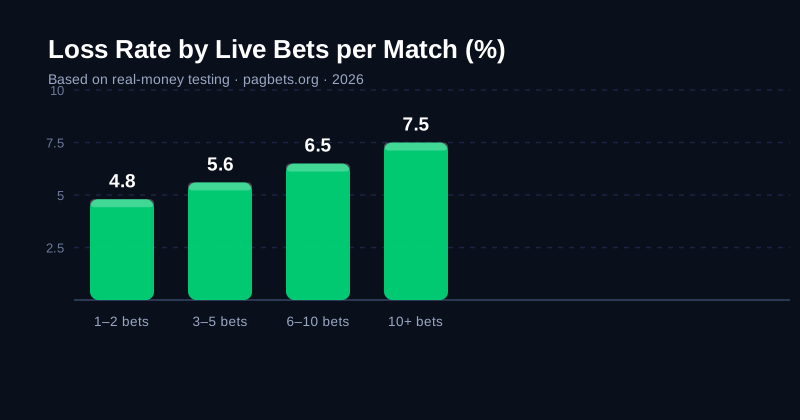
Every additional live bet is another price with the margin built in. Bet five times per match and you've paid the vig five times; bet twenty times and the maths is catastrophic regardless of your insight. The counter is a hard ceiling: maximum two live bets per match, each planned during the pre-match analysis, each at flat 1–2% stakes. The ceiling doesn't just limit losses — it forces every bet to be worth one of your two slots.
| Live bets per match | Margin paid | Outcome |
|---|---|---|
| 1–2 (planned) | 1–2 × margin | Sustainable |
| 5+ (reactive) | 5+ × margin | Slow bleed |
| 15+ (tilt) | 15+ × margin | Bankroll destruction |
The Pre-Match Plan: Psychology's Best Defence
Every psychological counter-rule above is downstream of one habit: write a live betting plan before the match starts. Three lines: which scenarios you'll bet (e.g. "back Team A if they're level at 60 minutes and still creating chances"), your maximum stakes, and your stop conditions. When the 60th minute arrives and the scenario matches, you execute the plan instead of improvising an emotion. That single habit converts live betting from the bookmaker's best product into a process you control.