
The Sharpest Market in Football
The Premier League is the world's most watched, most bet and most efficiently priced football league — margins near 3.8%, sharp syndicates on every match, models trained on decades of data. Nothing about EPL betting is easy, but the league's defining feature cuts both ways: more public data exists than for any other competition. Expected goals, shot maps, set-piece records, rotation news — all free, all weekly. The bettor's edge in the Premier League isn't knowledge the market lacks; it's discipline in using the knowledge everyone has.

The Market Hierarchy
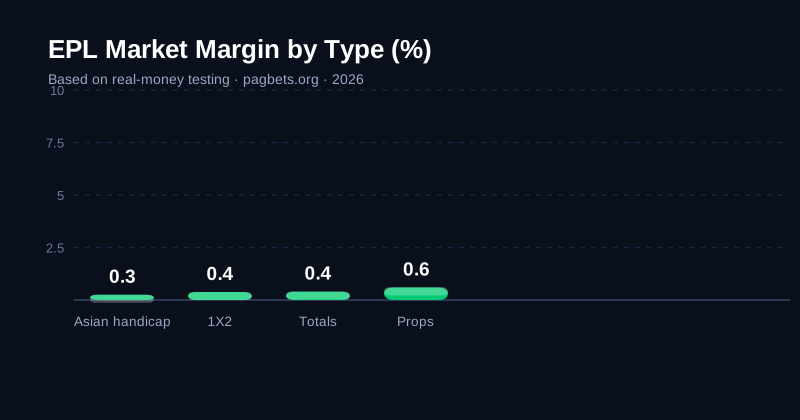
Not all EPL markets are equally sharp. 1X2 is the sharpest — beat it only with genuine specialisation. Totals respond to expected goals and are the natural home for data-driven bettors. Asian handicaps carry the lowest margins and remove the draw. Props — shots, corners, cards, bookings — are priced thinnest and reward specialists most. The realistic strategy: build your edge in the markets with the most researchable inputs, and treat 1X2 as the comparison benchmark, not the battleground.
| Market | Efficiency | Research input | Verdict |
|---|---|---|---|
| 1X2 | Extremely sharp | Everything | Hardest to beat |
| Totals (over/under) | Sharp | xG for/against | Best for data bettors |
| Asian handicap | Sharp, low margin | xG margins | Cheapest prices |
| Props (shots/corners/cards) | Thinner | Specialist data | Most value potential |
The xG Engine
Expected goals is the Premier League bettor's foundation. The core pattern: teams whose results diverge from their xG regress — an attack scoring far above its xG runs hot and the market overprices the streak; a team creating chances without converting is underpriced until the results catch up. The practical routine: track each team's xG for and against over the last 6–8 matches, adjust for opposition strength, and bet the totals or handicap where the divergence is widest. Our totals guide covers the full framework.
The Variables That Move EPL Prices
Four weekly variables move Premier League prices, and checking all four is the baseline routine. Team news: a missing holding midfielder or goalkeeper changes the totals maths instantly. Rotation: European midweeks produce rotated lineups — the market prices the strongest XI, so rotation news is real value. Fixture congestion: the festive period and cup weeks stretch squads in predictable, under-priced ways. Weather: wind and rain suppress totals — the most ignored input in football betting.

Home Advantage, Honestly
Home advantage in the Premier League is real but shrinking — and the market has priced the shrinkage. The refined view: home advantage concentrates in specific venues (hostile grounds, long travel for visitors) and specific teams (newly promoted sides historically overperform at home). Betting the league-average home advantage is outdated; betting venue-specific records is the current edge. Track the venue, not the narrative.
The Discipline Layer
In the sharpest league, discipline is the edge. Specialise in one market, bet a maximum of 5–8 selections per weekend, flat-stake within your bankroll rules, and log every bet with its xG reasoning. Compare two bookmakers' prices on every selection — a tenth of a decimal is real money at EPL volume. And accept the honest truth: the Premier League rewards process more than prediction. Run the process, and the results follow the data.