Deposits Are Fast, Withdrawals Are Not
Every operator advertises instant deposits, because deposits are where they make money and where competition is fierce. Withdrawals are a different matter entirely, and the gap between the two is where most complaints arise.
The reason is structural. A deposit is a payment instruction that the player authorises. A withdrawal is a movement of money out of a licensed business, which requires the operator to satisfy anti-money-laundering checks, confirm the account holder's identity, and pass funds through a banking or payment network that operates on its own schedule.
None of that is unreasonable, and most of it is legally required. But it means the method you choose to deposit with will shape your withdrawal experience later, which is a decision far more consequential than it first appears.

Cards, Wallets, Bank and Crypto Compared
Four categories cover almost all casino payments, and they differ substantially on speed, fees and reliability.
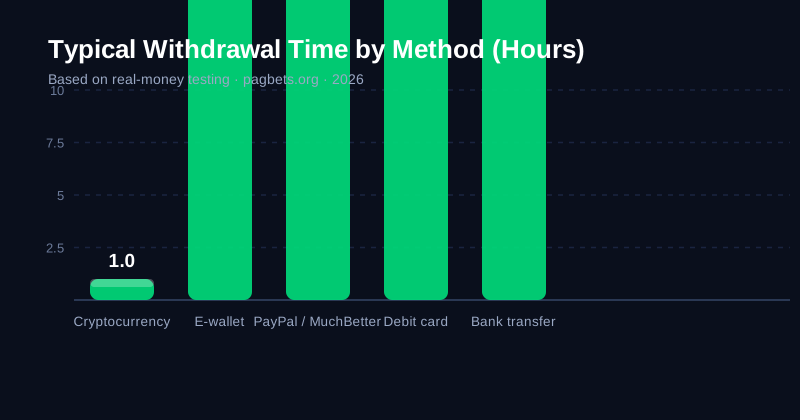
Debit and credit cards are the most widely accepted and the most familiar, but withdrawals through card networks are slow, commonly three to five working days, because the network treats them as individual transfers rather than payments. E-wallets such as Skrill, Neteller, PayPal and MuchBetter are usually the fastest conventional option, with withdrawals commonly inside 24 hours, and some of them — PayPal and MuchBetter especially — are treated as a single payment rather than a series of card transactions.
Bank transfer is the most traditional and frequently the slowest, often five to ten working days, and can attract fees at either end. Cryptocurrency is often the fastest of all because it operates continuously, but it introduces its own complications around volatility and irreversibility.
| Method | Deposit speed | Withdrawal speed | Fees | Notes |
|---|---|---|---|---|
| Debit/credit card | Instant | 3–5 working days | Usually free | Widest acceptance |
| E-wallet (Skrill, Neteller) | Instant | Under 24 hours | Usually free | Fastest conventional option |
| PayPal / MuchBetter | Instant | Under 24 hours | Occasional fees | Treated as single payment |
| Bank transfer | 1–3 working days | 5–10 working days | Possible both ends | Slowest conventional route |
| Cryptocurrency | Instant | Under 1 hour | Network fee | Fastest, but irreversible |
Verification and Why It Is Not a Red Flag
Casino verification normally requires a government-issued photographic ID, a proof of address dated within three months, and occasionally a selfie holding the ID or a bank statement in your name. It is required by regulation, applies to every player, and should complete within a day or two.
It becomes a genuine concern in two situations. The first is when an operator resists verification or asks for it repeatedly with new documents. The second is when verification appears only at the point of withdrawal, with no mention of it during registration — that is a sign the operator wants your money before completing checks, and it is a pattern worth avoiding.
Complete verification as soon as you register, before depositing. It removes the anxiety of a withdrawal request being held up, and it is a small step that makes a genuine problem obvious much earlier. Our AML and KYC policy page explains the framework in more detail.

The Rules That Catch Players Out
Three rules cause far more withdrawal problems than any technical issue.
Withdrawing to a third party is the first. A withdrawal to a friend's account or a different name is a standard fraud signal, and it results in a frozen balance while the operator investigates. The money is not necessarily lost, but the process is slow and unpleasant. Always withdraw to an account in your own name.
Not meeting turnover before withdrawing is the second. Depositing, immediately withdrawing, and repeating is a pattern operators monitor closely because it is how bonus abuse works. Some will decline a withdrawal that does not meet the qualifying turnover. Mixing payment methods is the third — depositing by card and trying to withdraw to a bank account will usually be refused.
None of these is a technicality. They exist because of regulation, and the operators that enforce them are the ones operating lawfully. Our complaints policy sets out how we handle disputes.
- Complete verification at registration, not at withdrawal
- Withdraw only to an account in your own name, always
- Meet turnover requirements before requesting funds
- Use the same method for deposit and withdrawal
- Check minimum withdrawal amounts, commonly $20–$50
- Keep confirmation of every transaction you make
Licensing and Why It Protects Your Payments
Payment methods matter, but the licence under which the operator holds your funds matters considerably more. A casino operating under a reputable licence is subject to rules about segregation of player funds, financial reporting and dispute resolution that simply do not apply to an unlicensed operation.
Several jurisdictions enforce player fund segregation, meaning your balance is held separately from the operator's operating accounts. In practice, that requirement is what prevents an operator using your deposits to cover its own costs. It is a genuine protection, and it exists only where a licensing regime requires it.
The licences worth prioritising are those from established regulators, and our gambling licences guide explains what each major jurisdiction actually enforces. A site operating under a reputable licence is also considerably more likely to publish withdrawal terms honestly, because the regulator requires disclosure.
A genuine red flag worth naming is a site offering payment methods that obscure who holds your money — a prepaid card only, or a payment channel with no banking intermediary. That is not always wrong, but it removes the trail that would otherwise let you recover funds if the operator stopped trading.
Disputes and Chargebacks as a Last Resort
If a withdrawal is refused or indefinitely delayed, the escalation path matters more than it does at first glance, because the quality of a complaint handling process is a real test of the operator.
Start with the operator's own complaints procedure, in writing. A request that is handled quickly, specifically and with a reference number is a sign of a functioning process. A response that is generic, or that requires the same information repeatedly, indicates a process that is not functioning.
Where the operator holds a reputable licence, the licensing authority generally provides a dispute resolution route, and this is a genuinely meaningful escalation because it carries regulatory weight. Our licences guide covers which authority regulates which jurisdiction.
A chargeback through your bank or card issuer is a real option and should be treated as one. It is a genuine consumer protection mechanism, and operators generally treat it seriously. It is also a last resort: it is slow, it will usually close your account, and the strongest reason to avoid needing it is to verify early.
Choosing a Site by Its Payment Terms
Payment terms are a far better indicator of an operator's quality than the size of its welcome bonus, because they are harder to disguise. A site offering a 400% bonus and promising instant withdrawals is worth considerably less than one offering 100% with honest terms.
Before depositing anywhere, check the withdrawal page rather than the promotions page. Look for stated withdrawal times by method, whether verification is required before withdrawal, minimum withdrawal amounts, and any fees. An operator that publishes all four is telling you it expects to be examined.
Avoid any site that will not state withdrawal times at all, that permits withdrawals to third parties, or that pressures you to deposit before completing verification. These are the markers that distinguish a licensed operation from a problem. Our crypto casino comparison and best casino apps comparison both assess operators on payment terms alongside game selection.