One Number Runs the Casino
Behind every casino game is a single number that decides everything: the house edge — the mathematical percentage of each wager the casino keeps over the long run. It's not a secret, it's not a trick, and it's not negotiable. But it varies enormously between games, and knowing the ladder — from blackjack's 0.5% to keno's 25% — is the difference between paying $0.50 or $25 per $100 wagered for the same evening of entertainment. This guide explains the number, how it works, and how to pick games where the casino's advantage is smallest.
Where the Edge Comes From
The edge exists because games pay less than true odds. The cleanest example: a fair coin flip pays even money at true odds of 50/50 — no edge for anyone. Now imagine the casino pays winners 0.95 to 1 on the same coin. Over a thousand flips, you win roughly 500 and lose 500; the casino keeps $0.05 from every winning flip. That small gap, applied relentlessly, is the entire casino business model. Roulette's zero, blackjack's dealer rules, slots' pay-table maths — all of them are just versions of the underpaid coin flip.
The Edge Ladder: Every Major Game Ranked
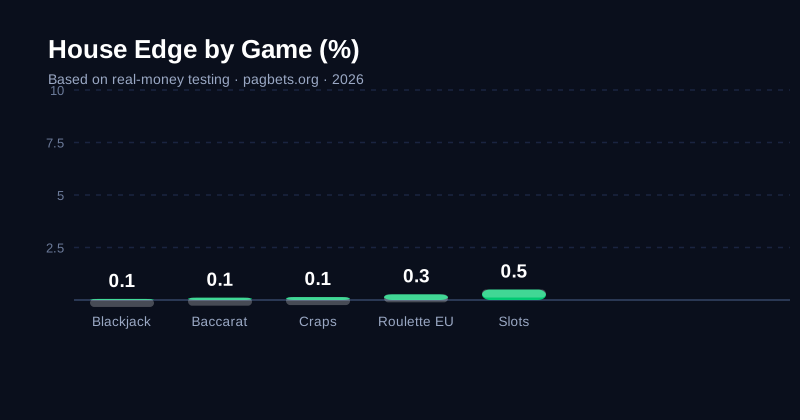
Here's the full ladder from our testing — the cost of every $100 you wager on each game, played correctly:
| Game | House edge (correct play) | Cost per $100 wagered |
|---|---|---|
| Blackjack (basic strategy) | ~0.5% | $0.50 |
| Baccarat (banker) | 1.06% | $1.06 |
| Craps (pass line) | 1.4% | $1.40 |
| European roulette | 2.7% | $2.70 |
| American roulette | 5.26% | $5.26 |
| Slots (average) | 4–6% | $4–$6 |
| Keno | 20–25% | $20–$25 |
Why Correct Play Matters
Two of those numbers deserve scrutiny. Blackjack's 0.5% edge assumes basic strategy — played randomly, the same table costs 2–4%. Roulette's numbers assume European wheels; the American double-zero nearly doubles the cost. The edge is fixed by the game's rules, but your share of it is set by your play. The cheapest game played badly can cost more than an expensive game played well — which is why our blackjack guide starts with the strategy chart, not the table minimums.
The Edge Never Sleeps — Variance Does the Selling
If the edge is so reliable, why does anyone win? Because the edge works over thousands of wagers, while any single session is dominated by variance — the short-term luck that produces winning nights and losing weeks. The casino sells variance as hope; the maths underneath is unchanged. Understanding both is the mature view of gambling: enjoy the swings, respect the edge, and price your entertainment accordingly.
Using the Edge to Choose
The edge converts directly into decisions. On a $500 evening budget: blackjack with basic strategy expects about $2.50 of cost per $500 wagered, European roulette $13.50, average slots $25, keno $125. Same evening, same fun, wildly different price. Choose the game first by its edge, play it correctly, flat-bet within your bankroll, and treat the expected cost as the ticket price. That's the entire intelligent approach to casino gambling — and it starts with this one number.