
The Paytable Is Your Rulebook
Every slot machine has a paytable — the complete information screen accessible via an 'i' or '?' button on the game interface. The paytable shows: which symbols pay and how much, how many paylines exist, what the wild and scatter symbols do, how bonus features are triggered, and what the game's RTP is. Reading the paytable before playing a new slot takes 30 seconds and is the most important habit for informed slot play. This guide covers what every element means.
Symbols and Payouts
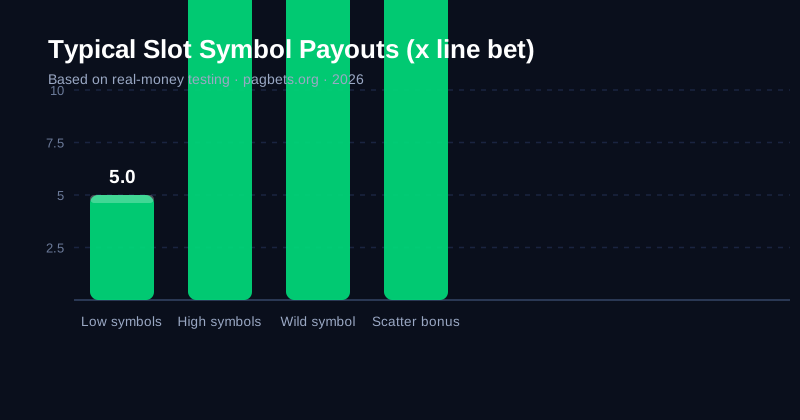
Most slots have two tiers of symbols. Low-value symbols (typically 10, J, Q, K, A) pay small multiples of your line bet for 3-5 matching symbols. High-value symbols (themed images) pay significantly more — usually 10x to 50x your line bet for 5 matching symbols. The paytable shows exact payouts for each combination, listed as multiples of your line bet (not total bet).
| Symbol type | Typical payout (5 of a kind) | Example |
|---|---|---|
| Low value (10-A) | 2x - 5x line bet | Five Aces = 5x |
| High value (themed) | 10x - 50x line bet | Five Dragons = 50x |
| Wild symbol | 20x - 500x line bet | Five Wilds = 500x |
| Scatter | 2x - 100x total bet | Five Scatters = 50x total |
Special Symbols
Wilds substitute for any symbol (except scatter) to complete winning combinations. Types include regular wilds, expanding wilds (cover entire reel), sticky wilds (remain for multiple spins) and stacked wilds (appear in groups). Scatters trigger bonus features regardless of payline position — 3 or more scatters typically trigger free spins. The paytable explains the specific behaviour of wilds and scatters in each game.

Bonus Features
The paytable describes all bonus features: free spins (most common — triggered by 3+ scatters, usually 10-20 spins with enhanced features), pick-and-click (choose items to reveal prizes), cascading reels (winning symbols disappear and new ones fall), and multipliers (increase wins by 2x-10x during bonus rounds). The paytable also shows the maximum win potential (e.g., 5,000x your stake).
Paylines and Ways to Win
Fixed paylines (classic): wins must land on specific line patterns (1-50 lines). All ways (243 ways to win): any left-to-right combination of matching symbols wins. Megaways (up to 117,649 ways): reel heights change every spin, creating varying numbers of ways to win. The paytable or game info shows the exact payline patterns or ways-to-win structure.
- Before playing any new slot: open the paytable (usually an 'i' button)
- Check: RTP (aim for 96%+), volatility, maximum win and bonus trigger conditions
- Understand: what wilds, scatters and bonus symbols do in that specific game
- Note: some casinos run the same slot at lower RTP settings — always verify
Reading a Paytable in Under Two Minutes
The paytable is the only place the mathematics of a slot is stated, and it takes less time to read than most players spend choosing a game.
Find the RTP and the volatility first, because they tell you what the machine does regardless of theme. Then check whether the paylines are fixed or adjustable, because an adjustable line count changes the maths per spin. Everything else on the page is presentation. Our the RTP guide covers what those two numbers mean in practice.
The Features Are Where the Cost Is
Bonus features look like the attractive part of a slot and are where a disproportionate share of the house edge sits.
A feature that triggers on a fixed number of spins rather than randomly can be measured, and a feature that awards a large prize at a low frequency can be calculated against the base game. Free spins and cascades change the volatility profile rather than the return, which means a player choosing between them is choosing a different shape of session. Our the bonus features guide covers each type.
Volatility Is Stated Alongside the RTP
The two numbers that determine what a slot does to your balance are RTP and volatility, and both appear in the paytable or the game's information panel. RTP is the long-run return: a 96 percent slot returns 96 dollars per 100 dollars wagered, averaged across millions of spins. Volatility describes the distribution rather than the average — how far individual results sit from it. High volatility means long stretches of nothing punctuated by large returns; low volatility means a steady drip with a lower ceiling.
The pair matters because they answer two different questions. RTP tells you whether the game is worth playing relative to another game. Volatility tells you whether it suits your session length and your bankroll. A 96 percent high-volatility slot at a 200-dollar bankroll will ruin more sessions than a 94 percent low-volatility slot at the same stake, because the first one's average result arrives after a run the bankroll cannot absorb. Our RTP guide covers the arithmetic.
There is a practical way to read volatility from the paytable even where it is not stated. The number of paylines, the maximum win, and the ratio between the lowest and highest symbol payouts are all visible. A game with a 500x maximum and heavy cascading is almost always high volatility; a game with a 40x maximum and simple paylines is almost always low. Our casino volatility guide covers how each structure drives that number.
A rough session rule falls out of it. Match the volatility to the number of spins you intend to buy rather than to the balance you happen to have. A player planning 200 spins at one dollar on a 50-dollar bankroll on a high-volatility title will see most of that budget absorbed before the distribution delivers. Our house edge guide covers why the edge compounds regardless of which game it lands on.
Maximum win is the third number worth pulling from the paytable, and it is the one most often misread. A 5,000x maximum does not mean a 5,000x return is likely — it is the ceiling, and on most games it is reached only through a feature combination that occurs once in tens of thousands of spins. Our volatility guide covers how the ceiling and the typical result are entirely different quantities.
The Same Game at Two Different Casinos
The identical game title is often available at two different returns, and the difference is a licensing and configuration decision rather than a difference in the software. The same Megaways title may run at 96 percent on one casino and 94 percent on another, with the maths in the paytable adjusted to match. Because the theme, the reels and the bonus round are unchanged, nothing on the interface tells you which version you are playing.
Finding out takes two minutes. The paytable or rules panel states the RTP for that specific configuration rather than the provider's headline figure. If it is absent, the casino's own game information page will normally state it, and where even that is missing the operator is working in a grey area our licence guide would raise. Our RTP guide explains why the number is worth checking every time.
The difference compounds exactly as you would expect. Two percentage points of RTP is roughly the entire house edge, so a player moving between a 96 percent and a 94 percent version of the same title is halving the expected return. Across a year of regular play on one game that is a sum worth having, and it is entirely avoidable with no change in strategy, discipline or bet size. It is the cheapest edge available anywhere in the casino.
Volatility is also configured, though less often, and the difference shows in session behaviour rather than in any stated number. A low-volatility configuration of the same title feels flatter and pays more frequently. Our casino app rankings cover operators where the configuration is stable and the paytable is transparent, and our volatility guide covers how to recognise which one you have been given.
A third variable is the bet denomination structure. Games offering 1 to 100 credits at 0.01 to 1 per credit let you play the same maths at any size, which is genuinely useful for a small bankroll. Games fixed at one stake size force a choice between betting too little to matter and too much to survive. Our bankroll guide covers why flexibility in bet size is worth a great deal.
Turning the Paytable Numbers Into a Budget
The paytable contains enough information to produce a defensible session budget, and most players never run the calculation. You need three numbers: the RTP, the total bet per spin, and the number of spins your bankroll supports. At 96 percent RTP a one-dollar spin returns 96 cents on average, so a 100-dollar bankroll funds roughly 2,500 spins before exhaustion on average — with enormous variance distributed around that figure.
The honest version of that calculation includes the variance, which the average hides. On a high-volatility title the median session is much shorter than the mean implies, because most sessions end early and a small number run long. Budgeting to the mean will therefore be wrong in practice most of the time. Our volatility guide covers the distribution properly, and the practical response is to budget on the short side rather than the average.
The bet size is the one variable entirely under your control, and it deserves more attention than players give it. Halving the bet size on a 96 percent game roughly doubles the number of spins your bankroll buys and roughly halves the standard deviation of the outcome, without changing the theoretical return at all. Our bankroll guide covers the general principle: the amount at risk should be a fraction of a total set aside for gambling and nothing else.
What the paytable cannot tell you is worth saying plainly. It describes the game; it does not describe you. Two players with identical bankrolls and identical stakes have completely different experiences of the same high-volatility slot, and the difference is behavioural rather than mathematical. Our responsible betting tools guide covers the session limits that keep a budget real, and no paytable calculation substitutes for them.
Record the outcome. A player who writes down sessions, stakes and returns at the end of each month knows something useful at the end of a month, and nothing at all without it. The same record turns a vague sense that a game is unlucky into a number you can check against the published RTP, and it is the first evidence that a particular title is not performing as advertised. Our responsible betting tools guide covers the same discipline.
✓ What We Like
- Tells you how to check a licence rather than asking you to trust one
- Covers the payment problem that decides whether the product is usable for you
- Uses named regulators, laws and figures rather than general description
✕ What Could Improve
- A limit or ceiling constrains how much you can actually stake