The Core Four Colours
Chip colour conventions exist because a dealer cannot ask a player what a chip is worth forty times an hour, and the system works well enough that a player who learns four colours can sit at almost any table in the world without confusion.
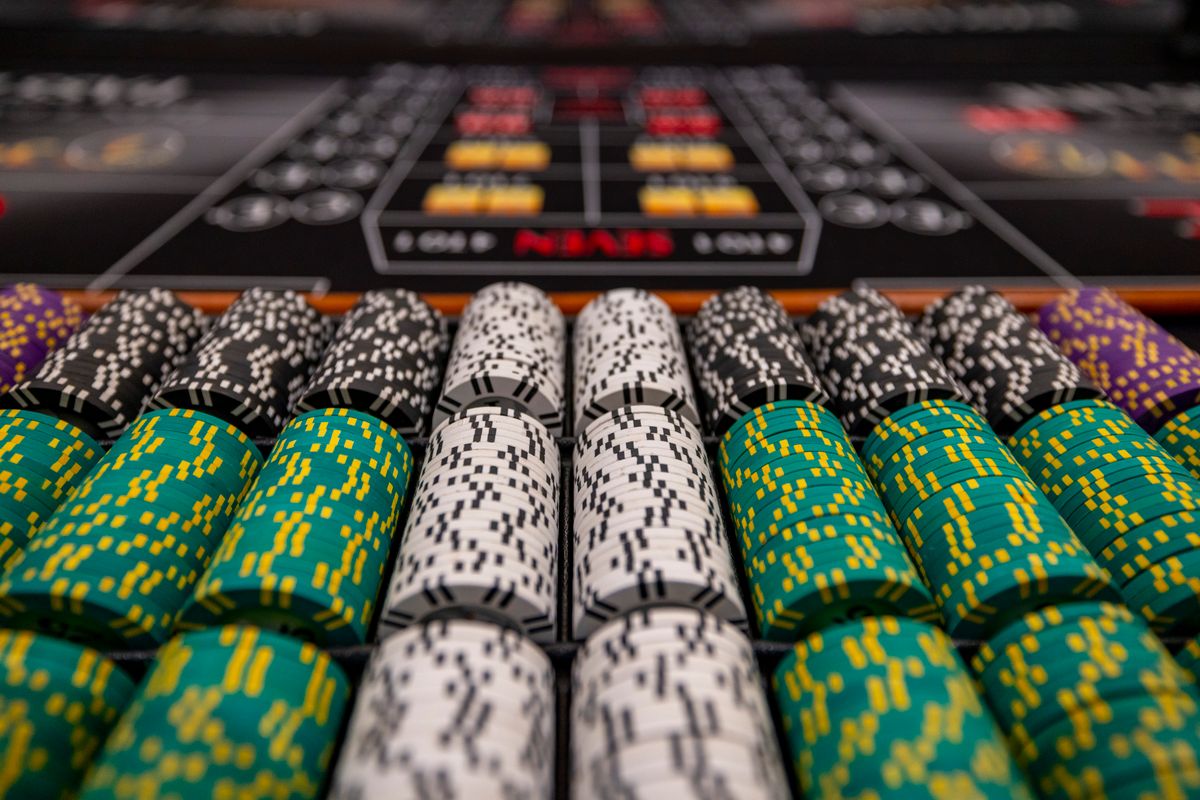
The core set is remarkably consistent: white for one, red for five, green for twenty-five and black for one hundred. These four appear at essentially every property, and they cover the large majority of bets placed at a low or mid-stakes table.
Our the table games guide covers how a table operates, and the etiquette guide covers buying in and handling chips at a live table.
The Denomination Ladder
Below one hundred the conventions are near-universal. Above it, casinos diverge, and the specific property decides.
A useful way to read the table is that colours below black are effectively a standard language, and colours above it are a house dialect that must be checked locally.
| Colour | Typical value | Consistency | Where it appears |
|---|---|---|---|
| White | 1 | Near universal | Every table |
| Red | 5 | Near universal | Every table |
| Blue | 1 or 2 | Variable | Low-limit rooms |
| Green | 25 | Very common | Mid-stakes tables |
| Black | 100 | Very common | Standard high chip |
| Purple | 500 | Common | Higher-limit rooms |
| Yellow or gold | 1,000 | Variable | High-limit rooms |
| Grey or custom | 5,000+ | Property-specific | VIP rooms |
Why the High End Is Not Standardised
The reason low denominations are universal and high ones are not is straightforward enough once noticed.
A one chip appears at every table in a property, so a shared convention is operationally necessary. A five thousand chip appears in a handful of rooms in a large property, so there is no pressure toward consistency, and casinos use the opportunity for custom denominations and distinctive colours.
The practical rule is simple. Trust the four core colours everywhere. Ask before assuming anything above one hundred, particularly at a property you have not played before, and confirm at the cage rather than at the table if a large chip is involved. Our the online versus land guide covers where the two experiences genuinely differ.
Chips at a Live Dealer Table
Live dealer casino games do not use physical chips, and understanding what replaces them resolves a common point of confusion for players moving from land venues.
A live table uses a numeric balance and a click-to-bet layout. The chip graphics on screen represent stake sizes, and most platforms let a default chip value be chosen so the interface resembles a physical table.
What transfers from a real table is the concept of a chip rack as a stake selector, and what does not transfer is any of the physical handling, which is why live tables feel faster. Our the live casino guide covers how these tables work in practice, and the live dealer sites guide covers which platforms implement them best.
Practical Chip Etiquette
A handful of conventions make a player look competent at a live table immediately, and all of them are trivial once known.
Buy in with cash on the table rather than handing it across, and let the dealer convert and lay out the chips. Never touch chips already in a betting circle after a round has started, because it makes the bet ambiguous and disrupts the dealer.
Rack chips face up so denominations are visible, and cash out at the cage rather than handing chips back to a dealer at the end of a session. Our the full etiquette guide covers the rest of the conventions.
- Place cash on the table to buy in, do not hand it over
- Never touch chips in a circle once a round begins
- Rack chips face up so values are readable
- Ask the value of any colour above black
- Cash out at the cage, not at the table
- Confirm large denominations before leaving
Does Chip Denomination Affect Anything but Convenience?
It affects behaviour, which in a casino is effectively the same as affecting cost.
Players presented with a rack of one chips tend to bet more frequently and more casually than players holding a single one hundred chip, because a small denomination reduces the felt cost of each decision. The relationship between chip size and bet size is well documented and it operates below conscious intention.
The useful implication is that buying in with larger denominations and fewer chips produces more deliberate decisions, which is a genuine behavioural control rather than a superstition. Our the psychology guide covers the related effect during a losing run.
A Short Reference Before Sitting Down
A player who knows six things handles a live casino table confidently whether playing in person or on a live dealer stream.
Memorise the four core colours. Ask about anything above one hundred. Buy in with cash placed on the felt. Leave chips alone once a round is running. Cash out at the cage rather than at the table.
And at a live dealer table, remember that the chips are graphics over a balance, so the real decisions are stake size and pace rather than anything physical. Our the tools guide covers setting limits before a session begins.
- White 1, red 5, green 25, black 100 — learn these
- Ask above 100, the high end varies
- Buy in by placing cash on the felt
- Do not touch chips in an active betting circle
- At a live table, chips are graphics over a balance
- Set limits with our tools guide
The Rack, and Why Buy-In Matters More Than It Looks
How a player buys in has a measurable effect on how they play, and it is a mechanism rather than a superstition.
Buying in with a large note and receiving a rack of higher denominations produces fewer, larger chips. The player then makes fewer decisions, because each decision consumes a larger fraction of what they hold. The reverse applies to a buy-in that produces a rack of ones.
Neither is inherently better, and both are legitimate. The point is that the rack a player receives is an unintentional stake-size decision made before the game begins, and a player who wants control over decision frequency should choose the rack deliberately rather than accept whatever is presented.
Our the etiquette guide covers the full buying-in procedure, and the psychology guide covers the effect of chip size on behaviour during a losing run.
Markers, Plaques and the Limits of the Colour System
Not everything on a casino table is a chip, and the objects that are not tend to be the high-value ones.
A marker is a disc used to mark a position — typically a large bet, a specific player position, or a reserved seat. It carries no value and is not part of any wager. A plaque is a large rectangular object used for very high denominations, often five thousand and above, and it is a chip with a face value.
Below the plaque range the colour system works well. Above it, denominations are frequently printed rather than encoded in colour, and a player should read the value rather than assume it.
Our the table games guide covers what sits on a table beyond the chips, and the live dealer sites guide covers where these are most commonly used.
Why Knowing Values Matters Beyond the Table
Chip literacy has consequences that extend past avoiding an awkward moment, and the two practical ones are worth knowing.
The first is redemption. Chips are ordinarily redeemable for cash at the cage and generally do not expire, so a player who leaves with chips rather than cash has changed the form of the money without changing the amount. Where very large denominations are concerned, some properties restrict redemption or require identification, which is a genuine reason to cash rather than carry.
The second is social reading. A player who understands values can tell what a table is actually like before joining, because the minimum bet and the quality of chips on the felt indicate the stakes of the room. Reading a room by its chip denominations is a genuine casino skill.