
What a Loyalty Programme Is For
A casino loyalty programme is a retention tool, and understanding that is what makes it possible to assess one honestly. Its purpose is to keep a customer playing at one operator rather than moving to another.
That purpose creates a predictable structure. The headline reward is set at a level that looks generous, and the conditions attached to it — wagering requirements, expiry windows, maximum bet caps — are what determine the real value. In practice, the gap between headline and real value is frequently very large.
Our bonus terms checklist covers the condition mathematics in full, and the same framework applies here to loyalty rewards.

Ranking Reward Types by Real Value
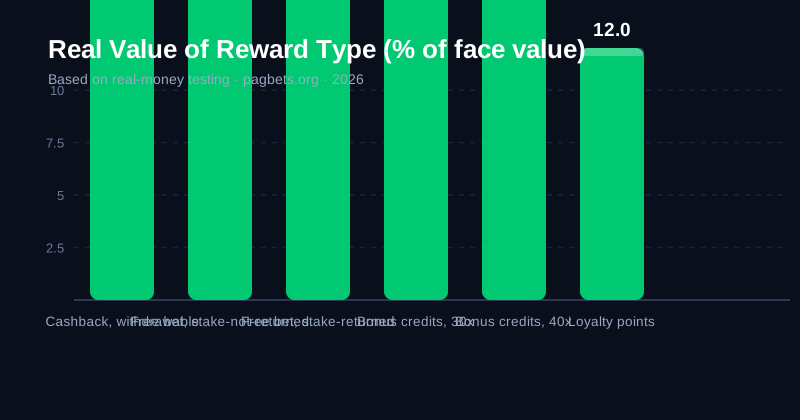
Casino rewards are not equal, and the ranking below is by how much of the face value you actually receive.
Cashback is the best, because it returns real value with no further condition. The percentage varies, typically from 1% to 20% of losses, and the key question is whether it is credited as withdrawable cash or as bonus funds requiring wagering. A 5% cashback paid as cash is genuinely valuable; a 20% cashback paid as 30x-wagered bonus funds is worth substantially less.
Free bets rank second, provided they are stake-not-returned. That means the stake is not returned on a losing bet, so the expected return can be extracted by laying the bet at an exchange. This is a real, quantifiable benefit and is why free bet offers are routinely converted into cash.
| Reward type | Headline value | Real value | Key question to ask |
|---|---|---|---|
| Cashback, withdrawable | 1–20% of losses | Full | Is it cash or bonus funds? |
| Cashback, wagered | 1–20% of losses | Low | What is the multiplier? |
| Free bet, stake-not-returned | £5–£50 | Moderate–high | Can it be converted? |
| Free bet, stake-returned | £5–£50 | Low | Only the winnings return |
| Bonus credits | £10–£200 | Low | Is there a multiplier? |
| Loyalty points | Varies | Very low | What do points convert to? |
| Tier gift | Fixed amount | Depends | Wagered or cash? |
How Tier Systems Work
Most programmes use tiered structures — bronze, silver, gold, platinum, diamond or similar — where the benefit scales with cumulative deposit or turnover.
The progression is deliberately accelerating. Early tiers are reached quickly and offer modest benefits, and the later tiers require disproportionate totals. The design is effective because most players plateau in the middle, spending steadily at a tier they have reached rather than progressing further.
Two things determine whether a programme is worth joining. First, the real value of the reward at the tier you will actually reach, which is usually not the top one. Second, the cost of reaching it, which is the total deposit required. A programme where the reward at your expected tier is worth less than the deposit needed to earn it is a net cost, and a better use of the same money is simply not depositing it.
Reading the Terms on a Reward
Before treating any reward as value, five things need checking, and the checklist is short enough to apply in a couple of minutes.
Is it cash or bonus funds? This single question determines most of the value. What is the wagering requirement? A 30x requirement on a £50 reward means wagering £1,500 at the game edge before withdrawal. What is the expiry window? A seven-day window on a high requirement assumes constant play. Is there a maximum bet cap? Overshooting it typically voids the progress. Does the expiry roll over? Some programmes reset the clock on each deposit, which changes the calculation substantially.
Our free spins guide works through the arithmetic on a specific reward type, and the volatility in our volatility guide explains why a high-multiplier requirement is so hard to clear.
- Cash or bonus funds? determines most of the value
- Wagering multiplier? 30x is very different from 10x
- Expiry window? short windows assume constant play
- Maximum bet cap? overshooting wastes progress
- Does the clock reset? changes the whole calculation
- Game weighting? some games count below 100%
Using a Programme Without Chasing
The characteristic failure mode of loyalty chasing is predictable and common. A player at a mid tier accumulates losses, upgrades a tier, receives a reward, and uses it to play more in the hope of advancing again — and the losses grow faster than the rewards.
It is the same escalation dynamic as chasing a losing run, and it is worth recognising early. Our betting psychology guide covers the pattern in detail, and it applies to casino loyalty tiers precisely as it does to sports betting.
The realistic approach is to treat a loyalty programme as a modest discount on the cost of playing rather than as a system. Take the cashback when it is genuinely withdrawable, redeem free bets where the terms allow conversion, and do not deposit more in order to advance a tier unless you were going to deposit that amount anyway.
- Treat it as a discount, not a strategy
- Take real cashback, it is the only clean value
- Convert free bets, where the terms permit it
- Never deposit to advance a tier on its own
- Set deposit and loss limits, using our tools guide
- Watch the clock, losing sessions are the ones that chase
The Real Cost of Tier Chasing
It is worth quantifying what happens when a player chases tier progression, because the arithmetic is more straightforward than it first appears.
Consider a programme offering a 5% cashback credit paid as 30x-wagered bonus funds. For a player wagering £1,000 losing £200 in a month, the reward appears as £10 of bonus funds, which then requires £300 of wagering to clear. At a 96% return rate, that £300 of wagering returns £288, a loss of £12 — meaning the reward has produced a net loss of £2 on top of the original £200 already lost.
This is the calculation that makes cashback type the decisive detail, and it is invisible unless you do it. A programme that looks generous by percentage can deliver negative net value when the multiplier is applied, while the same percentage paid as cash returns £10 of genuine value. Our bonus terms checklist works through the same arithmetic in full.
Joining a Programme Without Becoming a Player
The easiest mistake in loyalty programmes is joining one and then playing in order to advance, rather than playing what you already intended to play and letting the progression follow.
Those two orders of operations sound similar and are materially different. Playing normally and collecting rewards means the programme is a small reduction in the cost of something you were already doing. Playing to advance a tier means the deposit is driven by the programme rather than by a genuine intention to play, and the deposit is the expensive part.
A useful discipline is to decide the budget first and treat tier progress as incidental. If you reach a tier, take the reward. If you do not, nothing has been lost beyond what you would have spent anyway. The alternative — reducing other spending to fund tier progression — is a real pattern in reported problem gambling, and our responsible gambling tools guide explains why hard deposit limits are the protection that works.
Choosing a Programme Worth Joining
Since most players hold accounts at several operators anyway, the sensible approach is to join every programme offered and use the best features of each, rather than treating one as a relationship.
Rank operators on the practical measures: whether cashback is withdrawable, the cashback percentage, whether free bets are stake-not-returned, how generous the tier thresholds are, and — importantly — whether the programme excludes some games. Our best casino apps comparison ranks operators on these factors alongside game selection, and the live dealer comparison does the same for live tables.
One final note worth making: a loyalty programme is a reason to play at a particular operator, not a reason to play. If the only thing holding you at a site is tier progression, that is worth examining. Our security checklist covers the more important question of whether the operator is worth playing at all.
- Rank on cashback first, cashback type and percentage
- Check free bet terms, stake-not-returned is the good version
- Check game exclusions, some games earn nothing
- Compare tier thresholds, generous ones are worth more
- Check expiry rollover, it changes the calculation
- Join several, they are independent — set limits via our tools guide