
The Variable That Explains Everything Else
Return to player tells you the average. Volatility tells you the shape. Two games can both return 96% over a very large number of spins and yet feel entirely different to play, because one pays steadily and the other pays rarely and heavily.
Consider two games, both at 96% RTP. In a low volatility version, the average spin pays back close to the stake most of the time, so your balance drifts slowly and predictably downward. In a high volatility version, most spins return very little and a small fraction return several times the stake, so your balance moves in dramatic jumps.
Over enough play the two are identical. Over one hour, or one bankroll, they are not, and the practical consequence is that volatility determines how long your session lasts more than anything else you control. Our RTP guide covers the return side of this in detail.
The Three Categories
Casino games are broadly classified into three volatility bands, and the classification is standard across the industry.
Low volatility games return small amounts very frequently. Balance movement is slow and easy to observe, sessions run long, and the experience is closer to a steady drip. Slots with frequent small wins and low maximum multipliers are typical. Medium volatility is the default and covers the majority of modern titles.
High volatility games pay rarely and heavily. Balance swings are large, sessions are short, and a substantial proportion end with the entire bankroll lost within a fraction of an hour. The largest advertised maximum wins are almost always on high volatility games, and that is the connection worth noticing.
| Level | Payout pattern | Typical session | Bankroll needed | Best for |
|---|---|---|---|---|
| Low volatility | Small wins, very frequent | Long and steady | Small | Bonus play, casual sessions |
| Medium volatility | Balanced pattern | Moderate length | Moderate | General play |
| High volatility | Rare, large payouts | Short and dramatic | Large | Experienced players with a big bankroll |
| Progressive jackpot | Rare, very large | Usually long | Any | Entertainment, not strategy |
Why Session Length Is the Real Issue
Volatility is usually discussed in terms of risk, but its most practical effect is on time, and time is what drives most harm.
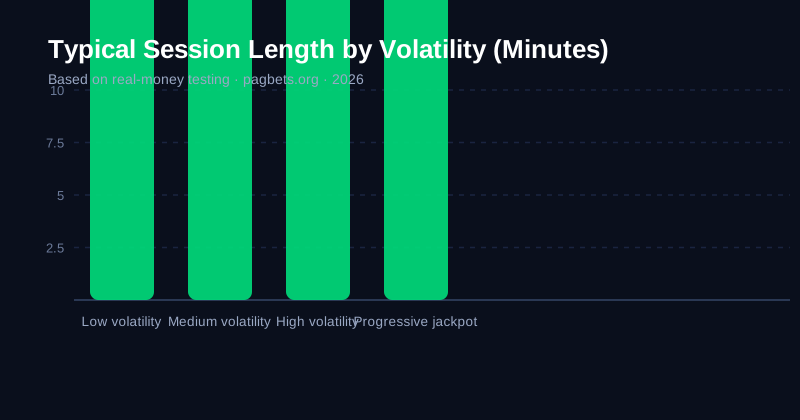
A low volatility game with a small bankroll might run for several hours before the bankroll is exhausted, and the player is exposed to the full duration of that. A high volatility game ends in minutes, which limits the total loss but also limits the entertainment value.
There is a genuine risk in low volatility play that is often overlooked. Because the bankroll declines slowly, it is easy to play for a long time while the balance declines by increments too small to register as meaningful. The bonus terms checklist makes the same point about wagering volume, and the fix in both cases is a hard session limit rather than a judgement about when to stop.
Volatility and Bonuses
When playing with bonus funds, volatility becomes more important than at any other time, because the wagering requirement has to be cleared before a withdrawal is possible.
A high volatility game with a small balance is likely to be exhausted before the required volume is reached, and when the balance is gone the bonus is over along with it. Low and medium volatility games keep a bankroll alive far longer, which is precisely what the requirement needs.
There is a second consideration: maximum bet caps. Bonuses almost always include a cap, and high volatility games invite accidental overshooting — a large bet on a volatile title can exceed the cap in a single spin, which typically means that bet contributes only the stake to the requirement and none of the winnings. Choose a low-volatility game with small bets and stay well under the cap.

Choosing by Bankroll and Temperament
Match the volatility to the bankroll and to how you want the session to feel, rather than to which game looks most exciting.
A modest bankroll — a few hundred pounds or its equivalent — should be paired with low and medium volatility games. High volatility with a small bankroll is a fast route to losing it, because the variance is too large relative to the number of spins you can afford.
A larger bankroll can sustain high volatility play, though it should still be money genuinely available to lose. Our payment methods guide covers the practical question of keeping a bankroll genuinely separate, which is a prerequisite for any of this being sensible.
On temperament, the honest question is whether you would be comfortable watching a balance halve in twenty minutes. If the answer is no, high volatility is not a test of nerve, it is simply a mismatch.
- Small bankroll, low or medium volatility only
- Large bankroll, high volatility becomes a choice
- Bonus play, low volatility to survive the requirement
- Long sessions, low volatility with a hard time limit
- Short sessions, accept high volatility ends quickly
- Separate bankroll account, it must be genuinely disposable
Reading Volatility from the Paytable
Where a game does not publish its volatility directly, the paytable gives you enough to estimate it — and the estimate is good enough for a decision.
Look at the maximum win first. A very large figure relative to the stake, such as 5,000x or above, almost always indicates high volatility, because such outcomes are necessarily rare. A modest maximum of 500x suggests the opposite. Then look at the frequency of the bonus feature: a free spins round triggered by three scatters in a 243-ways game occurs fairly often, while one requiring five high symbols on a single payline is genuinely infrequent.
The paytable structure is the third signal. A game paying 2x for three low symbols and 25x for five low symbols, with no large top-end symbol, is low volatility by construction. A game where the top symbol pays 100x or more is not.
Taken together these three give a reliable classification without a published figure. The slot paytable guide explains how to work through the paytable systematically, and the slot selection guide covers putting the estimate to use.
Setting the Right Stake for a Given Volatility
Once you have chosen a volatility level and a bankroll, the remaining decision is the stake, and the rule is simpler than most players expect.
For low volatility games, a stake around 1 to 2% of the bankroll per spin allows a comfortable number of spins and keeps variance manageable. For medium volatility, 1% is a reasonable ceiling, because the swings are larger and the same stake produces a wider range of outcomes. For high volatility, the appropriate stake is low enough that a bad run cannot end the session in minutes — on a 96% high volatility game, a stake above 2% will frequently do exactly that.
The reasoning is about survival rather than return. The expected return per unit wagered is identical across volatility levels, so the only question is how many units you can wager before the bankroll is exhausted, and variance determines that number far more than the RTP does.
One practical addition: keep a small note of which games at which volatility you have played and for how long. Volatility is a fixed property of the game, so that record removes the need to work it out twice, and our journal method applies equally to casino play.
A Sensible Session Plan
Decide the volatility level before you open the game, along with a stake that is a small fraction of the bankroll and a hard session time limit. Changing any of these mid-session is the pattern the tools exist to prevent.
Keep a written note of the games you have played and what happened, because volatility is a property of the game rather than of your session, and knowing which titles suit your bankroll saves repeatedly re-learning it. Our casino security checklist covers the separate question of whether the operator is legitimate.
Most importantly, set the deposit and loss limits first, using our responsible gambling tools guide. Volatility knowledge is useful, but it is a way of making informed choices within boundaries you have already set — not a substitute for setting them.
- Decide volatility before opening the game, not mid-session
- Stake a small fraction of bankroll, 1–2% is sensible
- Set a hard session time limit, before you start
- Keep notes on which games suit you, volatility is a fixed property
- Stay well under bonus bet caps, overshooting wastes progress
- Set deposit and loss limits first, using our tools guide