
The Margin Is the Whole Story
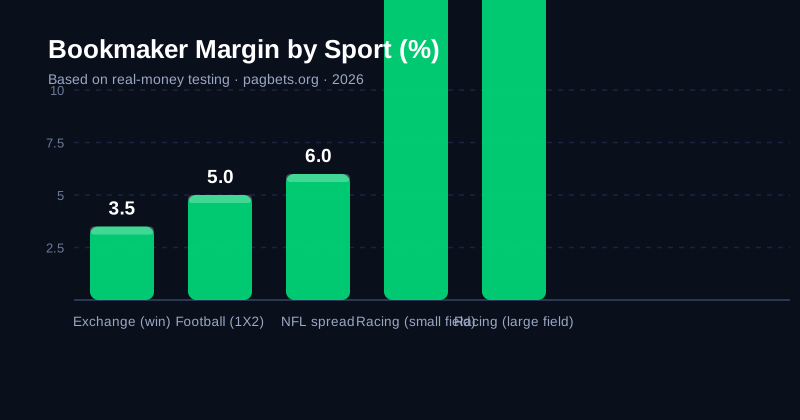
Any honest conversation about horse racing betting has to start with the margin, because it is dramatically higher here than in any other major sport. In a football match with three outcomes, a typical book overround is 4 to 6%. In a twelve-runner race it can easily reach 20% or more.
That figure changes everything about what counts as a good bet. In football, finding a one-point edge is enough to profit over hundreds of bets. In racing, a small edge is swallowed entirely by the margin, and you need a substantial mispricing just to break even. A runner priced at 5.0 might genuinely be a 4-to-1 shot, and that gap is not value — it is the margin doing its work.
The practical implication is that discipline matters more here than in almost any other betting market. A punter who chases, who bets short favourites on hot streaks, and who adds to losing runners will lose regardless of how well they understand horses. Our value betting guide explains how to account for margin properly.
How Racing Prices Are Built
A racing book prices a field, not individual runners. The bookmaker has an opinion about each horse's chance, converts that to fractional odds, and then applies a margin so the book returns a profit regardless of the result. A twelve-runner field with a total implied probability of 120% is running at a 20% margin.
Because the whole field is priced together, a strong opinion about one runner distorts the prices of others. Betting a horse heavily often shortens its own price, which means you are paying more for the same opinion as the market. The alternative is to bet before the market has absorbed your view, which requires discipline about timing.
Short and long pricing also behave differently. A market on a heavy favourite produces very short odds, where the margin consumes a large proportion of the true probability. Longer runners carry less margin proportionally, which is one reason the outsider market can be better value despite lower strike rates.
| Race type | Typical runners | Typical margin | Value assessment |
|---|---|---|---|
| Flat, small field | 5–7 | 12–18% | Difficult — margin too wide |
| Standard handicap | 8–12 | 18–25% | Very difficult |
| Large handicap | 14–20 | 22–30% | Exchange strongly preferred |
| National Hunt | 6–10 | 20–28% | Very difficult |
| Exchange win market | Varies | 2–5% commission | The realistic route to value |
Favourites, Outsiders and Why Both Misprice
Backing favourites is statistically the most reliable approach in racing, because favourites win far more often than their odds suggest. A horse at 2.0 wins roughly half the time, and across a season that reliability is real.
The problem is that backing favourites produces small, frequent profits that the margin gradually consumes. It feels productive because the bets usually win, and it is exactly the pattern that encourages increasing stakes. The second issue is that the strongest favourites carry the highest win rate and attract the most money, which shortens their price and makes them progressively worse value.
Outsiders are the mirror image. They win far less often than their odds imply, but because they attract less money their prices are longer, and a well-chosen outsider is a far more interesting bet. The difficulty is judging how much longer is enough. Our top-rated bookmaker comparison includes several operators with strong exchange offerings worth considering.

Each-Way Betting, Calculated Properly
Each-way splits a stake into a win part and a place part — usually one quarter on the win and three quarters on the place at one-fifth the odds. The attraction is that two payoffs are possible, which reduces variance, and it is a genuinely useful product for backing longer-priced runners.
The break-even calculation is worth doing properly. At 5.0 with quarter odds each-way, the win part returns 5.0 if it wins and nothing otherwise, while the place part returns 2.0 if it places. You need either the win or the place to return more than the total stake to profit overall. A quick way to think about it: each-way generally becomes more attractive as the price lengthens, and is frequently poor value below about 3.0.
The subtlety is that place means finishing in the top three in most markets, not second. A horse that comes fourth pays nothing on the place part. That is a rule beginners regularly misremember, and it materially changes the calculation.
- Win part: 25% of stake at full odds — pays only if the horse wins
- Place part: 75% of stake at one-fifth odds — pays if the horse finishes in the top three
- Good value: 4.0 and above, or at 3.0 with 1/4 odds
- Poor value: short prices, where the margin does most of the work
Exotic Markets and Where to Avoid Them
Forecasts, trifectas, exactas, each-way forecasts and every other exotic market are priced with a far wider margin again, often 30% or more. They are also harder to value, because the underlying probability involves combinations rather than a single outcome.
There is a reasonable argument for playing them occasionally. A strong opinion about three horses finishing ahead of the rest is a more demanding judgement than a single selection, and the payoff reflects that. The error is treating them as a serious strategy rather than as occasional entertainment.
Where exotic markets genuinely fail is when they are combined with progressive staking, which is a pattern more common in racing than anywhere else. A long run of losses on exotic bets produces a strong urge to raise the stake dramatically for the next one, and the wide margin means the sequence of losses can be long. Flat staking on a small number of well-researched runners is the durable approach.

Why Form Figures Deserve Scepticism
Form guides are published for every runner and are used by almost every bettor, which makes them one of the most crowded sources of information in the sport. If a factor is available to everyone and priced accordingly, it is unlikely to provide an edge.
There are also specific problems with racing form data. Distance change is the clearest: a horse that has won at 2000 metres is being asked to win at 1400, and the ability to sprint is a completely different physical quality. Jockey changes matter too, because a horse's record is partly the record of the rider operating it.
Racecourse and going figures are more useful, because they are contextual rather than purely statistical. A horse that has only raced on soft going and is dropped into a firm track is being asked to do something it has not done, and the difference is genuine information rather than a restatement of the public record.
The honest position is that public form should be used to eliminate runners rather than to select them. Using it to narrow a large field down to three or four credible runners, and then applying your own judgement about the specific race conditions, is a more productive use of it than treating a form line as a recommendation.
A Racing Routine That Works
Decide in advance how much you will spend on a meeting and stop when it is gone, regardless of results. Racing is uniquely suited to a fixed-meeting budget because the number of races is known in advance, which makes a hard stop straightforward.
Research properly, using form, going, distance suitability, weight and the jockey. Then bet one runner per race at a modest flat stake. Record everything, including the races you skipped, because a record of what you would have bet is the only honest measure of whether your research has value.
Most importantly, treat racing as the highest-margin, least predictable betting environment on offer. If your aim is entertainment, it is a good one. If your aim is sustainable profit, the exchange is a more sensible venue. Either way, the tools in our responsible betting tools guide are worth setting up before you go.
- Set a fixed meeting budget and stop when it is spent
- One runner per race, researched rather than tipped
- Prefer the exchange for anything longer than 3.0
- Use each-way selectively, mainly at 4.0 and above
- Avoid exotic markets as a core strategy
- Record skipped races too, that is where your honesty lives
- Keep a written record and review monthly