Why Odds Matter More Than You Think
Every bet you will ever place is a question answered by a number. Before you compare bookmakers, hunt bonuses or build accumulators, you need to read that number fluently. Odds tell you two things at once: how much you stand to win, and — once you learn the maths — how likely the bookmaker thinks the outcome is. The second part is where long-term bettors find their edge, because a price that disagrees with reality is exactly what value betting is built on.
In this guide we cover the three formats used worldwide — decimal, fractional and American — with worked examples, conversion tables and the implied-probability formula. By the end you will be able to look at any odds display on any betting site and know precisely what it means.
Decimal Odds: The Global Standard
Decimal odds are the default at most international bookmakers, including Bet365, 1xBet, Melbet and Mostbet. The rule is one multiplication: stake × odds = total return (profit plus your stake back).
A $10 bet at 2.50 returns $25 total — your $10 stake plus $15 profit. A $25 bet at 1.80 returns $45. There is nothing else to learn; the maths is identical at every stake size.
| Decimal odds | $10 stake returns | Profit |
|---|---|---|
| 1.20 | $12.00 | $2.00 |
| 1.50 | $15.00 | $5.00 |
| 2.00 | $20.00 | $10.00 |
| 2.50 | $25.00 | $15.00 |
| 5.00 | $50.00 | $40.00 |
Fractional Odds: The UK Tradition
Fractional odds (6/4, 5/1, 2/5) dominate British bookmakers and horse racing. The number on the right is your stake; the number on the left is your profit. 6/4 means a 4-unit stake wins 6 units of profit, plus the stake back.
So 5/1 on a $10 bet returns $60 total ($50 profit), and 1/2 — a short-priced favourite — returns just $5 profit on a $10 stake. If the left number is bigger than the right, the selection is an outsider; if it is smaller, it is the favourite.
- 5/1 (five-to-one) — $10 stake wins $50 profit
- 6/4 (six-to-four) — $10 stake wins $15 profit
- 1/2 (one-to-two) — $10 stake wins $5 profit
- 100/1 (hundred-to-one) — $10 stake wins $1,000 profit
American Odds: Plus and Minus Lines
American (moneyline) odds use plus and minus signs and a $100 reference stake. A minus line (-150) tells you how much you must risk to win $100: at -150 you stake $150 to win $100 profit. A plus line (+250) tells you how much a $100 stake wins: at +250 a $100 bet returns $250 profit.
Minus lines are favourites; plus lines are underdogs. This format is standard on US sportsbooks but appears on international sites for American sports such as the NBA and UFC.
Implied Probability: The Maths Behind the Numbers
This is the section that separates bettors who understand odds from bettors who merely read them. Every price encodes a probability: implied probability = 1 ÷ decimal odds.
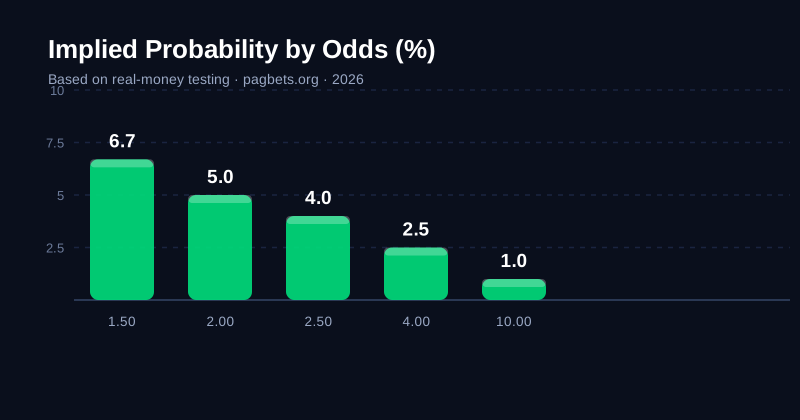
Odds of 2.00 imply 50% (1 ÷ 2.00). Odds of 1.50 imply 66.7% (1 ÷ 1.50). Odds of 3.00 imply 33.3%. If you believe the true probability of an outcome is higher than the implied probability, you have found a value bet — a price worth taking. That single comparison is the entire foundation of professional betting.
| Decimal odds | Implied probability | Fair value price |
|---|---|---|
| 1.50 | 66.7% | The favourite |
| 2.00 | 50.0% | Even money |
| 2.50 | 40.0% | Mild underdog |
| 4.00 | 25.0% | Clear underdog |
| 10.00 | 10.0% | Long shot |
The Bookmaker Margin: Why the Maths Always Adds Up to Over 100%
Add the implied probabilities of every outcome in a market and you will never get 100%. A fair coin-flip market should price both sides at 2.00, but real bookmakers price both sides at 1.95 — implying 51.3% each, a total of 102.6%. That extra 2.6% is the overround, the bookmaker's built-in margin, and it is why profitable betting is hard.
Margins differ by bookmaker and by market. In our 2026 odds audits, major football leagues carried margins of roughly 3.8% at Bet365 and 4.5% at the industry average, while niche markets often exceed 8%. Lower margins mean better prices for you — the first thing we measure when scoring any sportsbook.
Converting Between Formats
You will eventually want to convert formats without thinking. Decimal to fractional: subtract 1 and simplify (2.50 → 1.50 → 3/2). Decimal to American: above 2.00, multiply by 100 and subtract 100 (2.50 → +150); below 2.00, use -100 ÷ (odds − 1) (1.67 → -150). Fractional to decimal: divide and add 1 (6/4 → 1.50 + 1 = 2.50).
Don't memorise these — bookmark an odds converter or, better, set every bookmaker account to decimal odds so the comparison across sites is instant. Our top-rated bookmakers all allow format switching in account settings.
Reading a Real Odds Screen
Open any match on Bet365 or 1xBet and you will see three numbers: home win, draw, away win. Example: 2.10 / 3.50 / 3.40. The lowest number (2.10) is the favourite — the home side. The draw at 3.50 implies about 28.6%, and the away win at 3.40 implies 29.4%. Add them up: 47.6 + 28.6 + 29.4 = 105.6%, so the margin on this market is 5.6%.
Now you are reading odds the way a professional does: not as mystery numbers, but as probabilities with a price tag. And once you can see the price tag, you can start shopping for the cheapest one.
Common Beginner Mistakes With Odds
Three mistakes account for most beginner losses. First, confusing return with profit: decimal odds include your stake, so 2.00 odds do not double your money — they return your money plus an equal profit. Second, ignoring the margin: always check that the probabilities add up before believing a price is generous. Third, chasing long shots: a 50/1 price feels exciting, but if the true chance is 3%, you are paying a margin on a bet you will lose 97 times out of 100.
From Reading Odds to Finding Value
Once odds stop being mysterious, the whole betting experience changes. You compare prices across bookmakers, you notice when one site is out of line with the market, and you bet only when the number justifies it. That is the difference between betting for entertainment and betting with a process — and it starts with understanding the three formats explained above.