What a Virtual Sport Actually Is
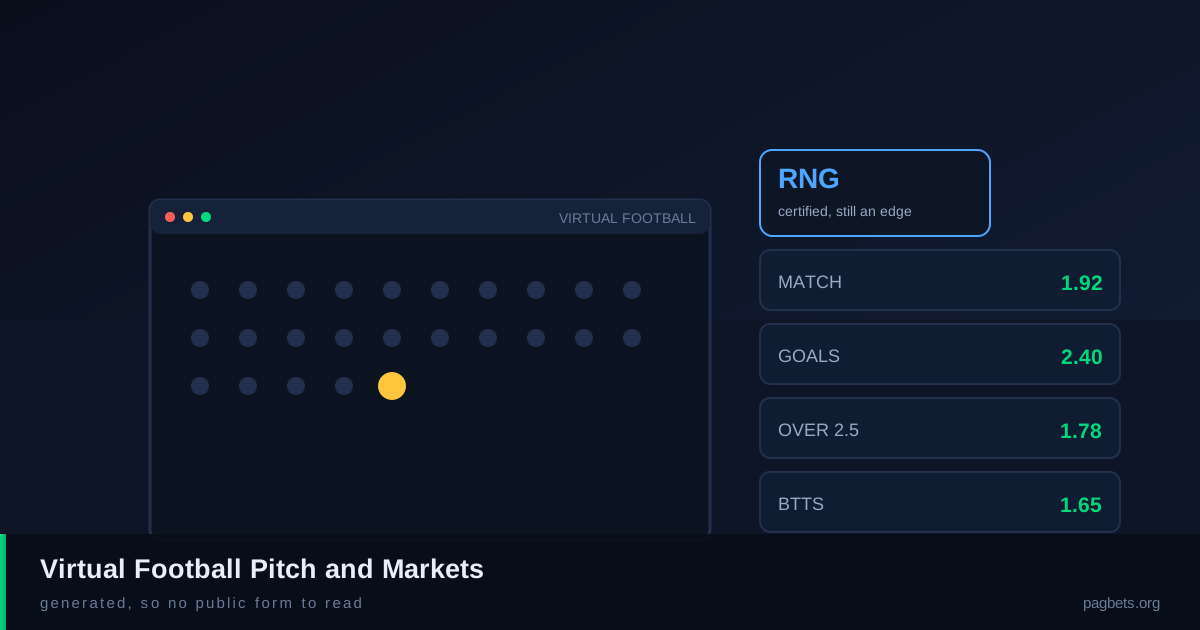
A virtual sport is a computer simulation that produces a sequence of results, and the results are generated by a random number generator. That is the complete mechanism. There is no match happening, no team playing, no injury report, no tactical adjustment, and no skill component of any kind. The graphics are a presentation layer on top of a number.
Three layers matter for a bettor, and understanding which layer is which resolves almost every question people have about these games.
Layer one, the random number generator. This produces the outcome. It is a pseudo-random process, which in practice means a deterministic algorithm seeded from an entropy source. The important practical point is that the sequence is not predictable from observation, regardless of how the seed works. A pseudorandom generator is not a random number, but it behaves unpredictably enough that pattern-hunting on past results is exactly as hopeless as with a real random source.
Layer two, the outcome model. This maps the random number onto a football result, a set of horse finishes, a tennis score or a car finishing order. This is where virtual sports genuinely resemble real sport, because the mapping is usually calibrated to something close to real outcome distributions. A virtual football game will produce home wins, draws and away wins at roughly the proportions real football does. It is not identical, and the difference is consistent, and it is never in your favour.
Layer three, the payout table. This is the commercially decisive layer. The operator decides what a win pays, and the return to player across the whole game is set to somewhere between 96 and 98 per cent. Every bet in the game carries that margin. Nothing you do changes it.
What You Are Actually Paying
This is the only table in this article that matters, and it is worth reading slowly. These are realistic 2026 figures across a mainstream sportsbook virtual sports product.
| Game type | Typical RTP | House margin | Number of bets to expect a 50% drawdown |
|---|---|---|---|
| Virtual football, 1X2 match winner | 96.0-97.5% | 2.5-4.0% | About 17-28 bets |
| Virtual football, correct score | 94.0-96.0% | 4.0-6.0% | About 12-17 bets |
| Virtual horse racing, win bet | 95.0-97.0% | 3.0-5.0% | About 14-23 bets |
| Virtual tennis, match winner | 96.0-98.0% | 2.0-4.0% | About 17-28 bets |
| eFootball, single 1X2 | 95.0-97.0% | 3.0-5.0% | About 14-23 bets |
| Sim racing, race winner | 94.0-96.5% | 3.5-6.0% | About 12-23 bets |
| Correct score or exact finishing order | 92.0-95.0% | 5.0-8.0% | About 9-14 bets |
How Many Bets Before You Are Down Half
The table above includes a column that most virtual sports content never mentions, and it is the most useful number on the page. It is how long a random betting sequence lasts before a bettor loses half their bankroll.
Here is the arithmetic, and it is deliberately blunt. On a fair coin, a bettor loses half their bankroll after roughly 4 bets at 50 per cent margin, around 17 bets at 3 per cent margin, and around 28 bets at 2.5 per cent margin. That is not a bad run. That is the expected path. The median bettor reaches a 50 per cent drawdown in roughly the number of bets listed, and a minority never reach it at all because they win early and stop.
Read that row for the correct score markets again: 5 to 8 per cent margin, half your bankroll gone in about a dozen bets. Nobody wins consistently at a game with a 6 per margin. What actually happens in practice is that a small number of bettors hit a run early, believe they have found something, and stake progressively harder until the expected path catches them, which it always does.
This is the whole game, and the bankroll management guide explains the same principle for real betting. The difference is that with real sports you have a skill component that can make the expected path positive. With virtual sports it is negative by construction, which is the entire difference between the two products.
Why Pattern Hunting Fails
Every few months someone posts a system for virtual sports. Martingale on correct score, a staking ladder on horse racing, a system that "reads" the sequence of results. I have seen these dozens of times and they all fail for the same reason, which is worth explaining properly rather than dismissing.
The law of independent trials says that if each result is independent, then the probability of the next result is the same regardless of what came before. A run of five home wins tells you nothing about the sixth, because the generator does not have a memory of the first five. This is not a philosophical claim, it is a property of how the generator is built, and it holds even if the generator has a tiny bias.
The common counter-argument is that there must be a cycle, because the results look patterned. They do look patterned, and the reason is that the outcome model maps a uniform random number onto a realistic distribution. A distribution with 45 per cent home wins will, over a short window, produce runs that look patterned. If you see eleven home wins in a row in a thousand-bet sample, the probability of that happening somewhere in the sample is high, even though any given position has a 45 per cent chance. That is a property of looking at sequences, not a property of the generator.
The practical test if you are ever tempted: the previous result tells you exactly as much as a coin flip told you the previous flip. There is no version of this that becomes profitable through timing.
eFootball, Sim Racing and the Sports That Feel Real
Some virtual sports feel more convincing than others, and the reason is worth understanding because it explains why people bet them harder.
eFootball and simulated football present a rendered match with players, a stadium and a commentary track. The realism cues trigger a real sporting response in people, which is why the same person will refuse to bet a virtual football match on principle and then stake five percent of their bankroll on a virtual correct score at 3am. The visuals are doing emotional work that the mathematics does not justify.
Sim racing is similar. A rendered circuit with named cars and drivers who exist and compete in real life creates a false familiarity. That a driver is good in real life has no bearing whatsoever on a simulated outcome, and treating it as though it does is the single most common reasoning error in these markets.
Virtual tennis tends to have the lowest margins of the lot, at 2 to 4 per cent, because a two-outcome match winner is a simple structure. If you are going to play any virtual sport, tennis is the cheapest version of it, which is an odd thing to optimise but it is true.
The honest summary: the more realistic a virtual sport looks, the more money its players lose relative to what the same money would cost in a lower-fi game with similar margins. The graphics are a cost centre, not a feature you are paying extra for.
Settlement Speed and the Real Upside
There is one genuine advantage to virtual sports, and it is not a financial one, though it has financial consequences.
Everything settles in seconds. A virtual football match starts every few minutes and the bet settles immediately. There is no pending bet, no void risk, no suspension, no delayed settlement, no dispute, and no waiting three days for a cricket match to be confirmed. In a region where sportsbook payouts can take days and real matches get postponed, that reliability has genuine value for someone who wants a fast, predictable cashier experience.
It also changes the behavioural economics in a way that cuts both ways. Instant settlement means the gap between placing a bet and seeing the result is about four seconds, which makes it far easier to chase. There is no natural break in the rhythm where you might stop for the night. A real football bet placed at 2pm gives you a natural pause at 5pm. A virtual football loop gives you a pause when you decide to have one, and that is usually a long time later.
So the honest framing is this: virtual sports are a cheap, immediate, reliably-settling entertainment product with a 2 to 5 per cent margin, and they are the least suitable environment for anyone who has previously found themselves chasing a losing run. Our in-play risk management guide covers the psychology of chasing, which applies here more than anywhere else on the site.
A Realistic Way to Think About Virtual Sports
Not advice on how to win, because there is no such thing. This is how to interact with the product without overpaying for it.
- Treat the margin as the price of entertainment. 3 per cent on a football match winner is roughly what you would pay for a streaming service. If the hours are worth it, that is a defensible purchase made knowingly.
- Play the two-outcome markets, never the correct score. 3 per cent versus 6 per cent is the difference between half your bankroll lasting 17 bets and lasting 12. The product looks identical and the cost is double.
- Never chase. The instant settlement loop is designed to produce chasing behaviour and the expected path guarantees the result. Set a deposit limit before you start, not when you need it.
- Set a timer, not just a budget. A cash limit alone will not save you, because a losing player keeps playing until the money is gone. A 30-minute session limit ends it while it is still fun.
- Never treat a losing streak as meaningful information. Eleven home wins in a row is a coincidence with a known probability, not a cycle about to turn.
- Do not use virtual sports to learn to bet. There is no transferable skill. A bettor who practises on virtual football and then moves to football is carrying habits formed on noise.
- Keep it separate from your real-money account. If you can only access virtual sports through a casino wallet rather than a sports balance, that separation is doing you a favour.
Choosing an Operator and Checking the Terms
Because the products are near-identical across operators, the practical differences are licensing, limits and honesty about the payout tables.
What to check, in order of importance. First, the published RTP, which a reputable operator states somewhere in the game rules. If an operator does not publish it, that is a meaningful signal about how they would handle a dispute. Second, the maximum bet on virtual sports, which is often set at a fixed small figure and is the single most effective limit on how fast you can lose. Third, whether real money and bonus money can be mixed in a virtual sports bet, because bonus terms requiring a 20x turnover on virtual football is one of the most expensive requirements in the industry.
Our how we rate bookmakers page sets out the full criteria, the online casino security checklist covers the account and payment side, and free bets explained is worth reading if you are evaluating a welcome offer, because the turnover requirement is where the real cost hides.
One specific warning for this market. Because virtual sports are always running and always available, they are heavily used as a bonus-busting target by operators who know a bettor will never wager 20x on a football accumulator. If you see a welcome offer restricted to virtual sports with a high turnover, that restriction exists to be unprofitable. The casino bonuses guide explains how these are structured.
The Comparison That Should Decide It
Here is the comparison that matters, and it is the one every virtual sports page should lead with but almost none of them do.
Real sports betting at a sharp 3 per cent margin means you are paying 3 per cent for a market where skill moves the outcome by more than that. You will lose over the long run, but your losses are attributable to a real information deficit that can be reduced with work. Virtual sports at a 3 per cent margin means you are paying 3 per cent for a market where nothing you do affects the outcome. The margin is identical and the product is strictly worse.
Put the other way: if you bet 1,000 units at a 3 per cent margin on virtual football, your expected loss is 30 units and no skill, study, notebook or time investment will change it. If you bet the same 1,000 units at a 3 per cent margin on a market where you have measured a 6 per cent edge, your expected return is positive before you finish reading this sentence. The mechanics are the same. The edge is not.
That is the complete argument, and it does not require a conspiracy theory, a bad-faith operator or a clever system. The product charges you a margin for a random number, and the only variable you control is whether you keep paying it. The value betting mathematics page has the expectancy arithmetic if you want to run it yourself, and the responsible gambling tools guide is the more important read if you are currently playing these markets more than you intend to.
The Virtual Sports Summary
Virtual sports are a random number generator with good graphics and a 2 to 5 per cent margin. The outcomes are random, the patterns are coincidences, and the previous result tells you nothing about the next one. Play the two-outcome markets, not the correct score, because the margin is half as much. Set a session timer as well as a cash limit, because instant settlement is built to produce chasing. And if your aim is to make money, the identical margin on a market where skill applies is a strictly better purchase.