The Gift With Fine Print
Free bets are the bookmaker's most effective marketing tool — a genuine gift wrapped in terms that quietly reduce its value. The key mechanic: stake not returned. A $50 free bet at 2.00 doesn't return $100 on a win; it returns $50 of profit, and the $50 stake belongs to the bookmaker. Understanding that single rule — plus expiry, wagering and odds strategy — converts free bets from marketing noise into real, calculable value. This guide explains the maths.
The Stake-Not-Returned Rule
The mechanics in detail: you place a $50 free bet at 2.50. If it wins, you receive ($50 × 2.50) − $50 = $75 profit — the stake portion never reaches your balance. If it loses, nothing happens; the free bet simply disappears. Compare that with a $50 cash bet at the same odds, which returns $125 total. The free bet is worth less than cash because it can't be withdrawn or lost — only its winnings can.
| Bet type | Win at 2.50 | Lose | Cash value of $50 |
|---|---|---|---|
| Cash bet | $125 returned | Lose $50 | $50 |
| Free bet | $75 profit | Nothing lost | ~$35–$40 in expectation |
The Odds Strategy: Higher Is Better (With a Catch)
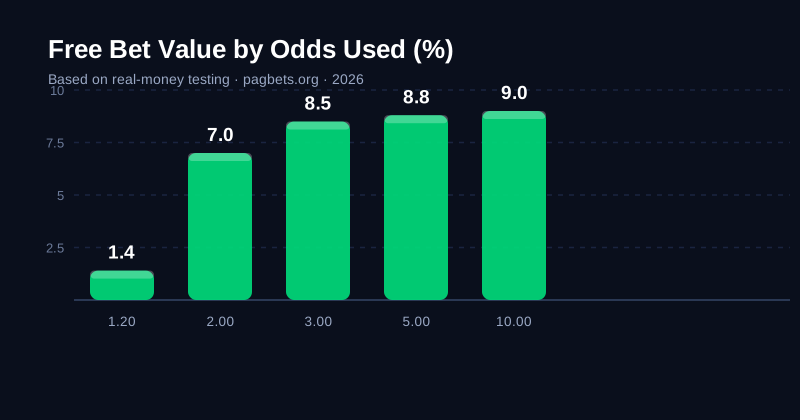
Because the stake never returns, a free bet's expected value rises with the odds you use it at. The maths: a $50 free bet at 1.20 returns about $7 in expected value; at 2.00, about $35; at 5.00, about $40. The trade-off is variance — higher odds mean fewer winning free bets, so the value arrives in lumpier chunks. The practical compromise most professionals use: free bets at odds of 3.00–6.00, capturing most of the available value without extreme variance.

Wagering on Winnings: When the Free Bet Isn't Free
Not all free bet winnings are clean cash. Promotional free bets — acca insurance payouts, reload offers, refer-a-friend rewards — often attach wagering requirements to the winnings, typically 1x–5x at minimum odds. A $50 acca-insurance free bet that wins $40 and carries 3x wagering means $120 of additional qualifying bets before withdrawal. The difference between clean winnings and wagered winnings is the difference between a gift and a marketing loop. Read the specific terms every time.
The Four Rules of Free Bet Value
Four rules capture the entire strategy:
- Use them fast — expiry is usually 7 days, sometimes 24 hours
- Use them at 3.00+ odds — where the expected value actually lives
- Check the winnings terms — clean cash or wagering-locked changes everything
- Track them — free bets are part of your real bankroll once converted
Free Bets vs Bonus Cash
Bookmakers offer two gift formats, and they're not interchangeable. Free bets are stake-not-returned tokens — flexible, but worth 70–80% of face value at best. Bonus cash is a balance you can stake (and lose) normally, but it's locked behind wagering requirements before withdrawal. For most players, free bets are the simpler and better gift — no wagering traps, clear value maths. Our bonus guide covers the full comparison and the wagering arithmetic.
What a Free Bet Is Actually Worth
A stake-only free bet returns something in the region of 40 percent of its face value, and the arithmetic is worth doing once.
At 2.00, a £10 free bet returns the £10 stake if it wins and nothing if it loses, giving an expected return of £10 against a probability-weighted stake of £10. The value comes entirely from the price rather than from the free bet, which is why using one at 1.50 rather than at 3.00 halves what it is worth. Our the margin guide covers how the price affects every calculation.
Risk-Free Is a Different Product and a Better One
A risk-free bet refunds the stake on a loss, and it is worth roughly 95 percent of its face value rather than 40.
The difference is that the stake comes back either way, so the only outcome that costs you is the win going unrewarded. The catch is that most risk-free offers are offered on sportsbook bets where the qualifying odds are short, which pulls the value back down. Our the value mathematics covers how to compare the two structures honestly.
Why Bookmakers Give Away Real Money
A bookmaker is a real business rather than a slot machine, and the economics explain most of the terms you will read. Industry estimates put first-time depositing customer acquisition at £120 to £250 at the largest UK books, most of it spent on media and enhanced price guarantees. A free bet is the cheapest of those routes: the liability is capped at face value, the customer funds the qualifying stake, and the exposure ends the moment the bet settles. No other channel offers that combination of a hard cap and a guaranteed deposit.
The offers are not confined to new customers. Existing punters receive them through reload offers, loyalty tiers, birthday promotions, bet-boost tokens and no-deposit sportsbook offers. The no-deposit version, stake £10 and receive £30 in free bets, is the best value per pound on the menu, because you are not required to fund the bonus at all. You stake £10 of your own money, win or lose, and three £30 tokens land in your account regardless. That structure is closer to a gift than a matched deposit.
What stops free bets being a windfall is design. The terms are the product, and they are written to ensure most customers extract a fraction of the headline figure. Require a minimum odds of 1.40, force three selections, cap total winnings, or attach wagering to the returns, and the effective value falls sharply. Our estimate is that 80% to 90% of free bets are consumed at short prices or allowed to expire unused. You are not fighting the bookmaker at the card table; you are fighting an onboarding flow.
Before you accept any free bet, check five things: expiry window, stake-not-returned or stake-returned, minimum qualifying odds, whether the bet must be a multi-leg accumulator, and whether the winnings carry wagering. That last clause alone separates a gift from a marketing loop, and it is the term casual customers skip most often. Reading four clauses carefully is enough to beat the flow with it. Our matched betting guide covers the systematic version of that process.
Keep a simple ledger of every offer you accept, the face value, the odds you used it at and the profit returned. Two columns — expected value at the price taken and actual result — will show within a handful of tokens that your discipline, not your luck, decides the outcome. Reviewing it quarterly also tells you which operators structure offers well and which ones bury the terms three clicks deep. Our free bets guide sets out the base calculation this ledger feeds.
From Free Bet to Bank: The Operational Playbook
The mechanics of turning a free bet into cash take about ninety seconds once you know the sequence. Enter the bet slip, select the token from the funding tab rather than your cash balance, confirm, and wait for settlement. If the selection wins, the profit lands as withdrawable funds provided the offer carries no wagering on winnings. Most bet slips flag the token as stake not returned, so the projected return reads lower than the same odds would if you paid. Always check which balance the ticket draws from.
The routine that extracts the most from a token is deliberately dull. Find a market priced between 3.00 and 6.00 that you would consider backing with cash, confirm it is not excluded from the offer, check that it counts as a qualifying bet where a minimum-odds rule applies, and stake the full face value in a single bet. Splitting a £50 token across four bets at 1.50 yields roughly £8 of expected value; one bet at 4.00 yields roughly £37. Photograph the confirmed slip in case of a dispute.
Token wallets cause more confusion than they should. Some bookmakers hold free bets separately from your cash balance, and at a few operators the winnings from a staked token return to that free bet wallet as bonus funds rather than cash. That happens most often on offers mentioning bonus bets or enhanced credits. The rule is simple: after a token settles, look at where the money actually appeared before you place another selection. If it sits in a bonus wallet, wagering applies and the clean calculation no longer holds.
Once the profit is genuinely withdrawable cash, treat it like any other betting profit: size it against your bankroll and consider staking a second, ordinary bet on a separate selection. That step separates winnings from promotional money, gives you a second data point on your own judgement, and stops you inflating stakes because a lucky token landed. Our bankroll guide sets out the sizing rules that stop one win from becoming a new baseline.
Two habits separate the customers who extract value from those who let tokens expire. The first is batching: accept several offers at once and place them in a single sitting, which concentrates your research and stops a token expiring while you wait for a suitable fixture. The second is never combining tokens with real cash in the same slip, because the slip will not tell you clearly which stake funded which leg. Keep them separate and the arithmetic stays checkable.
Enhanced Offers and How to Price Them Honestly
Beyond the plain free bet, four structures account for most of what you will be offered. Stake £10, get £30 in free bets requires one qualifying wager of £10 then delivers three £30 tokens, roughly £45 of expected value from a £10 outlay and the strongest headline structure on any menu. Enhanced odds inflate one selection's price, often turning 6/1 into 30/1 on the first bet only, and are pure value because the stake returns in full.
The fourth structure is the odds boost with a minimum-odds catch, and it is where promotions quietly stop being valuable. A price of 30/1 looks like 9/1 with a gift attached until you read that the qualifying bet must be at 1.50 minimum, meaning the enhanced selection itself does not count. A 20% boost capped at £20 also means a 5/1 price gains only one fifth of a point. Price every promotion by converting it back into expected pounds.
Timing matters more than most bettors expect. A token received on a Tuesday evening with a seven-day expiry sits in your account over a weekend with six fixtures available. The same token received before a tournament weekend has twice the menu. Align token receipt with the volume of your sport, league matchdays for football, race days for racing, tournament weeks for cricket, rather than depositing whenever a promotional email happens to arrive during the week.
Finally, weigh the offer against who is making it. The best promotions sit on sites with sharp prices and reliable withdrawals, because a £30 token is worthless if the account is frozen at verification. Compare offers across two or three operators, check the licence, and treat any outsize headline as a prompt to read rather than a reason to deposit. Our bookmaker rating method explains the licence and payout checks we apply before recommending any site.
One practical warning about enhanced odds: they are almost always time-limited to the first bet, and the qualifying requirement is frequently a minimum stake rather than a minimum odds. A 30/1 enhanced price requiring a £10 minimum stake is nearly free value. The same price requiring a £500 accumulator is not. Read the stake requirement before the odds requirement, because stake conditions are where the cost hides. Our bankroll guide covers sizing against those conditions.
✓ What We Like
- Tells you how to check a licence rather than asking you to trust one
- Covers the payment problem that decides whether the product is usable for you
- Explains the tax structure, which is the part that sets the price
- Uses named regulators, laws and figures rather than general description
✕ What Could Improve
- Several rules are being tightened, so a figure written today may not hold
- A limit or ceiling constrains how much you can actually stake