Why Map Knowledge Dominates E-Sports
Nothing in e-sports betting matters more than the map pool. Each title has a set of maps, and teams build their identities around a few of them. A team that is dominant on two maps and weak on the others is a genuinely different betting proposition from one that is uniformly strong, and the map veto and pick phase is where that becomes visible.
Before any tournament match, check which maps are in the active pool, then check the veto results. If the stronger team vetoed their own best map, the match has been materially altered. Most major platforms publish veto results in the days before an event, and treating them as essential information rather than a footnote is the single biggest edge available to a newcomer.

Bo1, Bo3 and Why Format Decides Everything
The best-of format changes the mathematics of every market. A best-of-one is essentially a single map with a match winner market on top, and it offers the least opportunity for a bettor to apply match-level insight. A best-of-three allows a team to absorb one bad map, which favours teams with deep map pools and punishes teams that are strong on only one or two.
Series handicaps are the other format-sensitive market. A handicap of -1.5 on a Bo3 means the favourite must win by two maps, which is a very different requirement from the same handicap on a Bo1. The same numbers mean entirely different things, and reading them without checking the format is a common and expensive mistake.
| Format | Maps to win | Series -1.5 requires | Favours |
|---|---|---|---|
| Best of 1 | 1 map | Win the single map | One-map specialists |
| Best of 3 | 2 maps | Win both maps | Deep map pools |
| Best of 5 | 3 maps | Win 3 maps | Elite consistency |
| Best of 7 | 4 maps | Win 4 maps | Rare, very high skill |
The Markets Available
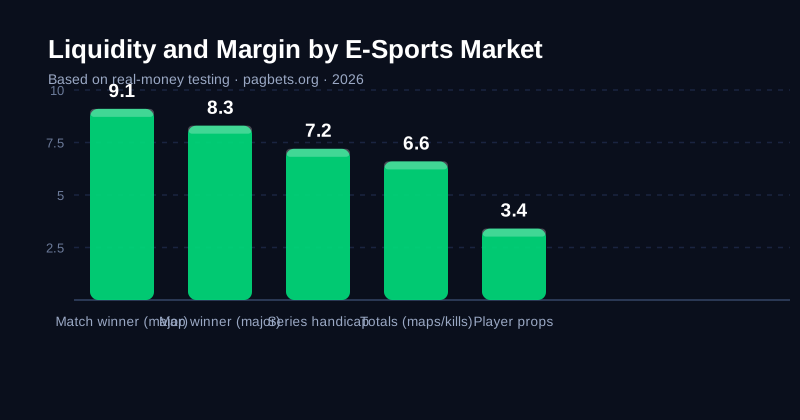
Match winner is the simplest and usually least interesting, because the price reflects the market's view closely. Map winner offers the most opportunities, and the value often lies in a specific map rather than the series. Series handicaps reward a view on the margin of victory, and totals markets — maps played, total kills, total rounds — are frequently the sharpest available.
Player-specific markets exist on some platforms, including first blood, most kills and duel win rates. These are worth approaching cautiously: individual statistics can be highly dependent on map and role, and a star player on a comfortable map can skew numbers in a way that does not represent the team's underlying strength. Props are often priced with a wider margin for this reason.
Researching Teams Properly
Roster stability is the factor most people overlook. E-sports teams change frequently, and a stand-in can shift a team's true strength considerably. Always confirm the current five before a tournament rather than relying on a ranking that may be weeks old, and treat rankings as a rough guide rather than a measurement.
Form should be measured against comparable opposition, not raw win rate. A team with a ninety percent win rate against regional opponents tells you little about how they will fare against a top-five side. Look at head-to-head records where the sample is meaningful, and at how teams perform in the specific tournament format rather than in general play.
- Check the map pool and veto results before anything else
- Confirm the current roster, including any stand-ins
- Measure form against comparable teams, not raw win rate
- Note the tournament format and how the team performs in it
- Use player props selectively, they carry a wide margin
- Prefer totals and map markets where margins are tighter
- Keep stakes within limits from our responsible betting tools guide
Where the Margin Sits
Different titles and different platforms carry very different margins, and this is worth checking before committing. Majors and established leagues with high liquidity usually price tightly, with maybe 3 to 4% built in. Smaller leagues, obscure tournaments and player props can run at 8% or more, which quietly consumes any edge you might have.
This is where our review approach matters. We compare the available markets and pricing across operators in our e-sports betting sites comparison, so you can see where a title is priced best before you invest research time in it. A small edge on a well-priced market beats a large theoretical edge on one carrying a wide margin.

Why E-Sports Form Is More Stable Than Most Sports
The property that makes e-sports attractive to bettors is also the one most often overstated. Player and team performance in a competitive title is far more consistent than in physical sports, because the same five people are using the same mechanics against the same map pool every week. A football striker can be injured, out of form or facing a different kind of defence. A counter-strike player faces essentially the same problems every match.
This stability is what makes form analysis in e-sports genuinely predictive rather than merely retrospective. A team that has won eight of its last twelve on a particular map has a real, measurable strength on that map, and the sample is not distorted by personnel changes the way a physical-sport sample would be.
The complication is that the stable unit is the team-plus-map combination, not the team in isolation. A team that is dominant on one map and weak on two is not a strong team; it is a strong team on a specific map. This is why the map veto remains the most important pre-match information in the sport, and why checking it is the first thing an informed bettor does.
Our general e-sports betting guide covers the fundamentals of the sport's markets and the differences that matter most for how you bet.
Scheduling and Metagame Shifts in E-Sports
E-sports have a feature that most sports do not: a published metagame that changes on a predictable schedule. When a balance patch lands, the value of every pick, every strategy and every player role can shift overnight. Teams that were dominant a week earlier may be weak, and the books may take a day or two to reprice accordingly.
That window is genuinely interesting, and it is a situation where careful research can beat the market. It is also a situation where the market corrects sharply and without notice, so an advantage that existed on Monday can be gone by Wednesday. The discipline is to check the patch notes before a tournament, not to build a long-term read across a patch boundary.
Map removals and additions have a similar effect, and they interact with the veto phase to create a confusing picture if you have not followed the chronology. A team whose signature map has been removed is a genuinely different proposition, and rankings published before the change will mislead you. Our main e-sports betting guide covers the tournament structure in more detail.
Betting In-Play on E-Sports
E-sports is one of the few areas where in-play betting is genuinely skilful rather than merely fast, because maps are long and structured. There is time to think between rounds, and the strategic shape of the game often becomes clear mid-map. If a team has won pistol rounds and their economy is thriving, the map is effectively decided at a price that may not yet reflect it.
It is also the area most prone to impulsive overreaction, because a round loss produces an immediate emotional swing. The approach that works is to have decided your threshold before the map starts, and to only bet when price reaches it rather than reacting to each round. Our in-play betting risk guide covers the general principles.