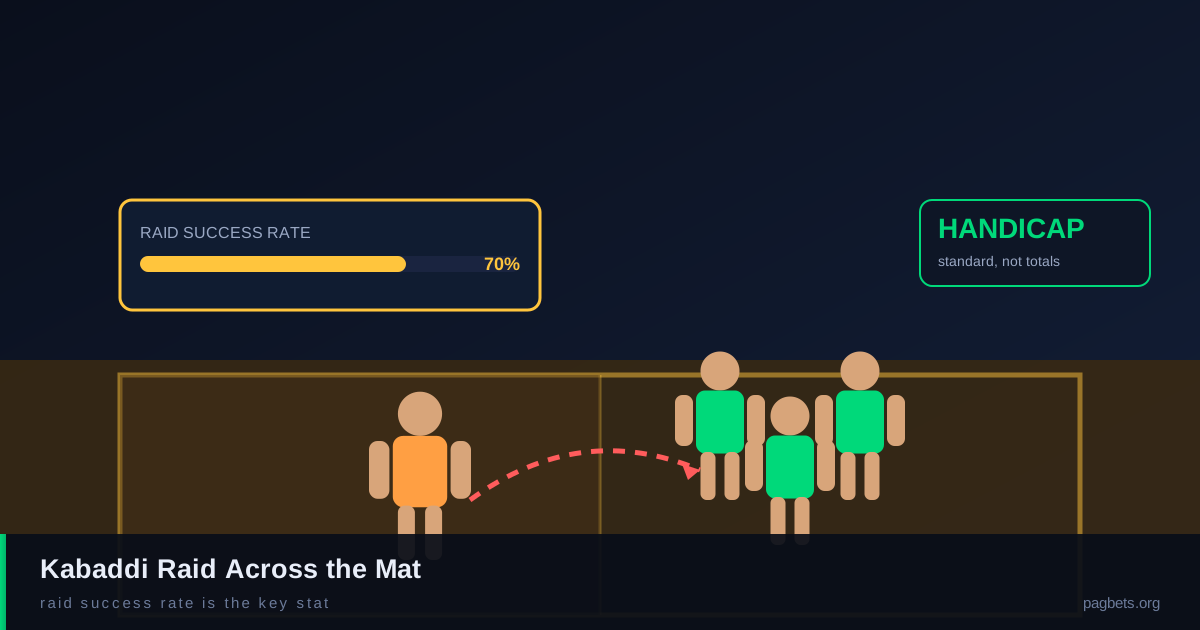
Kabaddi Is a Points Sport in Football Clothing
Most people arrive at kabaddi betting through the Premier Kabaddi League, see a scoreboard reading 38 to 35 after twenty minutes, and assume the rest of the match will behave like a football match. It will not. A football match produces two or three decisive moments. A Pro Kabaddi match produces roughly eighty, and the margin between two good teams is often under three points.
A market that settles on a narrow band of points rewards a small pricing error with a long winning run. A market that settles on a coin flip keeps the edge forever. Kabaddi sits in the first camp, provided you take the right market. If you have never placed a bet, start with our first betting guide and come back here once the staking part makes sense.
The Raid: Where Most of the Points Come From
A raid begins when one raider crosses the centre line. He must return without being stopped. If he is caught, the defenders score one point. If he gets back, he scores one. That is the base mechanic, and almost every stat in the sport measures how well one side does it against the other.
Then the modifiers arrive, and they are why kabaddi scores climb into the forties rather than the twenties. An empty raid scores nothing. Crossing the bonus line scores an extra point. Touching a defender and returning safely scores an extra point. Putting a defender out scores the raider one point and his team three more.
So a single raid is worth one, two, three, four or even five points. The best raiders run a success rate around 55 to 60 per cent. The worst sit near 40 per cent. Across a forty-point match that gap is roughly ten points, which is why a two-point handicap is a sensible line rather than a laughable one, and why a missing starter moves a total by more than a full point. That link between one raider and the match total is the same input structure that makes the expected goals framework work in football, with raid success rate standing in for expected goals.
Raid Scoring: What Each Outcome Is Worth
Before you look at a price, memorise this table. It is the complete list of raid outcomes and their point values, and it is the fastest way to read a live kabaddi bet.
| Raid outcome | Points scored | Who benefits |
|---|---|---|
| Empty raid (touched, tackled, or no bonus) | 0 | Defenders |
| Safe return, no bonus, no touch | 1 | Raider |
| Safe return across the bonus line | 2 | Raider |
| Safe return with a touch on a defender | 2 | Raider |
| Safe return, bonus line plus a touch | 3 | Raider |
| Defender put out (all-out) by the raider | 4 | Raider (1 raid + 3 team bonus) |
| Raider tackled without being put out | 1 | Defenders |
| Raider tackled after putting a defender out | 3 | Defenders (1 tackle + 2 team bonus) |
| Raid with one defender remaining | 1 | Normal rules apply |
| Raid with two or fewer defenders left | 2 | Raider automatically, on crossing |
Tackles, Super Tackles and the All-Out
Defence is scored through three mechanisms and they are not interchangeable. A standard tackle, where the raider is stopped but not put out, gives one point. An all-out, where the raider is taken beyond the backline, gives one point to the tackler and two to the team, so three in total. A super tackle gives four.
Super tackles are the most under-priced event in the sport. They are spectacular, they dominate every highlight reel, and they are rare. Most books have stopped pricing them. Where they do, track a team's super tackle rate across a season, which usually settles between three and eight per cent of raids.
The all-out is the mechanic the whole game is built around, because it shrinks the opponent half. Two all-outs early means the raider crosses into a half with three or four defenders, and the rules reward that with an automatic two points. Teams that generate all-outs systematically extract far more from a raid than their tackle numbers suggest.
Bonus Points, Chains and Rotation
Bonus points, chains and the all-out are where a kabaddi match is actually decided. Three bonus systems stack on top of each other.
First, the individual bonus. Every raider carries a quota for the half, historically between three and six points. Meeting it earns a technical point; missing it can cost the team one. This is why three quiet raiders suddenly start scoring: the bonus is threatened and the coach rotates hard.
Second, the team all-out bonus, a configurable one to three points awarded when a side puts out the entire opposition. The captain declares it before the raid, so it is public information, and the shape of the match changes when a captain will trade a defender for four points.
Third, the chain. When a side stops three consecutive raids and then puts a raider out for a fourth, that is a four-point chain rather than four single points. The chain is where momentum actually lives. Watch the live chain count, not the scoreboard margin. If you build your model on raid success rate, these three systems are the adjustments you layer on top.
Six Stats Worth Knowing Before You Bet
Kabaddi has no public xG equivalent, but the raw data is better than most people use. These six cover almost everything.
- Raid success rate. Points per raid attempted. Above 55 per cent is elite, below 45 is a liability. This is the single most predictive number in the sport.
- Tackle success rate. Percentage of raids defended. Add the empty raid rate and you can separate defences that win ugly from those that dominate.
- Super tackle rate. Usually three to eight per cent of raids. High variance and heavily skill based, so treat a short price with suspicion.
- Bonus and touch rate. The share of successful raids that bank the extra point. Turning eight one-point raids into eight three-point raids is worth more than the raid success rate alone shows.
- Raiders used per match. Between six and nine, occasionally ten. A side using nine raiders has a thin bench and a vulnerable second half.
- Points conceded when the bench is used. Early rotation tends to leak in the middle overs, and the middle of a kabaddi match is where most of the points land.
Why Totals Beat Match Winners in Kabaddi
Here is the case, and it is a strong one. In a Pro Kabaddi match the winner typically wins by under three points. Out of a forty-point match, three points is under eight per cent of the score, and it sits well inside the noise of a single all-out. The match winner is functionally a coin flip that the book has priced to a 105 per cent book.
Total points is not. It settles on a number in a narrow range, driven by inputs you can actually observe: which raiders start, how rested each side is, whether a key defender is missing, and the historical head-to-head. A 41.5 line between two teams averaging 39 and 42 against each other is genuinely tradeable.
The pricing is better too, which matters more than beginners realise. Football and cricket totals are competed down. A kabaddi total carries a wider book, often 108 to 115 per cent, because the modelling is thinner. Our sportsbook margin guide explains how to price that gap before you stake anything.
Total Points: Where the Margin Sits
Take a representative Pro Kabaddi fixture and compare the two approaches across ten bets at a 2 per cent stake.
| Approach | Typical price | Rough book % | Win rate needed | Reality |
|---|---|---|---|---|
| Match winner, even matchup | 1.90 | 105 | 52.6% | Very hard. Variance kills it. |
| Match winner, clear favourite | 1.35 | 104 | 74.1% | Dominated by single all-outs. |
| Handicap, 2.5 points | 1.90 | 106 | 52.6% | Workable, needs raider form. |
| Handicap, 5.5 points | 1.85 | 107 | 54.1% | Best handicap range in the sport. |
| Total points, 38.5 | 1.85 | 109 | 54.1% | Most data available. My default. |
| Total points, 41.5 | 1.90 | 110 | 52.6% | Needs both attacks at full strength. |
| Half-point total, 39.0 | 1.95 | 112 | 51.3% | Highest price, highest variance. |
The Half-Point Line and Why It Is the Best Price
Kabaddi shares football's habit of offering half-point lines for the same reason football does: a half-point removes the push, which removes the bookmaker's favourite outcome. A total of exactly 40 is rare but real, and on a 40.0 line that result refunds your stake. A bettor on over 40.0 has written a bet that cannot win on a dead heat, which quietly raises the break-even on everything else.
Whole lines are also where the money sits. If the total is 40.5 and a side trails by six with two minutes left, cash-out often offers near even money on 40.0 even though 40.5 and 41.5 are both still live. That gap is exploitable, and it appears more often in kabaddi than in football because the scoring is so compressed. For the push mechanics on quarter lines, see our over and under guide.
Why Kabaddi Has Fewer Markets Than Football or Cricket
Being honest about the limits matters. A mainstream book gives you a match winner, a handicap and a total on most Pro Kabaddi and World Kabaddi fixtures. Some add a half-time total. That is roughly the list. There are no corners, no cards, no player props, no correct score and, for the most part, no in-play bet builder.
The reason is simple. Those markets need event-level data the book collects itself. Kabaddi hands you a very small set of countable events, so the extra markets are worked off a public scorecard that updates once per raid. An in-play kabaddi bet is a bet against a number that can move four points in a single raid, which is not an edge for you.
Where the Value Sits, and What to Skip
Bet the total-points line and the 5.5 handicap. Skip the match winner unless the teams are far apart in raid success rate, skip any first-half market until you have logged a season, and skip every live kabaddi bet where the book offers a mid-match line that looks generous. That generosity is not generosity, it is the absence of a risk model. Full stake no more than 2 per cent, and treat the discipline in our Asian handicap guide as a floor rather than a ceiling.
A Working Routine for a Kabaddi Week
About forty minutes per matchday, in four steps.
One. Pull both teams' last six matches. Write down points scored, points conceded, raid success rate, empty raid rate and raiders used. Six is enough to spot a form break and not enough to overfit noise.
Two. Check injury and rotation news. In my model a missing lead raider costs roughly 0.35 points per raid, so a raider averaging nine points a night is worth about three a match. That is a full handicap line. A rested side after a three-week break is worth about the same.
Three. Find the head-to-head totals. If the last six meetings ran 38, 42, 39, 44, 37 and 41, the median is 40 and two were above 41.5. That is a real number.
Four. Take the best total price across two books, apply the margin test, stake 2 per cent, and log it the same day. Our bankroll management guide covers the record keeping, which is the least glamorous part of the exercise and the only part that makes the other three worthwhile.
Common Kabaddi Betting Errors
I have watched enough people lose money here to name the patterns. The first is treating a raid as a football chance. A raid is roughly 60 per cent likely to succeed, but it is worth one point, and forty accumulated raids mean one bad call barely registers. The second is not adjusting for halves: a side trailing by eight at half time has historically finished eight points down.
The third, and the most expensive, is over-staking a sure thing. A 1.20 favourite on a kabaddi match winner is a 1.20 price in a market with a 105 per cent book. You need 84 per cent to break even and the actual rate is nearer 78. That bet loses over a hundred bets.
The fourth is ignoring that many books cap kabaddi stakes well below their football limits, which tells you something about their confidence in their own numbers. Finally, do not confuse a league position with a kabaddi team. Raider quality is the whole sport, and the side built on raids is the one to back when the total is high.