The Formula in Plain English
The Kelly criterion answers one narrow question: given a stream of bets at known odds where I believe I have an edge, what fraction of my bankroll should I risk on each so the account grows as fast as possible without the risk of permanent ruin? It is not a betting strategy, it does not pick winners, and it knows nothing about football. It is a sizing rule you apply once a bet is already good.
In decimal odds the formula is:
f = (bp - q) / b
where b is net odds (decimal price minus one, so 2.00 becomes 1.00), p is your estimated win probability and q is the loss probability, which is simply 1 minus p. The answer f is a fraction of bankroll. If f comes out at 0.06, stake 6 per cent. If it comes out negative, that is a no-bet, because the price is worse than your estimate.
There is an equivalent form that is easier in your head, and it is the one I actually use:
f = edge / odds
where edge is your edge as a decimal fraction, not a percentage. If you think 2.00 is really a 56 per cent shot, your edge is 0.06 and your Kelly stake is 0.06 / 2.00 = 3 per cent of bankroll.
Before any of this matters, understand what it optimises. Kelly maximises the logarithm of your bankroll, which sounds academic until you realise it is the formal version of "do not let any single bet be capable of ending you". A rule that permits total ruin has an expected log return of minus infinity, however good its average return looks.
Why Full Kelly Is Almost Always a Mistake
Here is the arithmetic that should end the full Kelly debate. Take a bet at evens where you believe the true probability is 0.56, so your edge is 6 points.
Kelly says f = 0.06 / 2.00 = 0.03, or 3 per cent. At 3.00 with the same edge it is 2 per cent. At 20.00 with the same edge it is 0.3 per cent. Kelly refuses to let a long-priced bet blow up the account.
Now the failure case. If you believe 45 per cent and the price implies 50 per cent, and bet anyway at 2.00 for 5 per cent of bankroll, the formula does not protect you, because you have overridden it. Kelly is only correct if p is correct, and it is unforgiving when p is wrong.
Here is the number to memorise. At a price of 2.00, a bettor staking 10 per cent of bankroll is running five times the full Kelly stake. Consider a 20-bet losing run, which is constant in a 50 per cent market. After 20 consecutive losses at 10 per cent per bet the bankroll multiplier is 0.9 to the power of 20, which is 0.12. You have lost 88 per cent of everything. At full Kelly the same run costs 0.97 to the power of 20, which is 0.54, a 46 per cent drawdown. The Kelly bettor is ruin-adjacent; the 10 per cent bettor is dead.
Recovery arithmetic is brutal. A bankroll down 88 per cent needs a 733 per cent gain to get back to where it started. Down 46 per cent needs 85 per cent. The second is achievable; the first, in practice, is not.
What Fractional Kelly Looks Like Over Time
Same bet, same price, same assumed edge, four different staking rules, 400 bets at 2.00 where you are honestly right about a 54 per cent win rate. The edge is thin and realistic, which is the point.
| Rule | Stake per bet | Outcome over 400 bets | Comment |
|---|---|---|---|
| Full Kelly | 3.0% | Growth, but with a 60% peak-to-trough drawdown | Mathematically optimal on paper. Unbearable in practice. |
| Half Kelly | 1.5% | Growth, drawdown around 35% | Genuinely defensible if your edge is well measured. |
| Quarter Kelly | 0.75% | Steady growth, drawdown around 18% | My default. Survives bad estimates and bad runs. |
| Eighth Kelly | 0.375% | Slow steady growth, drawdown under 10% | For a market you have modelled less than 200 times. |
| Flat 1% | 1.0% | Beaten by quarter Kelly, and takes the same drawdown | No defence against overestimating your edge. |
| Flat 5% | 5.0% | Down 74% in a 40-bet run | The most common serious bettor error I see. |
Quarter Kelly: The Practical Default
Here is my actual rule, and it has survived six years of applying it.
Find a real edge first. A bet only enters the calculation if you have a logged, measured reason to think the price is wrong. Not a feeling, not a tip, not a hunch about a team. A model, a price comparison across books, or a dataset. The value betting mathematics guide covers how to establish that edge honestly.
Apply a fraction, not the formula. Use quarter Kelly as the ceiling. If the full Kelly number is 4 per cent, you stake 1 per cent. If the full Kelly number is 12 per cent, treat that as a warning that you have a calculation error somewhere, cap it at 2 per cent and go back to the inputs.
Never let it exceed your fixed cap. Whatever Kelly says, my hard ceiling is 2 per cent per bet.
Recompute, do not compound blindly. Rebuild the fraction from the current bankroll every time. Staking the same number of pounds regardless of how the account has moved silently converts a proportional system into a fixed one.
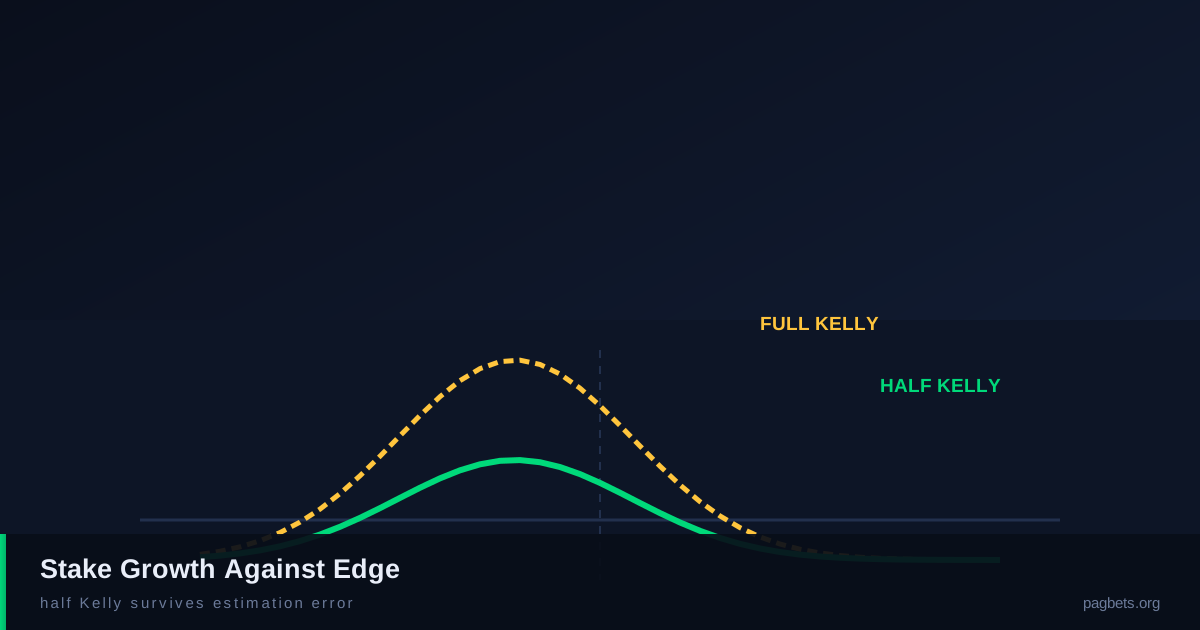
Quarter Kelly has one property full Kelly lacks: the damage from being wrong is bounded. If your true edge is half of what you thought, quarter Kelly is barely affected, because at small fractions the growth rate curve is close to linear. If your true edge is zero, it costs almost nothing. Full Kelly turns both situations into a catastrophe. This is why I would not use full Kelly on any bet where my edge is an opinion rather than a measurement.
What Fraction to Use, and When
Match the fraction to how well you have actually measured the market. The more your number is a guess, the smaller the fraction.
- Eighth Kelly, 0.125x. Your default for prop markets, correct score, and anything priced above 5.00. Long prices demand a very accurate probability, and a small error on a 20.00 shot moves the fair price by several points.
- Quarter Kelly, 0.25x. The working default for football handicaps, totals and Asian handicap lines where you have 200+ logged bets at that market type. This is what I use most days.
- Half Kelly, 0.5x. Reasonable only where you have a genuinely strong, well-tested model. My own half Kelly bets are confined to a single Asian handicap league I have priced several thousand times.
- Full Kelly, 1.0x. Reserved for arbitrage, where the edge is arithmetic rather than estimation. If f is an arbitrage play, a large fraction is correct because there is no estimation error. Our arbitrage guide covers why the logic is different there.
- Zero. When the formula returns a negative number, when you cannot articulate the edge in one sentence, or when the price is worse than last season closing line. No stake is a stake.
Why a Measured Edge Is the Hard Part
Kelly makes one enormous assumption: that you know p. Everything difficult about this formula is hidden inside that single letter.
Most bettors arrive at p by looking at a price and deciding it is slightly wrong. That is not a measurement, it is a feeling with a decimal point on the end. If your 54 per cent comes from "I reckon that is about right", you do not have 54 per cent. You have somewhere between 48 and 62, and any Kelly number computed from 54 is a fiction.
A real edge has a source, and it should be one of four things.
A model. You have built something that prices this market from data and validated it out of sample. The expected goals framework is the clearest example in football, because the inputs are published and the arithmetic is checkable.
A price comparison. You have established that a price is out of line with a reference, such as the sharpest book or the exchange. Fast, repeatable and very good value. The odds movement guide covers how to tell a sharp move from noise.
A specialist niche. You know something specific about a market almost nobody models: a competition, a ground, a referee. Potentially profitable, but it takes years of logged work first.
Not your intuition. Intuition can point you at markets worth researching. It cannot supply p.
Even with a source you must prove it. My standard is 200 to 300 logged bets at the same market and price, with a win rate above the break-even rate. Below 200 bets the interval is so wide that a 5 per cent edge and a 0 per cent edge are barely distinguishable. The betting journal method is the process I use.
The Effect of Estimation Error
Kelly is optimised for a known edge. You will never have a known edge. So what does a realistic error do to the growth rate?
The sensitivity to error depends on the price, and this is the part most write-ups get wrong. The danger is not highest at long odds. It is highest at short odds with a large relative error.
Take a bet at 1.20. Kelly with p = 0.85 says f = 0.04, a 4 per cent stake. Suppose your real probability is 0.78. Your true edge is then minus 2 points, the growth rate goes slightly negative, and a modest absolute error has destroyed a large share of the intended growth rate.
Now a bet at 5.00. Kelly with p = 0.22 says f = 0.008, a fraction of 1 per cent. Suppose your real probability is 0.19. The true edge is minus 1 point and you stake under 1 per cent. The proportional damage is identical to the 1.20 case; only the absolute amount at risk differs.
That gives the rule most people never reach. Short prices feel safe because the bet usually wins, but they generate the largest Kelly fractions, because small probability differences produce large relative edges.
There is a deeper problem: your estimates are not independent across bets. When you have a losing run, your model is probably wrong at that moment, because the run is itself evidence. Assuming the formula treats each bet as an independent coin with a fixed p is the deepest error in the method, and it is why quarter Kelly with a lower cap beats full Kelly with a higher one. The bankroll management guide covers keeping the two aligned.
Worked Examples With Real Odds
Four bets, four prices, four different answers. I use quarter Kelly throughout, because that is what I would actually do.
Bet one: 1.90, your estimate 56 per cent. Edge is 0.06. Full Kelly = 0.06 / 1.90 = 3.2 per cent. Quarter Kelly = 0.8 per cent. A standard football moneyline price, and note how small the answer is for a 6 per cent edge. That surprises people and it is correct.
Bet two: 2.50, your estimate 46 per cent. The price implies 40 per cent, so the edge is 6 points again. Full Kelly = 2.4 per cent. Quarter Kelly = 0.6 per cent. Same edge, smaller stake, because a longer price gives a smaller Kelly fraction, which is the formula protecting you from long-shot variance.
Bet three: 1.40, your estimate 80 per cent. The price implies 71.4 per cent, so the edge is 8.6 points. Full Kelly = 0.086 / 1.40 = 6.1 per cent. Quarter Kelly = 1.5 per cent, so my 2 per cent cap applies. This is the case that should make you nervous rather than excited. Short prices generate big Kelly numbers precisely because small probability differences produce large relative edges.
Bet four: 12.00, your estimate 12 per cent. The price implies 8.3 per cent, so the edge is 3.7 points. Full Kelly = 0.31 per cent. Quarter Kelly = 0.08 per cent, or 8 basis points. On a 1,000 bankroll that is 80 pence. Kelly is effectively saying do not bet, and it is right: at 12.00 a 3.7 point error is entirely plausible, and the variance swamps any edge you think you have. Our correct score guide covers why these markets need a separate approach.
Kelly in One Table
The practical summary. All quarter Kelly, all decimal odds, all assuming a genuine and measured edge.
| Decimal odds | Your estimate | Implied probability | Edge | Full Kelly | Quarter Kelly |
|---|---|---|---|---|---|
| 1.40 | 80% | 71.4% | 8.6 pts | 6.1% | 1.5% |
| 1.90 | 56% | 52.6% | 3.4 pts | 1.8% | 0.45% |
| 2.00 | 54% | 50.0% | 4.0 pts | 2.0% | 0.5% |
| 2.50 | 46% | 40.0% | 6.0 pts | 2.4% | 0.6% |
| 3.00 | 38% | 33.3% | 4.7 pts | 1.6% | 0.4% |
| 5.00 | 25% | 20.0% | 5.0 pts | 1.0% | 0.25% |
| 12.00 | 12% | 8.3% | 3.7 pts | 0.31% | 0.08% |
| 20.00 | 9% | 5.0% | 4.0 pts | 0.21% | 0.05% |
Why Kelly Is a Ceiling, Not a Target
Kelly answers a question most bettors are not asking. It is not a number you chase.
Two reasons, both behavioural rather than mathematical.
The optimal fraction is the one that would have been right in hindsight, given a correct estimate of your edge. Since you do not have a correct estimate, the target is unavailable by construction. Chasing it means the only time you hit it exactly is the moment you are most overconfident, and a rule that pays you for being overconfident is not a rule.
The variance of the fraction is a cost, not a free option. Even when p is right, quarter Kelly has roughly half the growth rate of full Kelly, because growth rate is concave in f. What you buy is a much larger drawdown tolerance, which lets you stay in the game long enough to realise the edge. Over a thousand bets the lower-variance rule wins because it survives.
There is an emotional test I run before placing anything above 1 per cent. Ask: if this bet loses, and it starts a 22-bet losing run, do I still want to be playing? If the honest answer is that I would be inclined to chase, the fraction is too big regardless of the formula. Your worst decision is always the one you make tired and behind.
Finally, where Kelly does not apply: a perfectly applied Kelly stake where you have no edge shrinks an account at a controlled rate, which is worse than gambling at a table. If you have no source of edge yet, read our bookmaker rating methodology and pick a sharp enough book that the margin does not consume it. A 4 per cent edge against a 6 per cent book is not an edge, and no formula rescues it. The sportsbook margin guide covers how to check what you are paying.
The Whole Argument in Five Lines
Estimate your win probability from something other than the price. Multiply the edge by the odds to get the full Kelly fraction. Bet a quarter of that, capped at 2 per cent of bankroll. Treat a negative answer as no bet. And accept that quarter Kelly will make your equity curve less dramatic than the maths says it could be, because the maths assumed you already knew the one thing you do not know.