What the House Edge Actually Is
The house edge in roulette is not a hidden mechanism or a rigged wheel. It is pure arithmetic, and it exists because the payouts offered do not quite match the true probabilities of the events.
On a European wheel there are 37 pockets: the numbers 1 to 36 and a single zero. Betting red covers 18 of them, so the true probability of winning is 18/37, or 48.65%. The fair odds for that are 2.06 to 1, but the casino pays 1 to 1. That gap is the edge, and it is 2.70%. It applies to almost every bet on the table.
The American wheel adds a second zero, giving 38 pockets. Red now covers 18 of 38, or 47.37%, and the edge rises to 5.26%. One extra pocket has almost doubled the house advantage, which is why wheel choice is the single most important decision in roulette.
The Wheel Types and Why They Differ
There are three versions you will encounter, and the differences are more than cosmetic.
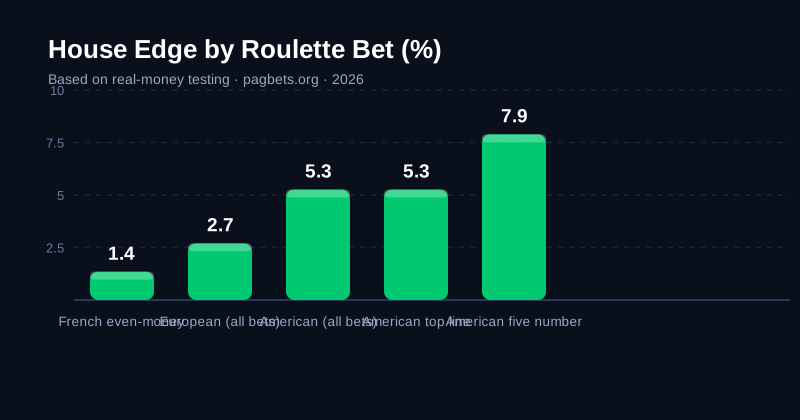
The European wheel has one zero and a 2.70% edge. The American wheel has a zero and a double zero, with a 5.26% edge. The French wheel also has a single zero but adds two special rules — la partage and en prison — which halve the loss on even-money bets that land on zero, reducing the effective edge on those wagers to about 1.35%.
Those French rules are the closest thing to a genuinely favourable table rule in the game, and they apply only to red, black, odd, even and the high-low bets. If a site offers French roulette, those bets are worth seeking out. Everything else plays at the standard 2.70%.
| Wheel | Numbers | Zeroes | Edge on even-money |
|---|---|---|---|
| European | 37 | 1 | 2.70% |
| French | 37 | 1 (la partage) | 1.35% on even-money |
| American | 38 | 2 | 5.26% |
| American five-number bet | 38 | 2 | 7.89% |
Every Bet Type and Its Real Cost
The bet types on a roulette layout look like a spectrum of risk, and it is tempting to read them as such. The surprising part is that the edge barely moves across most of them. A straight-up bet on a single number pays 35 to 1, and so does a split bet covering two numbers paying 17 to 1. The mathematics is identical underneath.
What does change the edge is any bet that covers zero or double zero, and any bet covering too many numbers. The five-number bet covering 0, 00 and 1 to 3 is the worst on the table at 7.89%, and it is the only bet where a casino has actually advertised it.
Column and dozen bets sit at 2.70% like everything else, which surprises people who assume a bigger coverage means a worse deal. It does not — the payouts scale correctly, and only the zero bets break the pattern.
| Bet | Numbers covered | Payout | Edge (European) | Edge (American) |
|---|---|---|---|---|
| Straight up | 1 | 35:1 | 2.70% | 5.26% |
| Split | 2 | 17:1 | 2.70% | 5.26% |
| Street | 3 | 11:1 | 2.70% | 5.26% |
| Corner | 4 | 8:1 | 2.70% | 5.26% |
| Line / six line | 6 | 5:1 | 2.70% | 5.26% |
| Column or dozen | 12 | 2:1 | 2.70% | 5.26% |
| Red / black / odd / even | 18 | 1:1 | 2.70% | 5.26% |
| Five number | 5 | 6:1 | — | 7.89% |
| Top line (0, 00, 1-3) | 3 | 11:1 | — | 5.26% |
Why Systems Cannot Work
Every roulette betting system sold commercially relies on the same flawed premise: that previous results influence future ones. They do not. Each spin of the wheel is independent of every other spin.
The Martingale is the most common, and the reasoning goes: double your stake after each loss, and a single win returns everything you lost plus a profit. The flaw is that it requires unlimited funds and the assumption that a win eventually arrives. On a fair game with an edge, a losing sequence is guaranteed to appear eventually, and it appears precisely when the accumulated stake is largest.
Changing the shape of the loss curve does not change the expected return. A session will either end slightly ahead with frequent small wins, or lose everything in one catastrophic sequence — and a long enough session guarantees the second outcome. Our house edge guide explains why this applies to every casino game.
Roulette on Live Streams and the Physical Wheel
A small and predictable number of losses in roulette come from versions of the game that are not what they appear to be. Physical wheels in casinos frequently have small imperfections, and a mechanical bias of even a fraction of a degree is enough to shift the result measurably over thousands of spins.
This is not a practical opportunity for online play, where the random number generator produces a genuinely uniform result. It is a warning about the difference between the two. An online roulette game audited by a recognised testing laboratory uses a cryptographically seeded generator, and the result is as close to truly random as practical computation reaches.
Where it is worth paying attention is verifying the audit. A casino that publishes the name of its testing laboratory — and a certificate showing the games and their RTP — is demonstrating something meaningful. Our guide to identifying legitimate operators covers the markers that distinguish a genuine audited site from one running unlicensed software.
Live dealer roulette is a hybrid: a real dealer spins a real wheel, so physical bias exists, but the outcome is genuinely determined by the wheel. It is a fair game with the same 2.70% edge and an unmeasurable physical component that in practice does not change the maths enough to act on.
Street, Corner and Neighbour Bets in Practice
Having established that every bet on a European wheel carries the same 2.70% edge, the remaining question is whether any of them are easier to win consistently. The answer is no, but some are psychologically harder to place correctly.
A split covers two adjacent numbers and pays 17:1. A street covers three numbers in a row and pays 11:1. A corner covers four numbers and pays 8:1. Each is straightforward to place, though the split is the one players most often misplace, because it is not a straight line through the layout — it is any two adjacent numbers, including vertically.
The neighbour bet is the one to be careful with. It is a bet on three numbers, and the temptation is to place it because the numbers are near a number you liked on the previous spin. That is a pattern that does not exist, and it is the most common way roulette players convince themselves they have found a system.
What genuinely helps is preparation. Decide your bet before the wheel spins, place it, and stop. A fixed sequence of bets on a single wheel spin introduces risk that has no compensating benefit.
Practical Ways to Reduce Your Loss
Since the wheel cannot be beaten, the only lever available is choosing where the money is placed. Three approaches genuinely reduce what you lose over a session.
First, choose a European or French wheel wherever available. The difference between 2.70% and 5.26% is larger than most people's strategy achieves in a year. Second, bet the lowest-edge wagers — on a French wheel, the even-money bets at 1.35%. Third, play at lower stakes for longer, because a higher hit rate does not reduce the edge but it does reduce the rate at which you lose, which is the difference between a bad evening and a bad month.
There is a further point that most players miss: the size of your bet relative to your session is the main thing you control, and the wheel is not. Treat roulette as entertainment you have budgeted for, in the same way as a dinner. Our live dealer comparison covers roulette variants in more detail.
- Always choose European or French over American
- Use French la partage rules where offered — 1.35% on even-money
- Stick to even-money bets for the lowest edge
- Never use a progression such as Martingale or Fibonacci
- Set a session limit and stop when reached
- Set deposit limits via our responsible betting tools guide before playing